The Umbwe Route is one of the steepest and most direct ways to
climb Mount Kilimanjaro. Starting on the southern side of the
mountain, this challenging trail passes through rainforest,
dramatic ridges and high-altitude landscapes before reaching
Uhuru Peak at 5,895 metres. Discover the 5-day and 6-day
itineraries, compare their differences and learn what to expect
before choosing your climb with WeWild Travel.
The Umbwe Route offers a challenging approach to the summit of
Mount Kilimanjaro. Its lower trail climbs steeply through the
rainforest before reaching the open heath and moorland zone.
Near Barranco Camp, the route joins the Southern Circuit and
continues toward Barafu Camp and Uhuru Peak.
At 5,895 metres (19,341 feet), Uhuru Peak is the highest point
in Africa. Reaching it requires physical preparation, careful
pacing and a sensible approach to altitude. The Umbwe Route has
a faster elevation gain than many other Kilimanjaro routes, so
it is generally better suited to trekkers with previous hiking
experience.
5 or 6 DaysAvailable trek durations
5,895 mUhuru Peak elevation
SouthMountain approach
MwekaDescent route
CampingMountain accommodation
Very ChallengingOverall difficulty
Important: The Umbwe Route's rapid ascent allows
limited time for acclimatization. Choosing the 6-day option adds
a night at Karanga Camp, but it does not remove altitude risks
or guarantee a successful summit.
Where Is the Umbwe Route on Kilimanjaro?
The Umbwe Route starts on the southern side of Mount Kilimanjaro,
near the village of Umbwe. The trail begins at Umbwe Gate and
climbs through the mountain's rainforest before reaching
Umbwe Cave Camp.
Above the forest, the route continues toward Barranco Camp,
where it joins the Southern Circuit. From there, climbers follow
the trail toward Karanga Camp on the 6-day itinerary or continue
directly toward Barafu Camp on the 5-day itinerary. Both options
descend through Mweka.
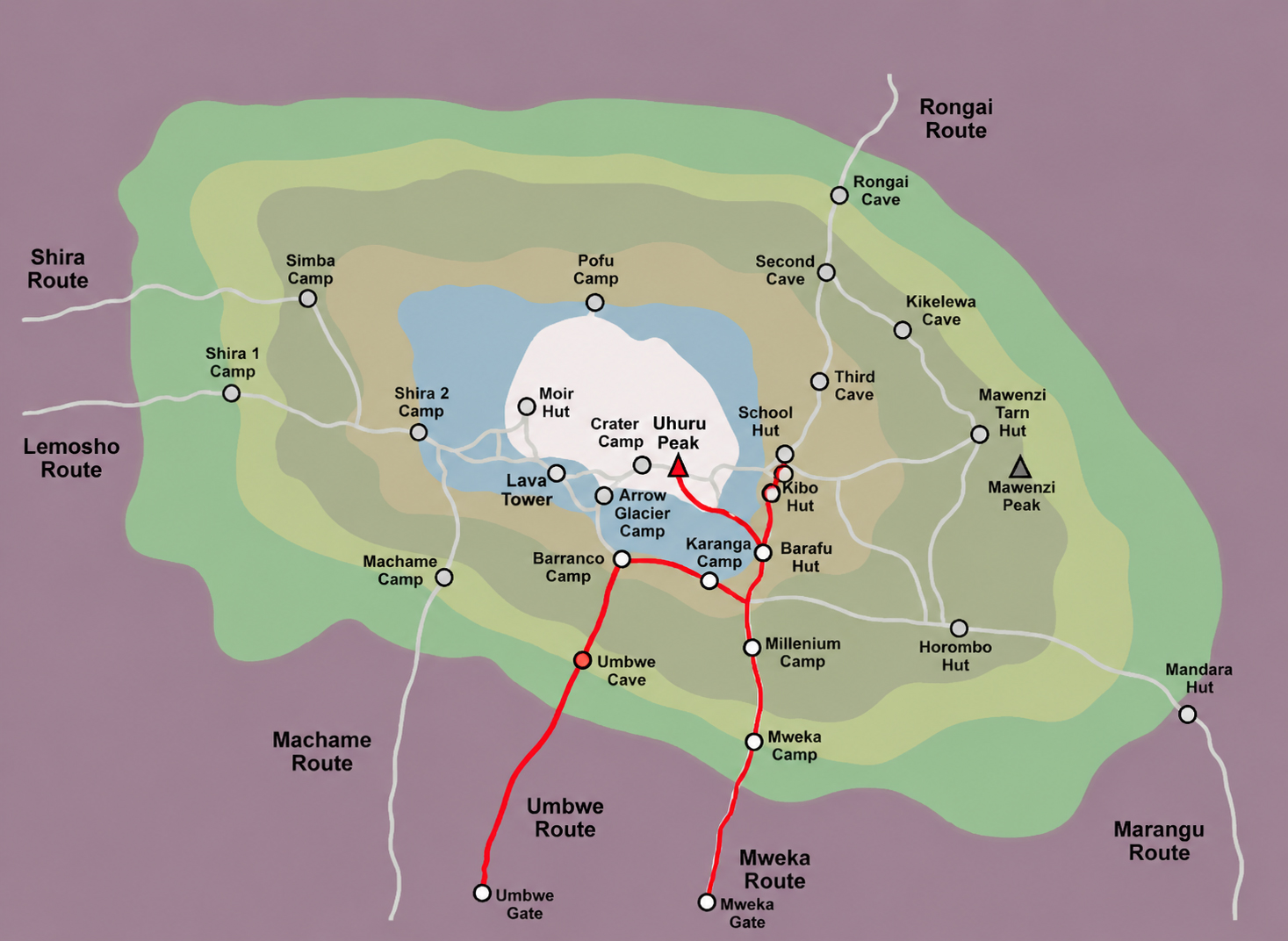
The Umbwe Route climbs from Umbwe Gate through the southern forest and joins the Southern Circuit before the summit attempt and descent through Mweka.
Landscape and Scenery on the Umbwe Route
The Umbwe Route passes through several of Kilimanjaro's natural
vegetation zones. The lower trail begins in a dense montane
rainforest with tall trees, ferns, moss and thick vegetation.
As the trail climbs, the forest gradually gives way to heath
and moorland.
Higher on the mountain, the landscape becomes more open and
rocky. Around Barranco and Karanga, trekkers see steep ridges,
valleys and views toward Kibo. Near Barafu Camp and the summit,
the terrain becomes an exposed alpine desert before reaching
the arctic conditions around Uhuru Peak.
How Difficult Is the Umbwe Route?
The Umbwe Route is very challenging because it combines steep
trails, rapid elevation gain and demanding trekking days.
The first two days involve sustained climbing through forest
and higher mountain terrain. The route then reaches the
Southern Circuit and continues toward the summit.
The Barranco Wall is one of the route's best-known sections.
It involves steep walking and hands-on scrambling in places,
but the standard trail does not normally require technical
climbing equipment or mountaineering skills.
The 5-day itinerary is shorter and more compressed. The 6-day
itinerary adds an overnight at Karanga Camp and separates
the climb to Barafu into another day. Neither option should
be treated as an easy climb.
Good physical fitness helps you manage long trekking days,
but it does not predict how your body will respond to altitude.
Follow your guide's advice and report symptoms promptly.
5-Day vs 6-Day Umbwe Route: What Is the Difference?
The main difference between the 5-day and 6-day Umbwe Route
is the overnight stop before Barafu Camp. The 5-day itinerary
travels from Barranco Camp directly to Barafu Camp. The 6-day
itinerary climbs to Karanga Camp first, then continues to
Barafu Camp the following day.
Feature
5-Day Umbwe Route
6-Day Umbwe Route
Duration
5 trekking days
6 trekking days
After Barranco
Direct to Barafu Camp
Overnight at Karanga Camp
Karanga Camp
Not an overnight stop
Overnight stop
Summit attempt
Day 4
Day 5
Final descent
Day 5
Day 6
Overall pace
More compressed
More spread out
Acclimatization
Limited
Still limited; one additional day
Both itineraries follow the same Umbwe approach and descend
through Mweka. The 6-day option provides an additional overnight
on the mountain, while the 5-day option is a shorter and more
demanding schedule.
5-Day Umbwe Route
A shorter, more demanding climb. This itinerary goes directly from Barranco Camp to Barafu Camp, leaving less time to spread the ascent across the mountain days.
5 trekking days
Barranco to Barafu in one day
Summit attempt on Day 4
Descent to Mweka Gate on Day 5
Image: General Kilimanjaro route success-rate comparison. It does not guarantee an individual climber's result.
The following outlines show how the 5-day and 6-day Umbwe
climbs progress from Umbwe Gate to Uhuru Peak and descend
through Mweka. The key difference is the overnight at
Karanga Camp on the 6-day route.
5-Day Umbwe Route Itinerary
Day 1
Umbwe Gate to Umbwe Cave Camp
Begin at Umbwe Gate after registration and meeting your mountain crew. The trail climbs steeply through dense montane rainforest, with tall trees, ferns and thick vegetation surrounding the path. Continue at a steady pace to Umbwe Cave Camp, where you spend your first night on the mountain.
StartUmbwe Gate – approx. 1,600 m
FinishUmbwe Cave Camp – approx. 2,850 m
DistanceApprox. 11 km
Hiking time5–7 hours
Day 2
Umbwe Cave Camp to Barranco Camp
Continue upward through the upper forest and into the heath and moorland zone. The trail follows steep ridges and rocky paths as the vegetation becomes shorter and the views open across the southern slopes. Reach Barranco Camp beneath the famous Barranco Wall.
StartUmbwe Cave Camp – approx. 2,850 m
FinishBarranco Camp – approx. 3,960 m
DistanceApprox. 6 km
Hiking time4 to 6 hours
Day 3
Barranco Camp to Barafu Camp
Start by climbing the Barranco Wall, following your guide across rocky steps and narrow sections. After reaching the top, continue across ridges and valleys toward Karanga Valley. The 5-day itinerary does not include an overnight at Karanga Camp. Continue toward Barafu Camp, the base camp for the summit attempt.
StartBarranco Camp – approx. 3,960 m
FinishBarafu Camp – approx. 4,673 m
DistanceLong trekking day
Hiking timeAllow a full trekking day
Day 4
Barafu Camp to Uhuru Peak to Mweka Camp
Begin the summit attempt around midnight. Climb slowly through the cold, high-altitude terrain toward Stella Point and continue along the crater rim to Uhuru Peak at 5,895 metres. After the summit, descend to Barafu for a short rest before continuing to Mweka Camp.
StartBarafu Camp – approx. 4,673 m
Highest pointUhuru Peak – 5,895 m
FinishMweka Camp – approx. 3,100 m
Hiking timeVery long summit day
Day 5
Mweka Camp to Mweka Gate
After breakfast, descend through the montane rainforest to Mweka Gate. Complete the park procedures and receive the appropriate summit certificate if you reached the qualifying summit point. Your driver will then transfer you back to your hotel.
StartMweka Camp – approx. 3,100 m
FinishMweka Gate – approx. 1,640 m
DistanceApprox. 10 km
Hiking time3–4 hours
6-Day Umbwe Route Itinerary
Day 1
Umbwe Gate to Umbwe Cave Camp
Meet your mountain crew at Umbwe Gate and begin the climb through the dense rainforest. The path rises steeply beneath tall trees and thick vegetation. Continue to Umbwe Cave Camp for your first night on Kilimanjaro.
StartUmbwe Gate – approx. 1,600 m
FinishUmbwe Cave Camp – approx. 2,850 m
DistanceApprox. 11 km
Hiking time5–7 hours
Day 2
Umbwe Cave Camp to Barranco Camp
Continue climbing through the upper forest and heath zone. The trail follows steep ridges toward the open moorland landscape. Reach Barranco Camp, located below the Barranco Wall, and rest before the next day's climb.
StartUmbwe Cave Camp – approx. 2,850 m
FinishBarranco Camp – approx. 3,960 m
DistanceApprox. 6 km
Hiking time4–6 hours
Day 3
Barranco Camp to Karanga Camp
Climb the Barranco Wall with support from your guide. Continue across rocky ridges and valleys before descending into Karanga Valley and climbing to Karanga Camp. This is the additional overnight stop that distinguishes the 6-day itinerary from the 5-day option.
StartBarranco Camp – approx. 3,960 m
FinishKaranga Camp – approx. 3,995 m
DistanceApprox. 5 km
Hiking time4 to 5 hours
Day 4
Karanga Camp to Barafu Camp
Leave Karanga Camp and climb steadily across the alpine desert toward Barafu Camp. After arriving, rest, eat and prepare your summit equipment. Your guides will explain the summit-night plan before you get some rest ahead of the midnight departure.
StartKaranga Camp – approx. 3,995 m
FinishBarafu Camp – approx. 4,673 m
DistanceApprox. 4 km
Hiking time3 to 5 hours
Day 5
Barafu Camp to Uhuru Peak to Mweka Camp
Start the summit attempt around midnight. Climb toward Stella Point and continue along the crater rim to Uhuru Peak at 5,895 metres. After time at the summit, descend via Barafu Camp to Mweka Camp for your final night on the mountain.
StartBarafu Camp – approx. 4,673 m
Highest pointUhuru Peak – 5,895 m
FinishMweka Camp – approx. 3,100 m
Hiking timeVery long summit day
Day 6
Mweka Camp to Mweka Gate
Descend through the rainforest to Mweka Gate after breakfast. Complete the park formalities and receive your summit certificate if eligible. Your driver will transfer you back to your hotel in Arusha or Moshi, depending on your arrangements.
StartMweka Camp – approx. 3,100 m
FinishMweka Gate – approx. 1,640 m
DistanceApprox. 10 km
Hiking time3–4 hours
Where Do You Sleep on the Umbwe Route?
The Umbwe Route uses designated mountain camps. Trekkers
sleep in tents, and the mountain crew prepares meals during
the climb. The camps provide places to rest between trekking
days, but conditions become colder and more exposed as you
gain altitude.
Umbwe Cave Camp: The first overnight stop in the forest zone.
Barranco Camp: A scenic camp beneath the Barranco Wall.
Karanga Camp: An overnight stop on the 6-day itinerary only.
Barafu Camp: The final base camp before the summit attempt.
Mweka Camp: The overnight stop after the summit descent.
Mweka Camp is the overnight stop after the summit descent on the Umbwe Route, before the final walk down to Mweka Gate.
Umbwe Route Distance and Trekking Time
The total trekking distance depends on the itinerary and
the route measurements used by the operator. Both versions
begin at Umbwe Gate and finish at Mweka Gate. The 6-day
version includes an overnight at Karanga Camp, while the
5-day version makes a longer journey from Barranco toward
Barafu.
Trekking hours vary with weather, trail conditions, group
pace and individual fitness. Summit day is particularly
long because it includes the ascent to Uhuru Peak and the
descent to Mweka Camp.
Safety and Altitude on the Umbwe Route
Altitude is one of the main challenges on the Umbwe Route.
The trail gains elevation quickly, and climbers may experience
headaches, nausea, dizziness, unusual tiredness or difficulty
sleeping. These symptoms can develop even in fit and
experienced hikers.
A responsible mountain team monitors climbers throughout
the trek. Guides should assess symptoms, check health
indicators and make decisions based on the climber's
condition. If altitude illness is suspected, descending
is often the safest response.
Walk slowly and follow your guide's pace.
Drink water regularly and eat enough during the trek.
Tell your guide about symptoms as soon as they appear.
Follow health checks and your guide's instructions.
Do not continue upward if your guide advises you to descend.
No itinerary, level of fitness or operator can guarantee
that a climber will reach Uhuru Peak. Safety decisions
must take priority over reaching the summit.
Best Time to Climb the Umbwe Route
The generally drier periods are January to early March
and June to October. These months often provide more
favorable trail conditions and clearer views, although
mountain weather can change at any time.
April and May usually bring the long rains, while November
can experience shorter rainy periods. Wet weather can make
the forest trail muddy and slippery. Climbs may still
operate outside the drier periods, but trekkers should
prepare for changing conditions.
What to Pack for the Umbwe Route
Temperatures vary significantly between the rainforest
and the summit zone. Pack clothing that you can layer,
along with suitable footwear and equipment for cold,
wind and rain.
Broken-in waterproof hiking boots
Moisture-wicking base layers
Fleece and insulated jacket
Waterproof jacket and trousers
Warm gloves, hat and neck covering
Headlamp with spare batteries
Sleeping bag suitable for cold mountain nights
Daypack and waterproof pack cover
Reusable water bottles or hydration system
Sunglasses, sunscreen and personal medication
Trekking poles
Pros and Cons of the Umbwe Route
Advantages
A steep and direct approach to Mount Kilimanjaro.
A quieter lower trail than some of the more popular routes.
Varied scenery from rainforest to alpine terrain.
Access to the Southern Circuit and views around Barranco.
Two itinerary choices: 5 days or 6 days.
Disadvantages
Rapid elevation gain and limited acclimatization time.
Steep early sections that can be physically demanding.
Long trekking days, especially during the summit stage.
Not the best choice for many first-time high-altitude trekkers.
How Does the Umbwe Route Compare with Other Kilimanjaro Routes?
Kilimanjaro has several routes, each with different scenery,
duration, difficulty and acclimatization profiles. Umbwe is
a steep and direct approach. Trekkers who want more time to
adjust to altitude may prefer a longer itinerary on another
route.
Lemosho Route: A longer western approach with several itinerary options.
Machame Route: A popular southern approach with varied scenery.
Rongai Route: Approaches Kilimanjaro from the north.
Marangu Route: Uses mountain huts instead of camping tents.
Northern Circuit: A longer route with more time on the mountain.
If acclimatization time is a priority, compare the full
itinerary and number of days on the mountain rather than
choosing a route by name alone.
How to Prepare for the Umbwe Route
Prepare for the Umbwe Route with regular walking, uphill
training and longer hikes carrying a daypack. Build your
fitness gradually and include exercises that strengthen
your legs and improve endurance.
Practice using your hiking boots and trekking poles before
the climb. Make sure your clothing and sleeping equipment
are suitable for cold mountain conditions. Discuss any
medical concerns with a qualified healthcare professional
before travelling.
Before booking, review the itinerary, inclusions,
accommodation, safety procedures and the operator's
approach to altitude monitoring.
Frequently Asked Questions About the Umbwe Route
1. How many days does the Umbwe Route take?
The Umbwe Route is commonly offered as a 5-day or 6-day climb. The 6-day option adds an overnight at Karanga Camp before continuing to Barafu Camp.
2. Is the Umbwe Route difficult?
Yes. It is considered one of the more challenging Kilimanjaro approaches because of its steep trail, rapid elevation gain and limited acclimatization time.
3. Is the 5-day or 6-day Umbwe Route better?
The 6-day option spreads the journey to Barafu across two days by adding a night at Karanga Camp. The 5-day option is shorter and more compressed. Neither guarantees a successful summit.
4. Does the Umbwe Route climb the Barranco Wall?
Yes. Both the 5-day and 6-day itineraries pass the Barranco Wall after reaching Barranco Camp. The standard trail involves scrambling in places but does not normally require technical climbing equipment.
5. Where does the Umbwe Route descend?
Both itineraries descend through the Mweka Route and finish at Mweka Gate on the southern side of Kilimanjaro.
6. Do I need previous climbing experience?
Technical mountaineering experience is not normally required, but the Umbwe Route is demanding. Previous hiking experience and good physical preparation are strongly recommended.
7. What is the highest point on the Umbwe Route?
The highest point is Uhuru Peak at 5,895 metres (19,341 feet) above sea level.
8. Is the Umbwe Route suitable for beginners?
It is generally not the first choice for beginners because of the steep approach and limited acclimatization time. A longer route may be more appropriate for many first-time Kilimanjaro trekkers.
9. When is the best time to climb the Umbwe Route?
January to early March and June to October are generally drier periods. Weather on Kilimanjaro remains unpredictable throughout the year.
10. Can WeWild Travel organize a private Umbwe climb?
Contact WeWild Travel to discuss your preferred dates, group size, itinerary and package arrangements for a private or group Umbwe climb.
Plan Your Umbwe Route Climb with WeWild Travel
Speak with our local Kilimanjaro team about the 5-day
or 6-day Umbwe Route. We can help you review the
itinerary, understand the mountain conditions and
discuss your climbing arrangements.
We are a team of seasoned African travel experts with over a decade of combined experience in the safari industry designing the best affordable safari adventures in Tanzania, without compromising on quality.