The 7-Day Rongai Route acclimatization schedule takes climbers up Mount Kilimanjaro from the northern side near the Kenyan border before descending via the Marangu Route. The itinerary includes overnight stops at designated mountain camps before the summit attempt at Uhuru Peak (5,895 m). The itinerary includes an overnight at Mawenzi Tarn for acclimatization before the summit attempt, followed by a descent to Horombo Hut and Marangu Gate.
This route is a good option for climbers who want a quieter approach to Kilimanjaro, varied mountain scenery, and a dedicated acclimatization stop before summit day. The Rongai Route is less crowded on its northern approach than several popular southern routes, although conditions and traffic vary by season.
Quick Facts About the 7-Day Rongai Route
- Total Distance: Approximately 73 to 76 km (45 to 47 miles), subject to the route and measurement method used.
- Starting Point: Rongai (Nalemoru) Gate, on Kilimanjaro’s northern side near the Kenyan border.
- Summit: Uhuru Peak at 5,895 m (19,341 ft), the highest point in Africa.
- Descent Route: Marangu Route, descending along Kilimanjaro’s southeastern side.
- Crowds and Scenery: The northern approach is often quieter and passes through forest, open moorland, remote mountain terrain, and the alpine desert of the Saddle.
- Weather and Conditions: The northern side generally receives less rainfall than Kilimanjaro’s southern slopes, although weather conditions vary by season and altitude.
- Difficulty: Moderate to challenging. The gradual approach does not remove the risks of high altitude, long trekking days, or the demanding summit climb.
- Acclimatization: The itinerary includes an overnight at Mawenzi Tarn before continuing to Kibo Hut. This schedule provides time to adjust to altitude, but it is not a separate acclimatization rest day unless your actual package includes an additional night or rest day there.
Highlights
- Departure and Return Place: Arusha or Moshi to Rongai Gate and back to Kilimanjaro International Airport (Google Maps).
- Departure Time: Please be ready by 8:00 AM for a prompt departure at 9:00 AM.
- Return Time: Approximately 10:00 to 11:00 AM on the final day after descent and transfer.
- Dress Code: Casual trekking clothing. Comfortable hiking boots, layered clothes, warm jacket, gloves, hat, and rain protection gear.
- Accommodation: Camping on all mountain nights. Hotel accommodation in Arusha or Moshi (Bed and Breakfast, 3-star standard). Upgrades available on request.
- Customizations: Can be customized upon request to match traveler needs, fitness level, and travel dates.
- Extensions: Safari or Zanzibar extensions available on request after the trek.
- Season: Available year-round, with best conditions during dry seasons.
- Suitable for: Moderate fitness level. Ideal for beginners and trekkers looking for a quieter Kilimanjaro route.
- Pros:
The Rongai Route is less crowded and offers a peaceful trekking experience. It provides a steady and gradual ascent, making it suitable for beginners. The route is also drier compared to southern routes, so it can be used even during rainy seasons. Trekkers enjoy beautiful wilderness views and higher chances of wildlife sightings, especially in the lower forest zone.
- Cons:
The route offers less scenic variety compared to southern routes. Acclimatization is slightly weaker due to its profile. Some climbers find the summit night more demanding due to the long distance and cold conditions.
Typical 7-Day Rongai Route Itinerary at a Glance
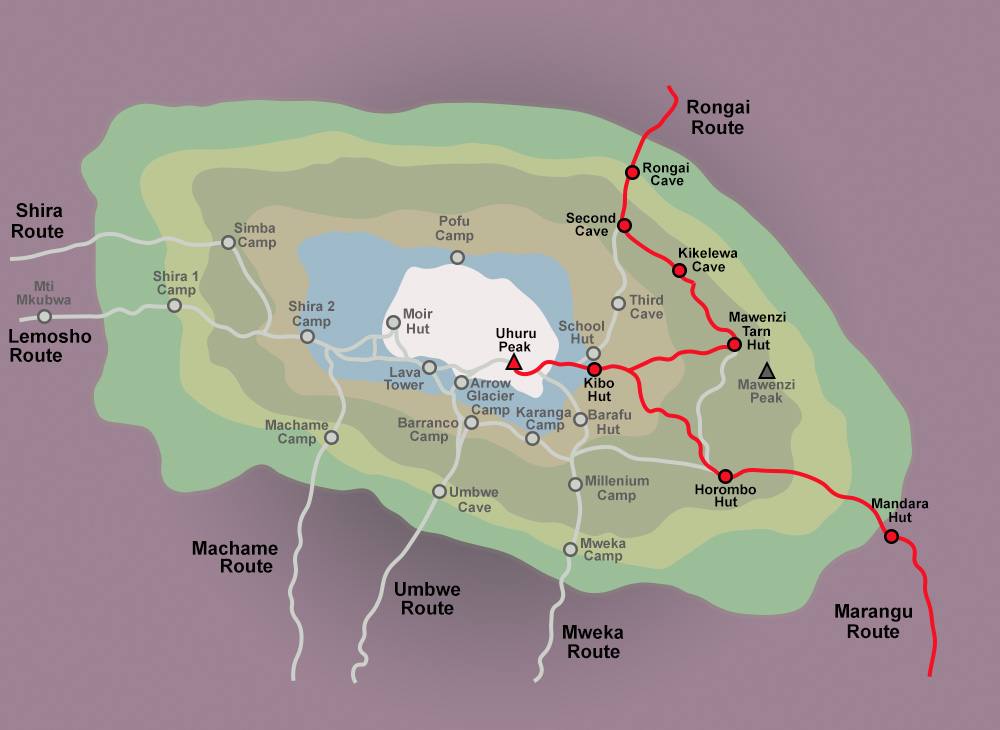
The 7-Day Rongai Route climbs Mount Kilimanjaro from the northern side near the Kenyan border and descends via the Marangu Route. The itinerary passes through forest, moorland, and alpine desert, with overnight stops at Simba Camp, Second Cave Camp, Kikelewa Camp, Mawenzi Tarn Hut and Kibo Hut before the summit attempt at Uhuru Peak (5,895 m). After the summit, climbers descend to Horombo Hut and continue to Marangu Gate on the final day.
| Day |
Route |
Elevation |
Daily Highlights |
| Day 1 |
Rongai Gate to Simba Camp |
Approximately 1,950 m to 2,625 m |
Register at the northern entrance and hike through farmland and forest toward the first camp. |
| Day 2 |
Simba Camp to Second Cave Camp |
Approximately 2,625 m to 3,450 m |
Ascend through open moorland, with views of Kibo and the northern slopes. |
| Day 3 |
Second Cave Camp to Kikelewa Camp |
Approximately 3,450 m to 3,630 m |
Cross the moorland toward Mawenzi, enjoying wide mountain views along the trail. |
| Day 4 |
Kikelewa Camp to Mawenzi Tarn Hut |
Approximately 3,630 m to 4,315 m |
Climb steeper terrain beneath Mawenzi’s rugged volcanic peaks and reach the scenic high-altitude camp. |
| Day 5 |
Mawenzi Tarn Hut to Kibo Hut |
Approximately 4,315 m to 4,703 m |
Cross the barren Saddle between Mawenzi and Kibo, then rest and prepare for the summit attempt. |
| Day 6 |
Kibo Hut to Uhuru Peak and Horombo Hut |
Approximately 4,703 m to 5,895 m, then descend to 3,720 m |
Begin the summit climb at night, pass Gilman’s Point or Stella Point depending on the route and conditions, reach Uhuru Peak if conditions permit, and descend to Horombo Hut. |
| Day 7 |
Horombo Hut to Marangu Gate, then Arusha or Moshi |
Approximately 3,720 m to 1,860 m |
Descend through moorland and rainforest, receive your summit certificate at the gate if you qualify, and transfer to your hotel. |
Why Choose the 7-Day Rongai Route?
The 7-Day Rongai Route is a good choice for climbers seeking a quieter approach to Mount Kilimanjaro, varied mountain scenery, and a gradual trekking schedule. It approaches from the northern side near the Kenyan border and descends via the Marangu Route. Compared with a shorter Rongai itinerary, the seven-day option provides more time on the mountain, depending on the confirmed itinerary and acclimatization schedule.
1. Quieter Trails and Remote Wilderness
The Rongai Route approaches Kilimanjaro from the north and is often quieter than the busier southern routes. It offers a more remote mountain experience, with peaceful trail sections, scenic camps and wide views across the northern slopes.
2. Generally Drier Northern Slopes
Kilimanjaro’s northern slopes generally receive less rainfall than its southern slopes. This makes Rongai an option worth considering during wetter periods. However, rain, cold, wind and changing conditions remain possible at different elevations.
3. More Time for Acclimatization
The seven-day Rongai itinerary spreads the climb over a longer schedule than the six-day option when the extra time is used for an additional overnight or a properly planned acclimatization period. The standard itinerary described here includes an overnight at Mawenzi Tarn before continuing to Kibo Hut. Confirm the actual schedule before describing this as an additional acclimatization day.
A longer itinerary can provide more time to adjust to altitude, but it cannot eliminate altitude sickness or guarantee a successful summit.
4. Varied Landscapes and Mountain Views
The trail passes through forest, open moorland and alpine desert. Climbers can enjoy views of Mawenzi Peak, Kibo and the broad Saddle between the two volcanic cones. Wildlife sightings are possible in suitable habitats, although they are not guaranteed.
5. Different Ascent and Descent Routes
Rongai approaches Kilimanjaro from the north, while the descent follows the Marangu Route on the southeastern side. This allows climbers to experience different parts of the mountain during the same trek.
6. A Challenging but Rewarding Summit Attempt
The Rongai Route begins with a relatively gradual approach, but the climb becomes more demanding at higher elevations. Summit night involves a long ascent in cold, low-oxygen conditions, followed by a substantial descent. Good preparation, a sensible pace and attention to your guides’ health advice are essential.
Climb the 7-Day Rongai Route with WeWild Travel
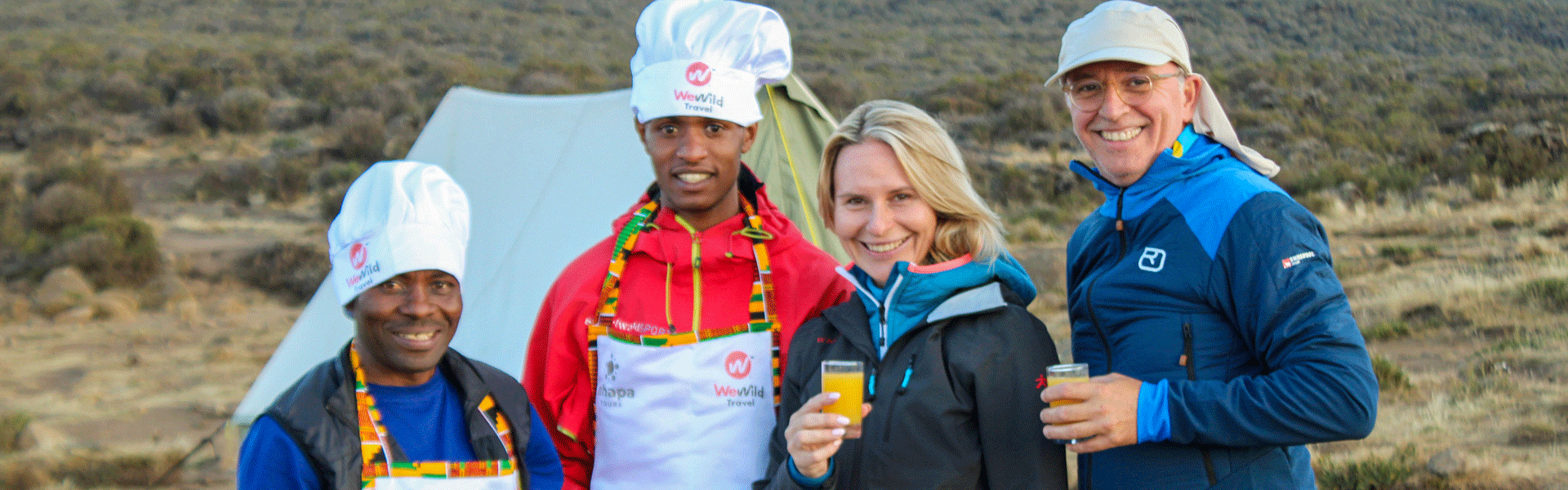
WeWild Travel organizes Kilimanjaro climbs with experienced local mountain guides, planned camp arrangements and trekking support. Our team helps climbers prepare for the route, understand the daily schedule and manage the practical details of the journey from Rongai Gate to the summit attempt and descent to Marangu Gate.
Best Time to Climb the 7-Day Rongai Route
The best time to climb the 7-Day Rongai Route on Mount Kilimanjaro is generally during the drier periods from January to early March and June to October. These months often offer better trail conditions, clearer views and favorable opportunities for trekking, although mountain weather can change quickly at high elevations. Read our guide to the best time to climb Kilimanjaro for a month-by-month overview.
January to March
January to early March is a popular period for climbers who want relatively dry trails and opportunities for clear mountain views. Temperatures remain cold at higher elevations, and snow or ice can occur near the summit. Conditions vary throughout the season.
June to October
June to October is another popular climbing period, particularly for travelers planning their Kilimanjaro trip during the Northern Hemisphere summer. The mountain can experience dry conditions and good visibility, but colder temperatures, wind and occasional rain remain possible. Because demand can be high, booking your preferred departure in advance is advisable.
Is the Rongai Route Good During the Rainy Seasons?
The Rongai Route approaches Kilimanjaro from the northern side, which generally receives less rainfall than the southern slopes. This can make it an option worth considering during wetter months. However, the route is not rain-free, and trail conditions depend on recent weather, elevation and the time of year.
Does the 7-Day Rongai Route Offer Better Acclimatization?
The seven-day itinerary provides more time on the mountain than a six-day itinerary when that extra time is used for a longer acclimatization schedule. The benefit depends on the actual route plan, including overnight stops and time spent at altitude. The schedule described on this page includes an overnight at Mawenzi Tarn before continuing to Kibo Hut; confirm whether your specific package includes a separate acclimatization day before making that claim.
Good acclimatization practices can help reduce altitude-related risks, but no itinerary guarantees that you will reach Uhuru Peak (5,895 m). Follow your mountain guides’ advice and report any symptoms of altitude sickness promptly.
Why Choose WeWild Travel for Your Kilimanjaro Climb?
Choosing a reliable local operator is important when climbing Mount Kilimanjaro. WeWild Travel organizes climbs with experienced local mountain guides, planned trekking schedules and on-mountain support to help climbers prepare for the challenges of high altitude. Our approach focuses on responsible trekking, health monitoring and informed decisions throughout the journey.
- Experienced Local Mountain Guides: Our guides lead climbers along Kilimanjaro’s routes and provide practical guidance on trail conditions, pacing and summit preparation.
- Daily Health Monitoring: Our mountain team monitors climbers’ well-being, including oxygen saturation checks where provided, and watches for symptoms of altitude sickness.
- Planned Acclimatization: Our itineraries follow a planned schedule with overnight stops at designated camps to support adjustment to altitude.
- Personalized Trekking Support: Our team provides guidance and assistance throughout the climb, with the guide-to-climber ratio determined by the departure arrangements.
- Emergency Preparedness: Our mountain team follows safety procedures for responding to health concerns and coordinating evacuation support when necessary.
Climb Kilimanjaro with WeWild Travel: Speak with our local team about route options, trekking schedules, equipment and preparation for your journey to Uhuru Peak (5,895 m). We help you choose an itinerary that matches your experience, schedule and preparation, while recognizing that reaching the summit is never guaranteed.