Deals of The Year: Join a trekking group Adventure 2025! Up to 15% OFF
d
h
m
s
Deals of The Year: Join a trekking group Adventure 2025! Up to 15% OFF
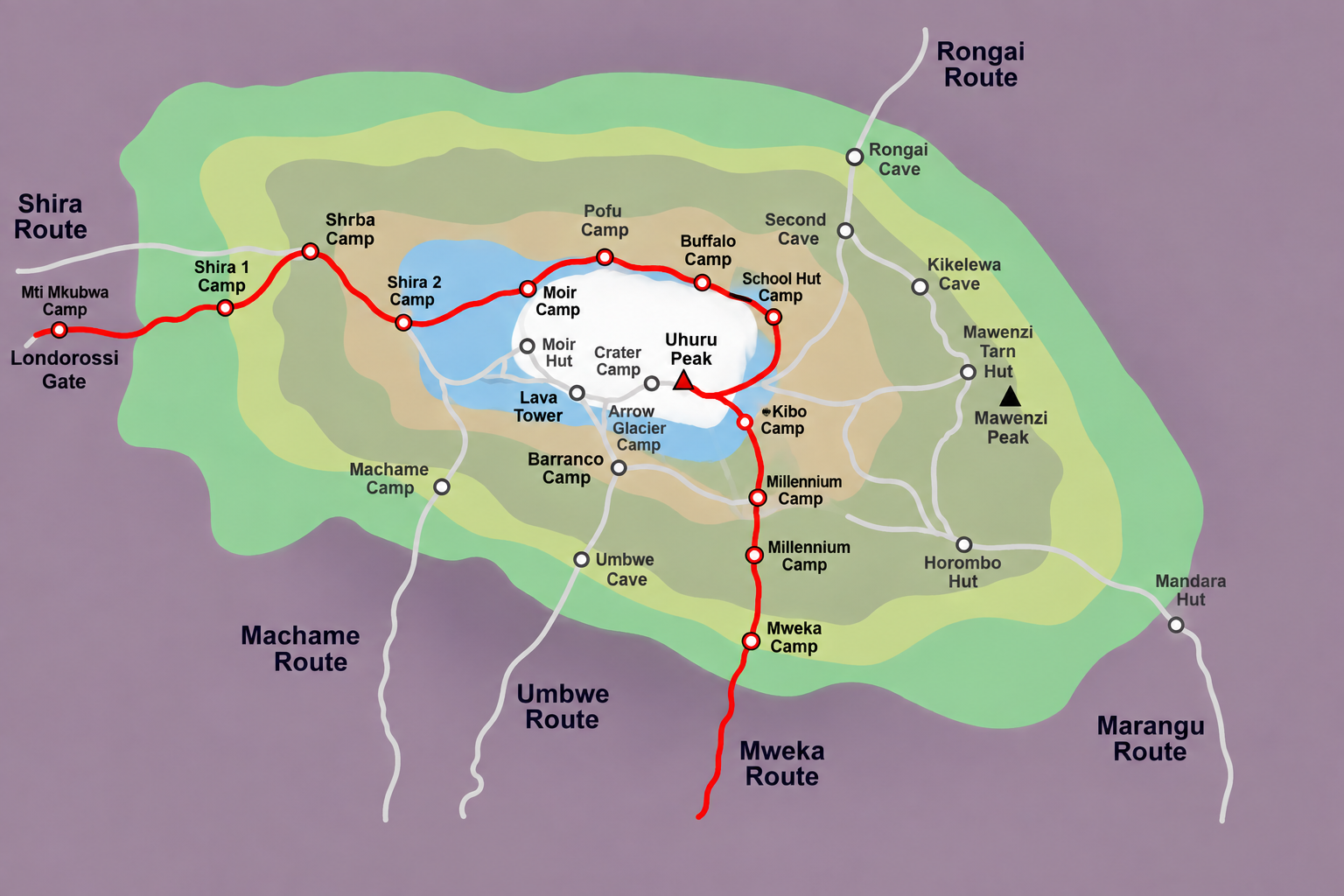
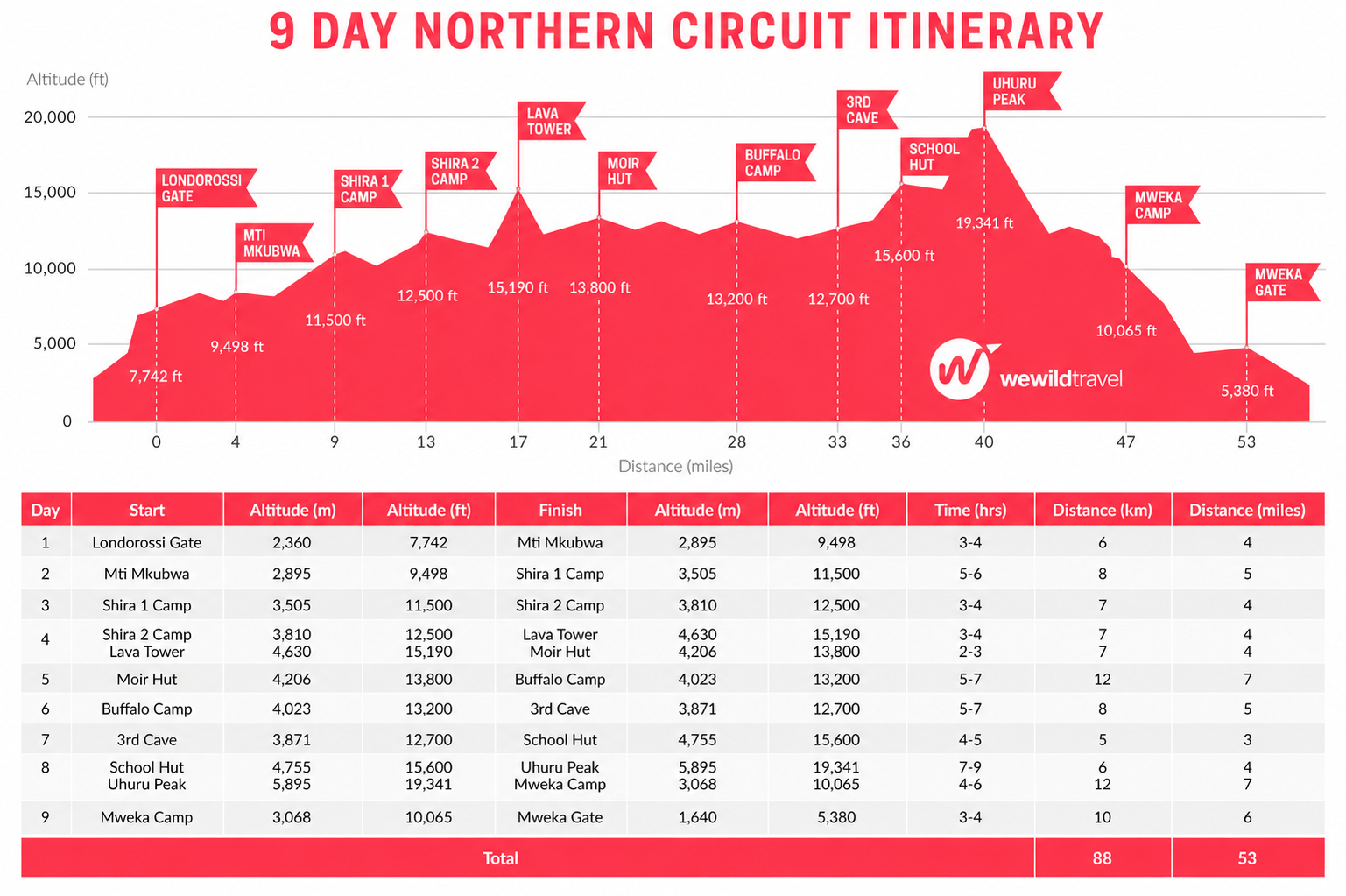
The 9-Day Northern Circuit Route Kilimanjaro itinerary is a nine-day mountain trek to Uhuru Peak (5,895 m / 19,341 ft), offering more time for acclimatization than shorter Kilimanjaro routes. Starting at Londorossi Gate, the trail crosses the rainforest and Shira Plateau before circling Kilimanjaro’s remote northern slopes through Moir Hut, Buffalo Camp, and Third Cave Camp. The route continues to School Hut before the summit attempt and descent to Millennium Camp, then exits through Mweka Gate.
The Northern Circuit is known for its extended itinerary, quieter northern trails, and wide views of Kibo, Mawenzi, and the surrounding plains. Although the longer schedule provides more time to adjust to altitude, summit day remains physically demanding, and reaching Uhuru Peak is never guaranteed.
This guide covers the 9-Day Northern Circuit Route itinerary, daily camp elevations, trekking distances, hiking times, difficulty, and price. You can also review package inclusions, accommodation, meals, park fees, transfers, and available departure dates before booking your Kilimanjaro climb with WeWild Travel.
| Day | Route | Elevation | Distance | Hiking Time | Highlights | Overnight |
|---|---|---|---|---|---|---|
| Day 1 | Londorossi Gate to Mti Mkubwa Camp | Confirm trailhead and camp elevations | Confirm | 3 to 4 hours | Walk through montane rainforest, with opportunities to spot forest birds and monkeys. | Mti Mkubwa Camp |
| Day 2 | Mti Mkubwa Camp to Shira 1 Camp | 2,650 to 3,500 m* | 8 km | 5 to 7 hours | Climb through forest and heathland toward the Shira Plateau. | Shira 1 Camp |
| Day 3 | Shira 1 Camp to Shira 2 Camp | 3,500 to 3,850 m | 7 km | 4 to 6 hours | Cross open moorland with views of Kibo and the Shira Plateau. | Shira 2 Camp |
| Day 4 | Shira 2 Camp to Moir Hut | 3,850 to approximately 4,150 m | 14 km | 5 to 7 hours | Cross the high-altitude landscape toward the Lava Tower area before continuing to Moir Hut. | Moir Hut |
| Day 5 | Moir Hut to Buffalo Camp | Approximately 4,150 to 4,020 m | 12 km | 5 to 7 hours | Traverse rocky ridges and remote northern slopes, with views across the surrounding wilderness. | Buffalo Camp |
| Day 6 | Buffalo Camp to Third Cave Camp | Approximately 4,020 to 3,870 m | 8 km | 5 to 7 hours | Continue across the northern slopes, with views toward the Kenyan plains. | Third Cave Camp |
| Day 7 | Third Cave Camp to School Hut | Approximately 3,870 to 4,800 m | 5 km | 4 to 5 hours | Cross the high-altitude Saddle between Kibo and Mawenzi before reaching School Hut. | School Hut |
| Day 8 | School Hut to Uhuru Peak and Mweka Camp | 4,800 to 5,895 to approximately 3,100 m | Confirm actual route distance | Confirm actual duration | Begin the summit ascent before dawn, reach Uhuru Peak if conditions permit, and descend via Barafu Camp toward Mweka Camp. | Mweka Camp |
| Day 9 | Mweka Camp to Mweka Gate | Approximately 3,100 to 1,640 m | 10 km | 3 to 4 hours | Descend through rainforest, complete park formalities, and collect your summit certificate if you reach the summit. | Trek ends |
The 9-Day Northern Circuit Route on Mount Kilimanjaro takes you across the Shira Plateau and around the mountain’s remote northern slopes before the summit attempt at Uhuru Peak (5,895 m). Its extended schedule allows more time for altitude adjustment than shorter itineraries, while the northern trail offers a quieter alternative to some of Kilimanjaro’s busier routes.
The nine-day itinerary spreads the climb across more days, allowing a gradual ascent and additional time to adjust to the lower oxygen levels at altitude. This can support summit preparation, but altitude sickness remains possible, and extra days cannot guarantee reaching Uhuru Peak.
Unlike routes that spend less time on the northern side, the Northern Circuit takes you through remote mountain landscapes and quieter camps. You can enjoy a greater sense of wilderness as the trail circles Kibo, away from some of the more frequently used trekking paths.
The route reveals changing views of the Shira Plateau, Kibo, Mawenzi, and the plains toward Kenya. Along the way, you cross rainforest, heathland, moorland, and alpine desert. Each landscape brings different scenery as you gain elevation.
The Northern Circuit approaches the summit after traversing Kilimanjaro’s western and northern slopes. This extended journey offers a broader experience of the mountain rather than focusing only on the most direct approach to the summit.
The longer itinerary provides more time on the mountain, but the climb remains physically challenging. Trekkers must manage long hiking days, cold conditions, high-altitude camps, and the summit ascent followed by a long descent. Good preparation, a steady pace, and attention to your guides’ health advice are essential.
WeWild Travel organizes the Northern Circuit with local mountain guides and planned trekking support from the trailhead to the descent gate. Before booking, ask our team about the itinerary, group options, equipment, meals, safety procedures, and package inclusions so you know what your climb covers.
The best time to climb the 9-Day Northern Circuit Route on Mount Kilimanjaro is generally during the drier periods from June to October and January to February. These months often bring more favorable trekking conditions, although weather can change quickly at high altitude.
June to October is a popular climbing season, with generally drier conditions and good opportunities for mountain views. January and February also offer favorable conditions, often with clearer skies between periods of cloud. Both seasons attract climbers, so crowd levels depend on your travel dates and the camps along your route.
You can plan a Northern Circuit climb during other months, but wetter weather, muddy trails, and reduced visibility may make trekking more challenging. The longer route offers time to explore Kilimanjaro’s northern slopes, but it does not eliminate weather-related risks. Choose your dates based on your flexibility, weather preferences, and comfort with changing mountain conditions.
To book the 9-Day Northern Circuit Route on Mount Kilimanjaro, choose your trekking dates, confirm the package details, and contact a local operator to arrange your climb. Before paying a deposit, check the itinerary, group size, accommodation, equipment, safety procedures, and what the package price includes.
WeWild Travel helps you plan your climb with local mountain guides and organized trekking support. Our team can explain the nine-day itinerary, discuss private or group departures, and clarify the arrangements before you book.
Ready to plan your climb? Contact WeWild Travel to request a quote for the 9-Day Northern Circuit Route. Share your preferred dates and group size so our team can help you plan the next steps.
Booking your 9-Day Northern Circuit Route Kilimanjaro climb involves five straightforward steps:
Ready to plan your climb? Contact WeWild Travel to request a quote and discuss your preferred dates.
Your Kilimanjaro adventure begins when you arrive at Kilimanjaro International Airport (JRO), Tanzania. A WeWild Travel representative will meet you and arrange your transfer to Mount Meru Hotel in Arusha, according to your confirmed booking.
The drive from JRO to Arusha takes approximately 1 to 1.5 hours, depending on traffic and road conditions. After checking in, you can rest, eat, and recover from your journey before the trek.
Later, your mountain guide will conduct a pre-climb briefing. You will review the 9-Day Northern Circuit Route itinerary, discuss altitude awareness and mountain safety, and check your trekking equipment. Use this opportunity to ask questions and identify any items you still need before departure.
Get a good night’s rest and prepare for the journey to Kilimanjaro’s western side the following day.
The first trekking day of the 9-Day Northern Circuit Route begins at Londorossi Gate on Kilimanjaro’s western side. After park registration and final preparations with your mountain crew, you travel to the trailhead and start hiking through the montane rainforest.
The trail passes beneath a dense canopy of trees, with thick vegetation and a cool, shaded environment. Listen for forest birds and look out for monkeys along the route, although wildlife sightings are not guaranteed.
Today’s hike introduces you to Kilimanjaro’s forest terrain and gives you time to establish a steady walking pace. Follow your guide’s instructions, drink water regularly, and take breaks when needed as you begin the climb.
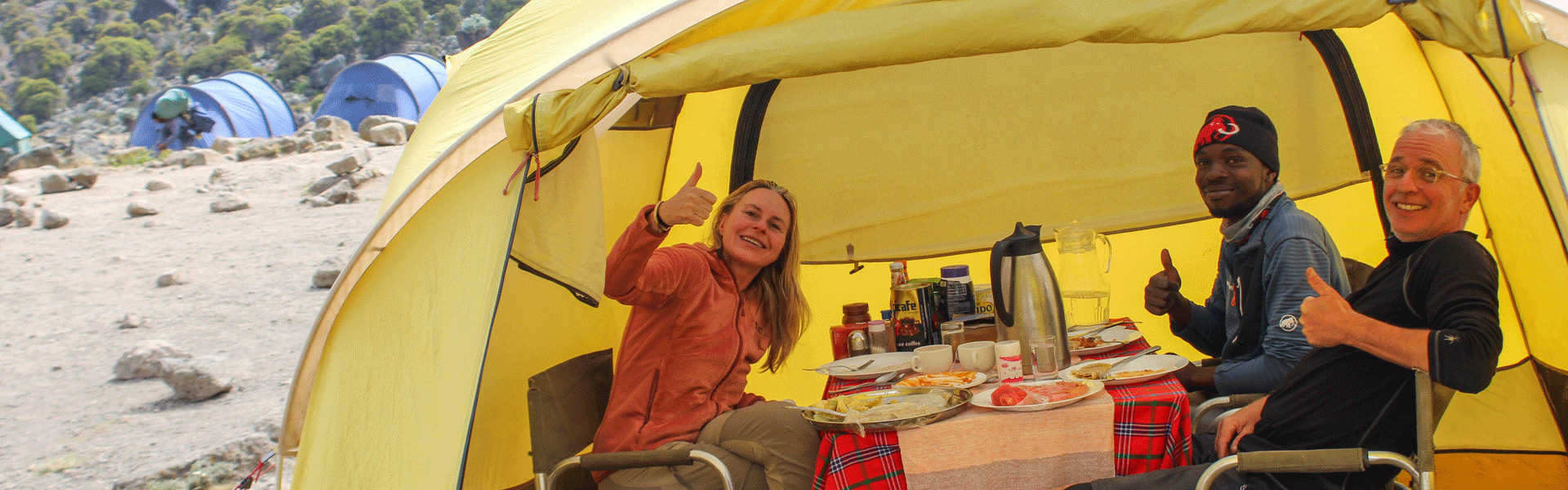
You then reach Mti Mkubwa Camp, also known as Big Tree Camp, where you spend your first night on the mountain. Your crew helps set up camp and prepares your meals while you rest and get ready for the next day’s trek toward Shira 1 Camp.
After breakfast at Mti Mkubwa Camp, you continue climbing toward Shira 1 Camp on the western side of Mount Kilimanjaro. The trail leaves the montane rainforest and passes through heathland and open moorland as you approach the Shira Plateau.
As you gain elevation, the dense forest gives way to lower shrubs, grasses, and high-altitude vegetation. The landscape becomes more open, revealing wider views across Kilimanjaro’s western slopes. The changing scenery marks an important transition from the forest zone to the mountain’s higher terrain.
Today’s ascent gains considerable elevation, so walk at a steady pace and follow your guide’s advice on hydration and rest breaks. Moving gradually helps you manage the effort as you climb higher, although your body will need more time to adjust to the altitude.
You arrive at Shira 1 Camp, where you can rest, enjoy your prepared meals, and take in the surrounding plateau scenery when visibility allows. After your overnight stay, you will continue toward Shira 2 Camp on Day 3.
After breakfast at Shira 1 Camp, you continue across the Shira Plateau toward Shira 2 Camp. The trail crosses open moorland, with wide views of Kilimanjaro’s volcanic landscape and Kibo Peak rising ahead.
Unlike the forest trails of the first two days, this section passes through more exposed terrain with low vegetation and expansive mountain scenery. The open plateau provides opportunities to photograph the landscape and appreciate the scale of Kilimanjaro as you move farther from the western trailhead.
Although the hike is shorter than some of the days ahead, the increasing altitude can make walking more demanding. Follow your guide’s pace, drink water regularly, and take breaks when needed. A gradual ascent supports acclimatization, but individual responses to altitude vary.
You reach Shira 2 Camp, where you can rest, enjoy your meals, and prepare for the next stage of the Northern Circuit. Tomorrow, the route continues toward Moir Hut and the more rugged terrain beyond the Shira Plateau.
After breakfast at Shira 2 Camp, you leave the Shira Plateau and trek toward Moir Hut on Kilimanjaro’s remote northern side. This stage crosses rugged moorland and increasingly barren alpine terrain as the trail approaches the Lava Tower area.
The route climbs toward Lava Tower, a prominent volcanic rock formation at approximately 4,630 m. From this higher point, the trail continues toward Moir Hut, descending into a sheltered valley beneath the Lent Hills. The changing terrain offers broad views of the Shira Plateau and Kibo’s western slopes when the weather is clear.
This is a demanding day because the trail reaches a higher elevation before descending to camp. Walk at a steady pace, drink water regularly, and follow your guide’s advice on rest breaks. Spending time at higher elevation before sleeping lower can form part of an acclimatization strategy, but it does not remove the risk of altitude sickness.
Moir Hut is a quieter overnight stop away from some of Kilimanjaro’s busier trails. After arriving, settle into camp, enjoy your evening meal, and rest before continuing across the northern slopes toward Buffalo Camp.
After breakfast at Moir Hut, you continue along the Northern Circuit toward Buffalo Camp. The trail climbs out of the sheltered valley and crosses a series of rocky ridges and rolling slopes on Kilimanjaro’s remote northern side.
Along the way, the landscape opens toward the northern plains, with distant views stretching toward Kenya when visibility is good. The route passes through rugged, sparsely vegetated terrain, offering a different perspective of Kilimanjaro from the scenery around the Shira Plateau.
Several ascents and descents make this stage more demanding than the distance alone might suggest. Follow your guide’s pace, drink water regularly, and take breaks as needed. The route continues at high altitude, so pay attention to how you feel and report any symptoms of altitude sickness to your guide promptly.
After several hours of trekking, you reach Buffalo Camp, your overnight stop on the northern slopes. Settle into camp, enjoy a warm meal, and rest before the following day’s trek toward Third Cave Camp.
After breakfast at Buffalo Camp, you continue eastward along Kilimanjaro’s northern slopes toward Third Cave Camp. The trail crosses open, rugged terrain, with sparse vegetation, volcanic rocks, and wide views across the remote northern side of the mountain.
The route includes gentle ascents and descents as you approach the area beneath Kibo. Compared with the forest and moorland encountered earlier in the climb, the landscape is increasingly exposed and rocky. Clear weather may reveal views across the northern plains toward Kenya.
Although this stage involves less elevation gain than some earlier sections, trekking at around 4,000 m can still feel strenuous. Maintain a steady pace, eat and drink regularly, and tell your guide if you develop symptoms of altitude sickness.
You arrive at Third Cave Camp and settle in for the night. Rest and prepare your equipment for the next day’s climb toward School Hut, where you will spend your final night before the planned summit attempt.
On Day 7 of the 9-Day Northern Circuit Route Kilimanjaro itinerary, you trek from Third Cave Camp to School Hut, your final overnight stop before the summit attempt. The trail climbs across rugged, high-altitude terrain toward Kibo, with increasingly open views of Kilimanjaro’s northern slopes and surrounding plains.
As you gain elevation, vegetation becomes sparse and the landscape transitions into the alpine desert zone. The steady ascent brings you closer to Kibo’s summit cone, marking the final stage of preparation before your climb to Uhuru Peak (5,895 m).
Walking slowly is important at this altitude. Follow your mountain guide’s pace, drink water regularly, eat your meals, and report any symptoms of altitude sickness promptly. Although the extended Northern Circuit itinerary allows more time for altitude adjustment, high-altitude illness remains possible.
After arriving at School Hut, you will have a meal and rest before the summit attempt. Your guide will review the overnight departure time, explain the summit schedule, and check your essential equipment, including warm clothing, a headlamp, and water. Try to rest early because the summit climb begins during the night.
Day 8 of the 9-Day Northern Circuit Route Kilimanjaro itinerary is summit day and the most physically demanding stage of the climb. You wake around midnight at School Hut and begin the ascent toward Uhuru Peak (5,895 m), the highest point in Africa.
The trail climbs steeply across rocky terrain toward Gilman’s Point on Kibo’s crater rim. From there, you continue along the rim past Stella Point toward Uhuru Peak. The thin air, cold temperatures, and sustained uphill effort make this a challenging ascent, so your guide will set a steady pace and schedule rest breaks as needed.
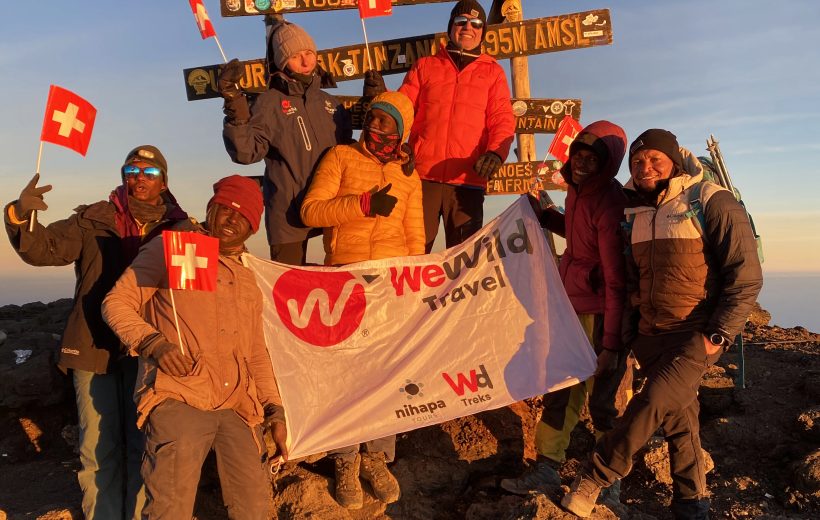
Reaching Uhuru Peak is a major achievement. If conditions allow, you can take photographs and enjoy views across the crater and surrounding mountain landscape. Summit access and visibility depend on weather, your condition, and the guide’s safety assessment.
After the summit, you descend toward Barafu Camp before continuing down the southern slopes to Mweka Camp. This long descent takes you through rocky high-altitude terrain toward lower alpine vegetation. Although the air gradually becomes richer in oxygen as you lose elevation, fatigue can make the descent difficult, so follow your guide’s instructions and take care on loose ground.
At Mweka Camp, you can enjoy your evening meal and rest after the summit attempt. Tomorrow, you will complete the final descent through the rainforest to Mweka Gate.
The final day of the 9-Day Northern Circuit Route Kilimanjaro itinerary begins at Mweka Camp, where you have rested after the summit attempt. After breakfast, you continue downhill through Kilimanjaro’s montane rainforest toward Mweka Gate, the official exit point for your trek.
The trail winds through dense forest, with tall trees, thick undergrowth, and damp ground in some sections. The cooler forest environment contrasts with the exposed alpine terrain near Uhuru Peak. You may hear forest birds along the way, so take time to appreciate the changing scenery as you descend.
Although you are losing altitude, the downhill trail can put pressure on tired knees and leg muscles after several days of trekking. Walk carefully on uneven or slippery sections, maintain a comfortable pace, and follow your guide’s advice.
At Mweka Gate, you complete the park exit formalities and say goodbye to your mountain crew. Your Kilimanjaro trek officially ends here. Your driver will then transfer you to your confirmed hotel in Arusha or Moshi, where you can shower, eat, and relax after completing the Northern Circuit.
After completing your 9-Day Northern Circuit Route Kilimanjaro climb, you can enjoy a final breakfast at your hotel before preparing for your onward journey. WeWild Travel will coordinate your departure transfer according to your confirmed travel arrangements.
If you are flying home, your driver can take you to Kilimanjaro International Airport (JRO). You may also extend your stay with a wildlife safari in Tanzania or a beach holiday in Zanzibar. If you would like to explore more of the country, our team can help you discuss suitable options for the next part of your trip.
As a thank-you for choosing WeWild Travel, our team will present you with a small farewell gift. We appreciate the opportunity to be part of your Kilimanjaro journey and hope you leave Tanzania with lasting memories of the mountain, its landscapes, and the people who supported your climb.
Climbing Mount Kilimanjaro is physically demanding but does not require technical climbing skills. Success depends on your fitness, acclimatization, and following your guide’s advice throughout the trek.
| Number of People | Cost Per Person in Mid-Range | Cost Per Person in VIP |
|---|---|---|
| 1 person | $3’833 | $6,400 |
| 2 people | $2’800 | $5,900 |
| 3 people | $2’456 | $5,400 |
| 4 people | $2’285 | $5,200 |
| 5 people | $2,181 | $5,000 |
| 6 people | $2,112 | $4,800 |
| 7 people | $2’063 | $4,600 |
| 8 people | $2’026 | $4,400 |
| 9 people | $1’997 | $4,200 |
| 10 people + | $1’975 | $4,000 |
| Mid-Range Package | VIP (Luxury) Package |
|---|---|
| Two Nights Accommodations on BB at either of the following Ameg Lodge or Salinero Hotels | Two Nights Accommodations at Mount Meru Hotel on FB or at Gran Melia Hotel |
Scan Qr to Add as a friend



We are a team of seasoned African travel experts with over a decade of combined experience in the safari industry designing the best affordable safari adventures in Tanzania, without compromising on quality.
Meru Spring Plaza,
Box 13287, Arusha Tanzania,
Plot 690 Block D, 23106 Sakina.