Is K2 the Same as Kilimanjaro?
K2 vs Kilimanjaro: Which Mountain Is Higher, Harder, and More Dangerous?
Estimated reading time: 17 minutes
K2 is higher, harder, and far more dangerous than Mount Kilimanjaro. K2 stands at 8,611 meters (28,251 feet) and ranks as the world’s second-highest mountain, while Mount Kilimanjaro rises to 5,895 meters (19,341 feet) as Africa’s highest peak. K2 requires advanced mountaineering skills, technical ice climbing, glacier travel, and experience at extreme altitude. In contrast, Kilimanjaro is a non-technical trek that thousands of hikers complete every year.
For most people, Kilimanjaro is the more achievable goal. K2 is considered one of the most difficult and dangerous mountains on Earth, while Kilimanjaro offers a challenging but accessible high-altitude adventure.
Table of contents
- K2 vs Kilimanjaro: Which Mountain Is Higher, Harder, and More Dangerous?
- Where Are K2 and Kilimanjaro Located?
- Which Mountain Is Higher?
- Which Mountain Is Harder to Climb?
- Which Mountain Is More Dangerous?
- K2 vs Kilimanjaro Success Rates
- How Much Does It Cost to Climb Each Mountain?
- Best Time to Climb K2 and Kilimanjaro
- Who Should Climb K2 or Kilimanjaro?
- K2 vs Kilimanjaro vs Everest
- Frequently Asked Questions
- Final Thoughts
- Read Also:
K2 vs Kilimanjaro at a Glance
| Feature | K2 | Kilimanjaro |
|---|---|---|
| Elevation | 8,611 m (28,251 ft) | 5,895 m (19,341 ft) |
| Location | Pakistan China Border | Tanzania |
| Continent | Asia | Africa |
| Mountain Range | Karakoram | Kilimanjaro Massif |
| Technical Climbing | Yes | No |
| Glacier Travel | Required | Not Required |
| Climbing Time | 6-10 Weeks | 5-9 Days |
| Difficulty | Extreme | Moderate to Challenging |
| Best For | Elite Mountaineers | Trekkers and Beginners |
| Danger Level | Very High | Relatively Low |
This comparison shows why climbers often view K2 and Kilimanjaro as completely different challenges despite both being famous high mountains. K2 tests technical mountaineering skills and survival in extreme conditions, while Kilimanjaro focuses on endurance, altitude adaptation, and multi-day trekking.
Where Are K2 and Kilimanjaro Located?
K2 and Mount Kilimanjaro stand on different continents and in very different environments. K2 rises from the rugged mountains of Asia, while Kilimanjaro towers above the plains of East Africa. Their locations play a major role in their climate, landscapes, and climbing conditions.
K2 Location
K2 is located in the Karakoram Mountains on the border between Pakistan and China. The mountain sits within the remote region of northern Pakistan, with most climbing expeditions approaching from the Pakistani side.
At 8,611 meters (28,251 feet), K2 is the second-highest mountain in the world after Mount Everest. The surrounding terrain consists of steep rock faces, massive glaciers, and some of the most challenging mountain landscapes on Earth. Its remote location makes access difficult, often requiring long treks through the Karakoram wilderness before climbers even reach base camp.
Kilimanjaro Location
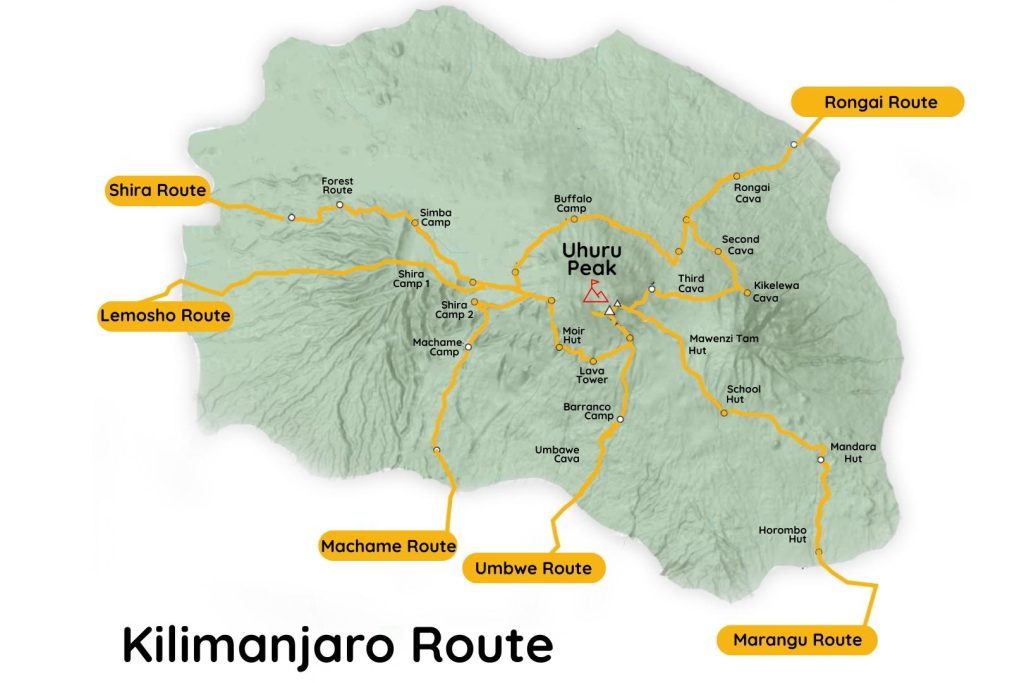
Mount Kilimanjaro is located in northeastern Tanzania, close to the border with Kenya in East Africa. The mountain stands within Kilimanjaro National Park and rises dramatically above the surrounding plains.
At 5,895 meters (19,341 feet), Kilimanjaro is the highest mountain in Africa and the tallest free-standing mountain in the world. Unlike K2, Kilimanjaro is not part of a large mountain range. Its isolated position allows it to dominate the landscape and remain visible from many miles away.
The mountain attracts thousands of trekkers each year because its summit can be reached without technical climbing skills.
Map Comparison
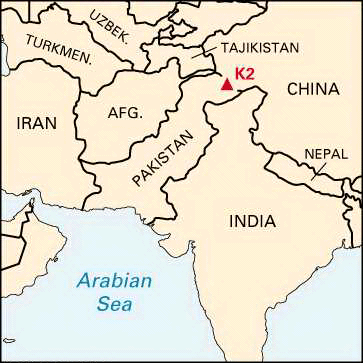
The distance between K2 and Kilimanjaro is more than 5,000 kilometers (3,100 miles). K2 lies in South Asia within the Karakoram Range, while Kilimanjaro stands in East Africa near the equator.
Their locations create very different climbing environments. K2 features glaciers, ice fields, and severe alpine conditions throughout the year. Kilimanjaro offers a unique journey through multiple climate zones, beginning in tropical forests and ending on an arctic summit.
Although both mountains rank among the world’s most famous peaks, their geography, surroundings, and climbing experiences could hardly be more different.
Which Mountain Is Higher?
K2 is significantly higher than Mount Kilimanjaro. Standing at 8,611 meters (28,251 feet), K2 ranks as the second-highest mountain in the world, while Kilimanjaro reaches 5,895 meters (19,341 feet) as Africa’s highest peak. The difference in elevation has a major impact on climbing difficulty, altitude exposure, and the amount of time needed to reach the summit.
K2 Height
K2 rises to 8,611 meters (28,251 feet) above sea level and is the highest mountain in the Karakoram Range. Only Mount Everest stands higher.
Its extreme elevation places climbers deep into the “death zone,” the area above 8,000 meters where oxygen levels become too low to sustain human life for extended periods. Because of this, climbers must spend weeks acclimatizing before attempting the summit.
Kilimanjaro Height
Mount Kilimanjaro stands at 5,895 meters (19,341 feet) above sea level. It is the highest mountain in Africa and the tallest free-standing mountain on Earth.
Although Kilimanjaro is much lower than K2, it still presents significant altitude challenges. Many trekkers experience symptoms of altitude sickness during their ascent, especially on shorter routes. However, oxygen levels remain much higher than those found on K2’s upper slopes.
Height Difference
K2 is 2,716 meters (8,910 feet) taller than Kilimanjaro.
This elevation gap explains why K2 requires much longer expeditions and more advanced altitude preparation. While Kilimanjaro climbers typically reach the summit within a week, K2 expeditions often take several weeks because climbers must adapt gradually to the extreme altitude. The higher elevation also contributes to K2’s harsher weather, colder temperatures, and greater overall danger.
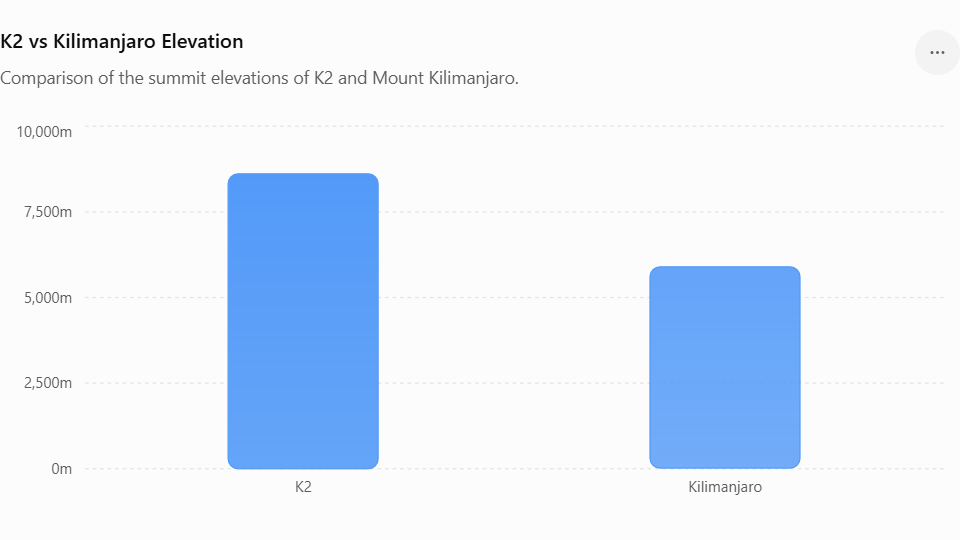
Comparison of the summit elevations of K2 and Mount Kilimanjaro.
| mountain | elevation |
|---|---|
| K2 | 8,611 |
| Kilimanjaro | 5,895 |
Which Mountain Is Harder to Climb?
K2 is far harder to climb than Mount Kilimanjaro. While Kilimanjaro is a trekking peak that requires no technical climbing on standard routes, K2 demands advanced mountaineering skills, glacier travel experience, and the ability to handle extreme altitude and severe weather. Most hikers can attempt Kilimanjaro with proper preparation, but only highly experienced climbers should consider K2.
Technical Climbing Requirements
K2 requires extensive technical climbing skills. Climbers must navigate steep rock sections, snow slopes, exposed ridges, and fixed ropes while carrying specialized equipment. Many sections require the use of crampons, ice axes, harnesses, and rope systems.
Kilimanjaro is very different. Standard routes such as Machame, Lemosho, and Marangu involve hiking rather than technical climbing. Trekkers walk to the summit without using ropes or advanced mountaineering equipment.
Glacier Travel
Glacier travel is a major part of every K2 expedition. Climbers must cross crevasses, unstable ice formations, and heavily glaciated terrain before reaching higher camps. These conditions increase both the technical difficulty and the risks associated with the climb.
Kilimanjaro’s standard routes do not require glacier travel. Although small glaciers remain near the summit, trekkers do not need to cross active glaciers or use specialized glacier-travel techniques.
Altitude Challenges
Both mountains expose climbers to high altitude, but K2 presents a much greater challenge. At 8,611 meters, K2 rises well into the death zone, where oxygen levels are dramatically reduced. Climbers often spend weeks acclimatizing and frequently use supplemental oxygen during summit attempts.
Kilimanjaro reaches 5,895 meters, which is high enough to cause altitude sickness but remains far below the death zone. Most climbers complete the trek in five to nine days, allowing gradual adaptation to the altitude.
Overall Difficulty
K2 is widely regarded as one of the most difficult mountains on Earth. Its combination of extreme altitude, technical climbing, glacier hazards, and unpredictable weather creates a challenge that only experienced mountaineers should attempt.
Kilimanjaro remains physically demanding, but it is achievable for many fit hikers with proper preparation. Success depends largely on fitness, pacing, and acclimatization rather than technical climbing ability.
For overall difficulty, there is no close comparison. K2 ranks among the world’s toughest mountaineering objectives, while Kilimanjaro is considered one of the most accessible high-altitude summits.
Which Mountain Is More Dangerous?
K2 is significantly more dangerous than Mount Kilimanjaro. Both mountains present risks related to altitude and weather, but K2 combines extreme elevation with technical climbing hazards that make it one of the world’s deadliest peaks. Kilimanjaro is much safer by comparison, although climbers must still take altitude sickness and changing weather conditions seriously.
K2 Risks
K2 presents numerous dangers throughout the climb. The mountain is known for steep rock faces, unstable snow slopes, falling ice, avalanches, and severe storms. Climbers often spend weeks on the mountain, increasing their exposure to changing weather and high-altitude conditions.
The biggest danger comes from K2’s extreme elevation of 8,611 meters. Above 8,000 meters, climbers enter the death zone, where oxygen levels become dangerously low. Even experienced mountaineers can suffer from altitude-related illnesses, exhaustion, or poor decision-making in these conditions.
The mountain’s remote location also makes rescue operations difficult and time-consuming.
Kilimanjaro Risks
Mount Kilimanjaro is much safer than K2, but it is not risk-free. The primary challenge is altitude sickness, which can affect climbers who ascend too quickly or fail to acclimatize properly.
Weather conditions near the summit can also become cold, windy, and unpredictable. Fatigue, dehydration, and inadequate preparation may increase the risk of health problems during the climb.
Unlike K2, Kilimanjaro’s standard routes do not involve technical climbing, glacier crossings, or significant avalanche hazards. Most climbers reach the summit by trekking on established trails.
Fatality Comparison
K2 has historically recorded one of the highest fatality rates among the world’s major mountains. The combination of technical climbing, severe weather, and extreme altitude creates a much higher level of risk than most other peaks.
Kilimanjaro has a very low fatality rate compared to K2. Most incidents occur because of altitude-related complications rather than climbing accidents. With proper acclimatization, experienced guides, and adequate preparation, the majority of climbers complete Kilimanjaro safely.
When comparing overall danger, K2 is in a completely different category. It is a mountain reserved for highly skilled mountaineers, while Kilimanjaro remains a challenging but achievable adventure for trekkers and first-time high-altitude climbers.
K2 vs Kilimanjaro Success Rates
Success rates provide one of the clearest ways to compare K2 and Mount Kilimanjaro. While thousands of trekkers reach Kilimanjaro’s summit every year, K2 remains one of the most challenging mountains on Earth, with far fewer successful ascents. The difference reflects the mountains’ vastly different levels of difficulty, altitude, and technical demands.
Kilimanjaro Summit Success Rate
Mount Kilimanjaro has a relatively high summit success rate, especially on longer routes that allow better acclimatization. Depending on the route and operator, success rates generally range from 65% to over 95%.
Routes such as Lemosho and the Northern Circuit often achieve higher success rates because climbers spend more time adjusting to the altitude. Since Kilimanjaro requires no technical climbing, most healthy and well-prepared trekkers have a realistic chance of reaching the summit.
Factors that influence success include route choice, fitness level, pacing, and proper acclimatization.
K2 Summit Success Rate
K2 has a much lower summit success rate than Kilimanjaro. The mountain’s extreme altitude, technical terrain, severe weather, and short climbing season make successful ascents far less common.
Even experienced mountaineers may spend weeks on the mountain without reaching the summit. Storms, avalanche danger, difficult route conditions, and altitude-related problems frequently force climbers to turn back before reaching the top.
Unlike Kilimanjaro, where success largely depends on endurance and acclimatization, success on K2 requires advanced technical skills, extensive mountaineering experience, and favorable weather conditions.
The contrast between the two mountains is striking. Kilimanjaro welcomes thousands of successful summits each year, while K2 remains an elite mountaineering challenge where reaching the summit is never guaranteed, even for the world’s most experienced climbers.
How Much Does It Cost to Climb Each Mountain?
The cost of climbing K2 and Mount Kilimanjaro differs greatly because the two mountains require completely different levels of preparation, equipment, logistics, and support. A K2 expedition is a professional mountaineering journey that can cost tens of thousands of dollars, while Kilimanjaro is a more accessible trekking adventure with a much lower overall price.
K2 Expedition Cost
A K2 expedition usually costs between $30,000 and $80,000+ per person, depending on the expedition company, route, services, and level of support.
The high cost comes from the complexity of climbing the mountain. Climbers need international travel, permits, experienced expedition staff, specialized equipment, base camp services, food supplies, transportation, and long expedition support. A typical K2 climb can take six to ten weeks because climbers need time for acclimatization and waiting for suitable weather conditions.
Additional expenses may include technical climbing gear, insurance, emergency evacuation coverage, and extra days on the mountain if weather delays the summit attempt.
Kilimanjaro Climb Cost
A Mount Kilimanjaro climb usually costs around $1,500 to $5,000+ per person, depending on the route, number of days, group size, and the level of service included.
The price normally covers park fees, permits, guides, mountain crew, camping equipment, meals, and transportation to and from the mountain. Longer routes such as the Lemosho Route and Northern Circuit often cost more because they provide better acclimatization and a higher chance of reaching the summit.
Kilimanjaro does not require expensive technical equipment or specialized climbing systems, making it one of the most affordable high-altitude mountain adventures.
The cost difference between K2 and Kilimanjaro reflects their climbing styles. K2 is a serious expedition for experienced mountaineers, while Kilimanjaro offers an achievable adventure for trekkers who want to experience a famous high mountain without extreme technical climbing.
Best Time to Climb K2 and Kilimanjaro
The best time to climb K2 and Mount Kilimanjaro depends on their different environments and climbing styles. K2 has a very short climbing window because of extreme Himalayan weather, while Kilimanjaro can be climbed during several months of the year because it has more stable conditions.
K2 Season
The best time to climb K2 is usually during July and August, when the Karakoram region experiences its most favorable climbing conditions.
K2 has one of the shortest climbing seasons among major mountains because strong winds, heavy snowfall, freezing temperatures, and storms affect the mountain for much of the year. During the summer window, climbers have a better chance of finding safer conditions for moving above base camp and attempting the summit.
Even during the best season, K2 remains unpredictable. Climbers must wait for suitable weather conditions before making a summit push, and sudden storms can end an expedition at any stage.
The limited climbing window is one reason K2 expeditions require long preparation and experienced teams.
Kilimanjaro Seasons
Mount Kilimanjaro can be climbed throughout the year, but the best seasons are during the dry months from January to March and June to October.
The months of June to October are popular because they offer clearer skies, lower rainfall, and good trekking conditions. This period also matches the summer holiday season, making it one of the busiest times on the mountain.
The January to March season provides another excellent opportunity with generally good weather and fewer crowds compared to the peak months.
The rainy seasons (April May and November) can make trails wetter and more challenging, but some climbers still choose these months because the mountain is quieter.
Unlike K2, Kilimanjaro does not depend on a short summit window. With proper preparation, route selection, and acclimatization, trekkers can successfully climb it in different seasons.
The main difference is simple: K2 requires a narrow weather window for a dangerous expedition, while Kilimanjaro offers more flexible climbing seasons for trekkers.
Who Should Climb K2 or Kilimanjaro?
K2 and Kilimanjaro attract completely different types of adventurers. The right mountain depends on your climbing experience, fitness level, goals, and the type of challenge you want to experience. Kilimanjaro welcomes trekkers looking for a high-altitude adventure, while K2 is designed for experienced mountaineers seeking one of the world’s toughest climbing challenges.
Best for Beginners
Mount Kilimanjaro is the better choice for beginners and first-time high-altitude climbers. The mountain does not require technical climbing skills, ropes, or glacier travel on standard routes. Instead, success depends on physical preparation, proper pacing, and allowing enough time for your body to adjust to the altitude.
Kilimanjaro is suitable for hikers who want to experience a famous summit, explore different climate zones, and challenge themselves without needing years of mountaineering experience.
Although it is more accessible, Kilimanjaro should still be taken seriously. Good preparation, choosing the right route, and climbing with experienced guides improve safety and summit chances.
Best for Experienced Climbers
K2 is only suitable for highly experienced mountaineers with advanced climbing skills. Climbers need experience with technical rock climbing, ice climbing, glacier travel, high-altitude expeditions, and extreme weather conditions.
A K2 expedition requires months or years of preparation because the mountain combines every major challenge found in serious mountaineering. Even skilled climbers face unpredictable conditions and difficult decisions during the ascent.
For climbers seeking a professional-level expedition and one of the greatest tests in mountaineering, K2 represents the ultimate challenge.
The choice between them depends on your goal: Kilimanjaro is ideal for beginners who want to reach a famous summit, while K2 is for elite climbers looking for an extreme mountaineering experience.
K2 vs Kilimanjaro vs Everest
K2, Kilimanjaro, and Mount Everest are three of the world’s most famous mountains, but they represent completely different climbing experiences. Everest is the highest mountain on Earth, K2 is one of the most difficult and dangerous peaks, while Kilimanjaro is the most accessible of the three for many trekkers.
Height Comparison
When comparing elevation, Mount Everest is the tallest, followed by K2 and then Kilimanjaro.
| Mountain | Height | Location |
|---|---|---|
| Mount Everest | 8,848.86 m (29,031.7 ft) | Nepal-China Border |
| K2 | 8,611 m (28,251 ft) | Pakistan-China Border |
| Mount Kilimanjaro | 5,895 m (19,341 ft) | Tanzania |
Everest is about 237 meters higher than K2, making it the highest point above sea level on Earth. K2 is slightly lower but still rises far above most mountains worldwide. Kilimanjaro is much shorter in comparison, but it remains Africa’s highest mountain and one of the world’s most famous trekking peaks.
The height difference also affects altitude challenges. Everest and K2 both enter the extreme altitude zone above 8,000 meters, while Kilimanjaro stays below that level but still requires careful acclimatization.
Difficulty Comparison
The difficulty difference between these mountains is much greater than the height difference.
K2 is considered one of the hardest mountains to climb because it combines extreme altitude, technical climbing, glaciers, steep terrain, and unpredictable weather. It requires advanced mountaineering skills and extensive expedition experience.
Mount Everest is also extremely challenging. Climbers must deal with high altitude, freezing temperatures, glaciers, and the dangers of the Khumbu Icefall and upper mountain sections. However, Everest has more established routes and larger expedition support compared to K2.
Mount Kilimanjaro is the easiest of the three in terms of technical difficulty. Standard routes involve trekking rather than climbing, and no advanced mountaineering skills are required. The main challenge is altitude, endurance, and proper acclimatization.
Overall:
- Highest mountain: Mount Everest
- Most technically difficult: K2
- Most accessible high-altitude climb: Mount Kilimanjaro
These three mountains show that height alone does not determine difficulty. A lower mountain like K2 can be far more demanding than a taller one, while Kilimanjaro offers a different type of high-altitude adventure.
Frequently Asked Questions
Yes, K2 is much harder than Kilimanjaro. K2 requires advanced mountaineering skills, glacier travel experience, technical climbing ability, and preparation for extreme altitude. Kilimanjaro is a trekking mountain where most climbers focus on endurance, altitude adjustment, and proper pacing rather than technical climbing skills.
No, K2 is not suitable for beginners. The mountain requires previous high-altitude climbing experience, knowledge of technical equipment, and the ability to handle dangerous conditions such as steep terrain, glaciers, and unpredictable weather. Most successful K2 climbers have years of mountaineering experience.
No, Kilimanjaro is not considered a technical mountain on its standard routes. Climbers do not need ropes, advanced climbing techniques, or glacier skills. However, it is still a serious high-altitude challenge because the summit reaches 5,895 meters (19,341 feet), where altitude sickness can affect climbers.
K2 is colder than Kilimanjaro because of its much higher elevation and location in the Karakoram Range. Temperatures on K2 can drop extremely low, especially near the summit, with severe winds and winter conditions. Kilimanjaro is closer to the equator, so temperatures are generally warmer, although the summit can still experience freezing conditions.
K2 costs much more to climb than Kilimanjaro. A K2 expedition can cost tens of thousands of dollars because it requires technical equipment, long expedition periods, specialized support, and complex logistics. Kilimanjaro is far more affordable, with costs mainly covering permits, guides, camping services, food, and mountain support.
Final Thoughts
K2 and Kilimanjaro may share a famous “K” name, but they offer completely different mountain experiences. K2 stands among the world’s most extreme climbing challenges, requiring advanced skills, technical equipment, and years of preparation. Kilimanjaro provides a more accessible adventure where trekkers can experience high altitude, incredible landscapes, and a famous summit without technical climbing.
Choosing the Right Mountain
The right mountain depends on your experience and adventure goals. If you are a beginner or a trekker looking for your first major summit, Kilimanjaro is the better choice because it offers a challenging but achievable climb. It allows you to experience one of the world’s great mountains while developing confidence at high altitude.
Read more about our K2 is for experienced mountaineers who want to test their technical skills in one of the harshest environments on Earth. Its difficulty, remoteness, and danger make it a goal for only a small number of climbers.
Planning for Safety and Success
No matter which mountain you choose, preparation is the key to a successful climb. Proper training, choosing the right season, understanding altitude risks, and climbing with experienced professionals can make the journey safer and more enjoyable.
K2 represents extreme mountaineering, while Kilimanjaro represents adventure and exploration. Both mountains are unforgettable, but they challenge climbers in completely different ways.