Kilimanjaro Glaciers: Formation, History, Ice Fields
Kilimanjaro Glaciers: Formation, History, Ice Fields and Their Future (2026 Guide)
Estimated reading time: 29 minutes
The Kilimanjaro glaciers are ancient masses of ice that formed over thousands of years as snowfall accumulated near the summit of Mount Kilimanjaro and gradually compressed into dense glacier ice. Today, several glaciers and ice fields, including the Northern Ice Field, Southern Ice Fields, Furtwängler Glacier, Rebmann Glacier, and Credner Glacier, still remain near Uhuru Peak. Although these glaciers are much smaller than they were a century ago, they continue to make Kilimanjaro one of the few places on Earth where permanent ice exists close to the equator.
For many climbers, seeing the glaciers is one of the most unforgettable moments of reaching Africa’s highest mountain. Their towering ice cliffs rise above the volcanic crater, creating a striking contrast between snow, rock, and the African landscape below. These glaciers are not only beautiful but also scientifically important because they preserve clues about Kilimanjaro’s climate and environmental history.
In this complete guide, you’ll learn how the Kilimanjaro glaciers formed, why they exist on an equatorial mountain, how they have changed throughout history, which glaciers you can still see today, and what current scientific research says about their future. You’ll also discover where to find the best glacier views during your climb, fascinating facts about the mountain’s remaining ice, and practical insights from experienced Kilimanjaro guides who have explored the summit many times.
Table of contents
- Kilimanjaro Glaciers: Formation, History, Ice Fields and Their Future (2026 Guide)
- What Are the Kilimanjaro Glaciers?
- What Happened to the Kilimanjaro Glaciers?
- How Did the Kilimanjaro Glaciers Form?
- The History of Kilimanjaro’s Glaciers
- The Main Glaciers and Ice Fields on Mount Kilimanjaro
- Glaciers That Have Disappeared or Greatly Shrunk
- Why Are Kilimanjaro’s Glaciers Changing?
- Can You See the Glaciers While Climbing Kilimanjaro?
- Fascinating Facts About Kilimanjaro’s Glaciers
- Will the Kilimanjaro Glaciers Survive?
- Frequently Asked Questions About Kilimanjaro Glaciers
- Conclusion: The Future of Kilimanjaro’s Glaciers
- Read Also:
What Are the Kilimanjaro Glaciers?
The Kilimanjaro glaciers are permanent masses of ice that cover parts of the summit of Mount Kilimanjaro. They formed over thousands of years as layers of snow accumulated, compressed under their own weight, and gradually turned into dense glacier ice. Today, these glaciers remain one of the mountain’s most remarkable natural features and make Kilimanjaro one of the few places on Earth where you can find glaciers close to the equator.
Although the glaciers cover a much smaller area than they did in the past, they still attract thousands of climbers, photographers, and scientists every year. Their towering ice cliffs, brilliant white surfaces, and dramatic contrast with the volcanic landscape create an unforgettable view for anyone who reaches the summit.
Where Are the Glaciers Located?
The glaciers sit near the summit of Mount Kilimanjaro, mainly around Uhuru Peak on Kibo, the mountain’s highest volcanic cone. Most of the remaining ice lies above 5,700 meters (18,700 feet), where temperatures stay cold enough to preserve glacier ice for much of the year.
The largest ice formations include the Northern Ice Field, Southern Ice Fields, Furtwängler Glacier, Rebmann Glacier, and Credner Glacier. Climbers can see many of these glaciers during the final ascent to Uhuru Peak, especially on clear mornings when sunlight reflects off the ice walls.
Why Does Mount Kilimanjaro Have Glaciers Near the Equator?
Many people wonder how glaciers can exist almost on the Equator. The answer lies in Kilimanjaro’s exceptional elevation. At 5,895 meters (19,341 feet) above sea level, the summit reaches an altitude where temperatures often remain below freezing, especially at night.
Snowfall, cold temperatures, cloud cover, humidity, and mountain weather all help maintain the remaining glaciers. Over thousands of years, fresh snow accumulated faster than it disappeared, allowing thick layers of ice to develop. These unique conditions created permanent glaciers on Africa’s highest mountain despite its tropical location.
Quick Facts About Kilimanjaro’s Glaciers
- Mount Kilimanjaro rises to 5,895 meters (19,341 feet) above sea level.
- The glaciers surround the summit crater on Kibo, the highest of Kilimanjaro’s three volcanic cones.
- The main remaining glaciers include the Northern Ice Field, Southern Ice Fields, Furtwängler Glacier, Rebmann Glacier, and Credner Glacier.
- Kilimanjaro is one of the few mountains near the Equator with permanent glacier ice.
- The summit glaciers create spectacular ice cliffs that many climbers photograph during sunrise.
- Scientists study the glaciers to understand long-term environmental and climate changes.
- Visiting the glaciers ranks among the most memorable experiences of climbing Mount Kilimanjaro.
What Happened to the Kilimanjaro Glaciers?
The glaciers on Mount Kilimanjaro have changed significantly over the last century. Historical photographs and scientific studies show that the mountain once supported a much larger ice cap that covered large parts of the summit plateau. Today, several glaciers and ice fields still remain, but they occupy a smaller area than they did in the late 1800s and early 1900s.
Despite these changes, Kilimanjaro still offers one of the most remarkable sights in Africa: towering ice cliffs rising above volcanic rock near the Equator. Many climbers reach the summit every year and experience the beauty of the mountain’s remaining glaciers firsthand.
Are the Glaciers Still There?
Yes. Mount Kilimanjaro still has glaciers and permanent ice fields near the summit. The main ice formations include the Northern Ice Field, Southern Ice Fields, Furtwängler Glacier, Rebmann Glacier, and Credner Glacier.
These glaciers surround the summit crater on Kibo, the highest of Kilimanjaro’s three volcanic cones. Most of the remaining ice lies above 5,700 meters (18,700 feet), where cold temperatures and snowfall help preserve glacier ice.
Although the glaciers cover less area than they did in the past, visitors can still see impressive ice walls and snow-covered sections around Uhuru Peak.
How Much Ice Remains Today?
Scientists estimate that Mount Kilimanjaro has lost a large portion of its ice since the late 19th century. Early explorers described extensive ice fields that covered much of the summit plateau, while modern observations show smaller and more fragmented glaciers.
The Northern Ice Field now contains the largest remaining body of ice on the mountain. Smaller glaciers, such as Furtwängler Glacier, continue to exist near the crater, while several historic glaciers have greatly reduced in size.
Researchers continue to study the mountain to understand how snowfall, temperature, humidity, cloud cover, and mountain winds influence the remaining glaciers.
Can Climbers Still See the Glaciers?
Yes. Climbers can still see glaciers during the final ascent to Uhuru Peak. Routes such as Lemosho, Machame, Northern Circuit, and Rongai offer excellent views of the summit ice, especially during clear weather.
Many trekkers first notice the glaciers near Stella Point and Uhuru Peak, where tall ice walls stand above the volcanic landscape. Sunrise often creates spectacular views as golden light reflects off the ice.
For many climbers, seeing glaciers near the Equator becomes one of the most memorable moments of the entire Kilimanjaro experience.
How Did the Kilimanjaro Glaciers Form?
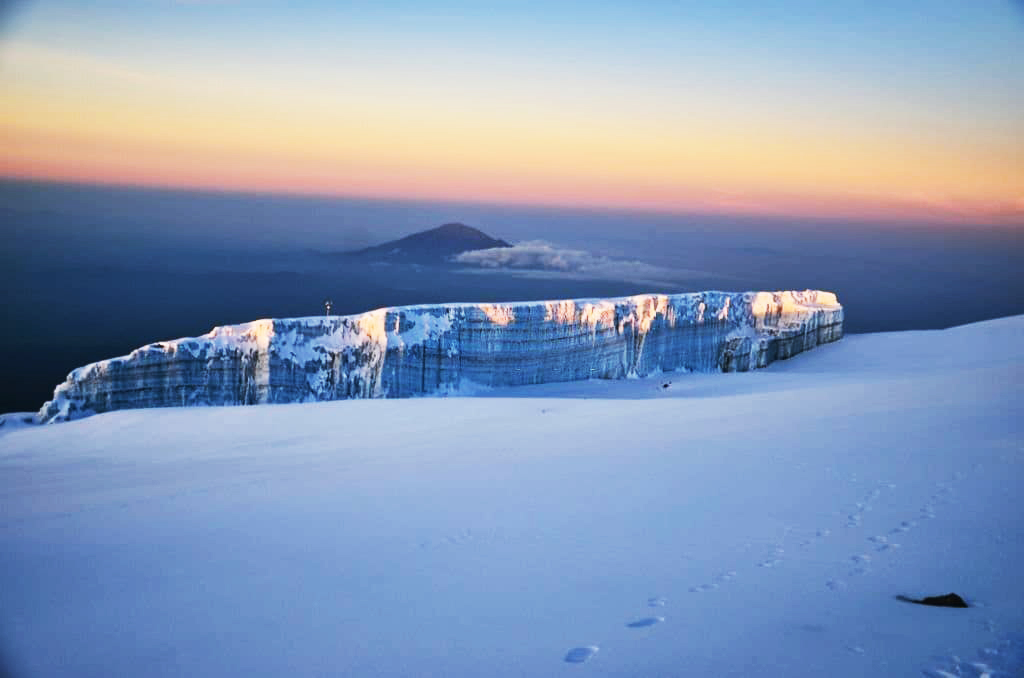
The Kilimanjaro glaciers formed over thousands of years through a combination of volcanic activity, high elevation, cold temperatures, and repeated snowfall. As snow fell on the summit year after year, it accumulated faster than it disappeared. The weight of new snow compressed the older layers into dense ice, creating the glaciers that still cover parts of Kilimanjaro’s summit today.
Although Mount Kilimanjaro stands only about 330 kilometers (205 miles) south of the Equator, its exceptional height creates an environment where glacier ice can exist. Every glacier on the mountain tells the story of Kilimanjaro’s geological history and the unique weather conditions that shape Africa’s highest peak.
Kilimanjaro’s Volcanic History
Mount Kilimanjaro began forming about 2.5 million years ago through a series of volcanic eruptions. Over time, these eruptions created the mountain’s three volcanic cones: Shira, Mawenzi, and Kibo. Kibo later became the highest point in Africa, reaching 5,895 meters (19,341 feet) above sea level.
As the mountain grew higher, temperatures near the summit became much colder than those on the surrounding plains. These freezing conditions allowed snow to remain on the summit for long periods, creating the perfect environment for glaciers to develop.
From Snow to Glacier Ice
Glaciers do not form after a single snowfall. Instead, fresh snow falls repeatedly over many years and gradually builds thick layers on the mountain.
The process happens in several stages:
- Snow falls on the summit during cold weather.
- New snowfall covers older snow.
- The weight of the upper layers compresses the snow below.
- Snow crystals become denser and transform into granular ice.
- Over hundreds or thousands of years, the compressed ice becomes glacier ice.
This slow natural process created the massive ice fields that once covered much of Kilimanjaro’s summit plateau.
Why High Elevation Allows Ice to Form
Elevation plays the most important role in glacier formation on Mount Kilimanjaro.
As altitude increases, air temperature decreases. At nearly 5,900 meters (19,341 feet) above sea level, the summit often experiences temperatures below freezing, especially during the night and early morning. These cold conditions allow snow and ice to remain on the mountain for long periods.
This explains why glaciers exist on Kilimanjaro even though the mountain rises from a tropical region near the Equator.
The Role of Snowfall, Temperature, and Humidity
Glaciers need more than cold temperatures to survive. They also depend on regular snowfall and enough moisture in the atmosphere.
Snow adds new layers to the glacier each year. Cold temperatures slow melting, while humidity and cloud cover help reduce direct solar heating during certain periods. When snowfall adds more ice than the mountain loses, glaciers remain stable or grow. When ice disappears faster than new snow accumulates, glaciers become smaller.
Scientists continue to study these natural processes to understand how they influence Kilimanjaro’s remaining glaciers.
How Mountain Winds Influence Ice Formation
Mountain winds also affect the glaciers by moving air, moisture, and clouds around the summit.
During the day, anabatic winds carry warmer air uphill from the lower slopes. As this air rises, it cools and often forms clouds around the upper mountain. These clouds can bring snowfall and reduce the amount of direct sunlight reaching the glacier surface.
At night, katabatic winds carry cold, dense air downhill from the summit. These winds help maintain low temperatures around the upper slopes and influence the mountain’s weather.
Another important process is sublimation. Instead of melting into water first, some glacier ice changes directly into water vapor under cold, dry, and windy conditions. This natural process removes ice even when temperatures remain below freezing.
Together, snowfall, cloud formation, humidity, elevation, sunlight, and mountain winds create the unique environment that allows glaciers to survive on Mount Kilimanjaro. Scientists continue to study how these factors interact and how they may shape the future of the mountain’s remaining ice.
The History of Kilimanjaro’s Glaciers
The glaciers on Mount Kilimanjaro have shaped the summit for thousands of years. Long before people explored the mountain, thick ice covered large areas of Kibo’s crater and summit plateau. Over time, explorers, scientists, and mountaineers documented the glaciers through written records, photographs, and scientific research. Their work allows us to understand how the glaciers formed, how they have changed, and why they remain one of Africa’s most extraordinary natural wonders.
Before Human Records
Long before anyone climbed Mount Kilimanjaro, snow and ice covered the mountain’s highest elevations. During colder periods in Earth’s history, glaciers extended much farther across the summit than they do today.
As snowfall accumulated over thousands of years, the weight of each new layer compressed the older snow into solid glacier ice. This natural process created extensive ice fields around Kibo’s crater. Although no written records exist from this period, the glaciers preserved evidence of ancient climates within their layers of ice.
1848 – Johannes Rebmann Reports Snow on Kilimanjaro
In 1848, German missionary and explorer Johannes Rebmann became the first European to report seeing snow on Mount Kilimanjaro. From the lowlands, he observed a brilliant white summit rising above the surrounding plains.
Many people in Europe doubted his report because they believed snow could not exist near the Equator. However, later expeditions confirmed Rebmann’s observations and proved that Africa’s highest mountain supported permanent snow and glaciers.
Today, Rebmann Glacier honors his contribution to the exploration of Mount Kilimanjaro.
Early Scientific Expeditions
During the late nineteenth century, explorers, geologists, and scientists began studying Kilimanjaro in greater detail. They mapped the mountain, measured its elevation, and described its glaciers and volcanic landscape.
These early expeditions identified several major glaciers and ice fields, including the Northern Ice Field, Southern Ice Fields, Furtwängler Glacier, Rebmann Glacier, and Credner Glacier. Their observations created the first scientific records of Kilimanjaro’s summit ice and provided valuable information for future researchers.
The First Photographs of the Summit Ice
At the beginning of the twentieth century, photographers captured some of the first images of Kilimanjaro’s glaciers. These photographs revealed enormous ice cliffs surrounding the summit plateau and showed that the glaciers covered a much larger area than they do today.
Modern scientists often compare these historic photographs with recent satellite images and drone surveys. This comparison helps researchers understand how the glaciers have changed over more than one hundred years.
Glacier Changes During the 20th Century
Throughout the twentieth century, researchers observed significant changes in Kilimanjaro’s glaciers. Several smaller glaciers became thinner, while some disappeared completely. The remaining glaciers also separated into smaller sections as the mountain’s ice cover declined.
Scientists link these changes to a combination of factors, including variations in snowfall, humidity, cloud cover, air temperature, solar radiation, and sublimation, a process in which ice changes directly into water vapor without first melting into liquid water.
Although the glaciers became smaller, they continued to survive on the highest parts of Kibo.
What Scientists Observe Today
Today, scientists monitor Kilimanjaro’s glaciers using satellite imagery, drones, GPS surveys, weather stations, and field measurements. These modern tools allow researchers to measure changes in glacier area, ice thickness, and seasonal snowfall with greater accuracy than ever before.
Current research shows that several glaciers and ice fields still remain near Uhuru Peak, including the Northern Ice Field, Southern Ice Fields, Furtwängler Glacier, Rebmann Glacier, and Credner Glacier. Researchers continue to study how snowfall, mountain weather, humidity, cloud formation, and atmospheric conditions influence the future of these remarkable glaciers.
Although many questions remain, one fact is clear: the glaciers of Mount Kilimanjaro continue to inspire scientists, climbers, and visitors from around the world. Their history reflects both the natural evolution of Africa’s highest mountain and the ongoing efforts to understand one of Earth’s most unique high-altitude environments.
| Year | Event |
|---|---|
| Thousands of years ago | Snow accumulates and glaciers form on Kibo. |
| 1848 | Johannes Rebmann reports snow on Kilimanjaro. |
| 1889 | First successful recorded ascent confirms permanent glaciers. |
| Early 1900s | Scientists photograph and map the summit glaciers. |
| 20th Century | Researchers document changes in glacier size. |
| Today | Scientists continue monitoring the remaining glaciers using satellites and field research. |
The Main Glaciers and Ice Fields on Mount Kilimanjaro
Mount Kilimanjaro still preserves several glaciers and permanent ice fields near the summit of Kibo, Africa’s highest point. Although these glaciers cover a smaller area than they did in the past, they remain among the mountain’s most remarkable natural features. Each glacier has its own history, location, and scientific importance, making them valuable to both climbers and researchers.
Furtwängler Glacier
Location
Furtwängler Glacier lies close to Uhuru Peak inside Kibo’s summit crater. Many climbers pass near this glacier during the final stages of their summit ascent, making it one of the best-known glaciers on Mount Kilimanjaro.
History
The glacier takes its name from Walter Furtwängler, a German mountaineer who reached the summit of Mount Kilimanjaro in 1912 with Siegfried König. Their successful climb became an important milestone in the mountain’s exploration, and later researchers named the glacier in Furtwängler’s honor.
Over the years, Furtwängler Glacier became one of the most photographed glaciers on Kilimanjaro because of its striking location near the highest point in Africa.
Current Condition
Today, Furtwängler Glacier covers a much smaller area than it did a century ago. Despite its reduced size, visitors can still see its impressive ice walls near the summit. Scientists continue to monitor the glacier to better understand long-term environmental changes on Mount Kilimanjaro.
Northern Ice Field
Size
The Northern Ice Field forms the largest remaining body of glacier ice on Mount Kilimanjaro. It stretches across the northern side of Kibo’s summit plateau and contains a significant portion of the mountain’s remaining permanent ice.
Importance
The Northern Ice Field holds valuable information about Kilimanjaro’s environmental history. Scientists study layers of glacier ice to learn about past weather patterns, snowfall, and atmospheric conditions. For climbers, the ice field creates one of the most spectacular summit landscapes on the mountain.
Why It Survives
The Northern Ice Field survives because of its high elevation and favorable position on the summit plateau. Cold temperatures, seasonal snowfall, and local weather conditions help preserve the remaining ice. Although it has become smaller over time, it remains the largest glacier system on Kilimanjaro.
Southern Ice Fields
Formation
The Southern Ice Fields developed over thousands of years as repeated snowfall accumulated and compressed into glacier ice. These ice fields consist of several connected ice masses that occupy the southern side of Kibo’s summit crater.
Their towering ice cliffs create one of the most recognizable landscapes on Mount Kilimanjaro.
Best Viewpoints
Climbers enjoy excellent views of the Southern Ice Fields during the summit ascent from Barafu Camp toward Uhuru Peak. The glaciers appear especially beautiful at sunrise, when the first light reflects from the bright white ice against the dark volcanic rock.
Trekkers following the Machame, Lemosho, and Northern Circuit routes often enjoy some of the best views of these impressive ice formations.
Rebmann Glacier
Who Was Johannes Rebmann?
Johannes Rebmann was a German missionary and explorer who became the first European to report seeing snow on Mount Kilimanjaro in 1848. His observations surprised many people because they believed snow could not exist near the Equator.
Although some doubted his report at first, later expeditions confirmed that permanent snow and glaciers covered the summit.
Why Does the Glacier Bear His Name?
Scientists later named Rebmann Glacier in honor of Johannes Rebmann and his important contribution to the exploration of Mount Kilimanjaro. His observations introduced the mountain’s glaciers to the wider scientific world and inspired future expeditions to explore Africa’s highest peak.
Credner Glacier
History
Credner Glacier takes its name from the German geologist Hans Credner, who contributed to geological studies in East Africa during the late nineteenth century. Researchers recognized his work by naming one of Kilimanjaro’s summit glaciers after him.
Like the other glaciers on the mountain, Credner Glacier has experienced significant changes over time, making it an important subject for scientific research.
Location
Credner Glacier lies near the summit crater of Kibo, close to the Northern Ice Field. Although it covers a smaller area than the Northern Ice Field, climbers can still observe parts of the glacier while exploring the summit area.
Today, Credner Glacier remains one of the surviving glaciers on Mount Kilimanjaro and continues to attract scientists interested in the mountain’s unique high-altitude environment.
| Glacier / Ice Field | Named After | Location | Can Climbers See It? | Special Feature |
|---|---|---|---|---|
| Furtwängler Glacier | Walter Furtwängler | Near Uhuru Peak | Yes | Most famous summit glacier |
| Northern Ice Field | Geographic location | North of Kibo | Yes | Largest remaining ice field |
| Southern Ice Fields | Geographic location | South of Kibo | Yes | Dramatic ice cliffs |
| Rebmann Glacier | Johannes Rebmann | Summit area | Limited views | Honors the first European to report Kilimanjaro’s snow |
| Credner Glacier | Hans Credner | Near the summit crater | Yes | Important for geological research |
Glaciers That Have Disappeared or Greatly Shrunk
Mount Kilimanjaro once supported many more glaciers than visitors see today. Historical maps, photographs, and scientific surveys show that the summit contained a much larger network of glaciers and ice fields during the late nineteenth and early twentieth centuries. Over time, several glaciers disappeared completely, while others shrank into small remnants.
These lost glaciers provide valuable evidence of how Kilimanjaro’s summit has changed through history and help scientists understand the mountain’s unique climate.
Little Barranco Glacier
The Little Barranco Glacier once occupied the western side of Kibo near the Western Breach. It formed part of the larger ice cap that covered much of Kilimanjaro’s summit in the past.
As the glacier gradually became smaller, only a small remnant remained. This remaining ice later became known as the Arrow Glacier. Eventually, the last section disappeared, leaving exposed volcanic rock where glacier ice once existed.
Arrow Glacier
The Arrow Glacier represented the final remnant of the former Little Barranco Glacier. It stood near the Western Breach at an elevation of approximately 5,300 to 5,470 meters (17,390-17,950 feet).
Many climbers on the Western Breach Route once viewed this glacier during their ascent. Today, visitors no longer see glacier ice in this location because the Arrow Glacier has disappeared. The route still carries its historical name, reminding climbers of the glacier that once stood there.
Drygalski Glacier
The Drygalski Glacier ranked among the largest glaciers on Mount Kilimanjaro during the early years of scientific exploration. It occupied the northwestern side of Kibo and connected with the Northern Ice Field.
Researchers documented a steady reduction in its size throughout the twentieth century. Eventually, the glacier fragmented and disappeared as a distinct glacier. Today, only nearby sections of the Northern Ice Field remain in that part of the summit.
Other Lost Ice Fields
Several other glaciers and ice fields have also disappeared or declined dramatically over the last century. These include the Great Penck Glacier and Uhlig Glacier, while glaciers such as the Great Barranco Glacier became much smaller and survive only as limited remnants under different names. Scientific maps from the early twentieth century show a summit that contained far more continuous ice than visitors see today.
Historical photographs clearly illustrate these changes. Early expedition images reveal broad ice fields and towering glacier walls surrounding Kibo’s summit, while modern photographs show a much smaller and more fragmented ice cover. Comparing old and new images allows climbers to appreciate how the summit landscape has evolved over time and highlights the importance of continued scientific monitoring.
| Glacier | Current Status | Last Known Condition |
|---|---|---|
| Little Barranco Glacier | Disappeared | Later became Arrow Glacier |
| Arrow Glacier | Disappeared | Final remnant vanished |
| Drygalski Glacier | Disappeared | Formerly connected to the Northern Ice Field |
| Great Penck Glacier | Disappeared | Historical glacier on Kibo |
| Uhlig Glacier | Disappeared | Recorded in early glacier surveys |
Why Are Kilimanjaro’s Glaciers Changing?
The glaciers on Mount Kilimanjaro have changed dramatically over the past century. Scientists agree that the mountain has lost a large amount of glacier ice, but they continue to study the natural processes responsible for these changes. Instead of pointing to a single cause, researchers examine how temperature, snowfall, humidity, cloud cover, mountain winds, and sublimation work together to influence the glaciers.
Understanding these factors helps climbers appreciate why glaciers can survive near the Equator and why they continue to change over time.
Temperature
Temperature influences every glacier on Earth, including those on Mount Kilimanjaro. Warmer conditions can increase ice loss, especially when they occur alongside reduced snowfall and dry air.
However, Kilimanjaro differs from many mountain ranges. Because the summit remains extremely cold for much of the year, scientists have found that air temperature alone does not fully explain the glacier changes. Other environmental factors also play important roles.
Snowfall
Snowfall provides the fresh snow that glaciers need to survive and grow.
When heavy snowfall reaches the summit, it adds new layers of snow that gradually compress into glacier ice. Fresh snow also reflects a large amount of sunlight because of its bright white surface, helping protect the glacier from absorbing too much solar energy.
Several studies suggest that East Africa became drier after the late nineteenth century, reducing snowfall on Kilimanjaro. With less fresh snow reaching the summit, the glaciers receive less new ice each year.
Sublimation
One of the most important processes on Kilimanjaro is sublimation.
Sublimation occurs when solid ice changes directly into water vapor without becoming liquid water first. This process happens under cold, dry, and windy conditions.
Unlike many glaciers in colder regions that lose ice mainly through melting, Kilimanjaro’s glaciers often lose a significant amount of ice through sublimation. Scientists have shown that this process plays a major role in the mountain’s glacier mass loss.
Cloud Cover
Clouds strongly influence the amount of sunlight that reaches the glacier surface.
Thick cloud cover can reduce direct solar radiation and help protect glacier ice during the day. Clouds also contribute moisture that supports snowfall near the summit.
When cloud cover decreases, more sunlight reaches the ice and snowfall may also decline. Researchers believe that long-term changes in cloud patterns have contributed to changes in Kilimanjaro’s glaciers.
Mountain Winds
Mountain winds help shape the weather around Kilimanjaro’s summit.
During the day, anabatic winds carry warmer, moist air uphill. As the air rises, it cools and often forms clouds around the upper slopes. These clouds may bring snow and reduce direct sunlight on the glaciers.
At night, katabatic winds carry cold, dense air downhill from the summit. These winds help maintain low temperatures and influence the movement of moisture across the mountain.
Although mountain winds do not create glaciers by themselves, they influence cloud formation, humidity, snowfall, and sublimation. Together, these processes help determine how much glacier ice the mountain gains or loses each year.
Scientific Research and Different Views
Scientists agree on one important fact: Mount Kilimanjaro’s glaciers have become much smaller than they were a century ago.
Researchers also agree that glacier change results from several interacting processes rather than a single cause. Temperature, snowfall, atmospheric moisture, cloud cover, solar radiation, and sublimation all influence the mountain’s ice.
Scientists continue to collect data using weather stations, satellites, drones, GPS surveys, and field observations. As new information becomes available, researchers refine their understanding of how Kilimanjaro’s glaciers respond to changes in climate and mountain weather.
Although research continues, the remaining glaciers still provide an extraordinary opportunity for climbers and scientists to experience one of the world’s most unique high-altitude environments.
Can You See the Glaciers While Climbing Kilimanjaro?
Yes. You can still see several glaciers and ice fields while climbing Mount Kilimanjaro. The best views appear during the final summit ascent on Kibo, especially between Stella Point and Uhuru Peak. As the sun rises, the glaciers glow against the dark volcanic landscape, creating one of the most unforgettable sights on Africa’s highest mountain.
Not every climbing route offers the same glacier views. Some routes provide longer and clearer views of the summit ice because they approach the crater from different directions.
Best Routes for Glacier Views
Lemosho Route
The Lemosho Route offers some of the best glacier views on Mount Kilimanjaro. After crossing the Shira Plateau and climbing the southern slopes, trekkers reach the summit via Barafu Camp. During the final ascent, climbers can see the Southern Ice Fields, Furtwängler Glacier, and other summit glaciers as they approach Uhuru Peak.
The Lemosho Route also provides excellent opportunities to photograph the glaciers during sunrise because climbers reach the crater shortly after dawn.
Machame Route
The Machame Route follows a similar summit approach to the Lemosho Route. Climbers pass through Barranco Camp, Karanga Camp, and Barafu Camp before reaching the summit.
From Stella Point to Uhuru Peak, trekkers enjoy spectacular views of the Southern Ice Fields and several remaining glaciers. The contrast between the bright white ice and Kilimanjaro’s volcanic rocks makes this one of the most scenic sections of the climb.
Northern Circuit Route
The Northern Circuit Route offers the most complete glacier experience on Mount Kilimanjaro. Since this route circles the northern side of Kibo, climbers enjoy unique views that many other routes do not provide.
Trekkers often see the Northern Ice Field, one of the largest remaining ice formations on the mountain. The route also offers quieter trails and more time to appreciate the summit landscape.
Rongai Route
The Rongai Route approaches Kilimanjaro from the northern side near the Kenya border. During the summit climb, trekkers enjoy excellent views of the Northern Ice Field before reaching Uhuru Peak.
Because fewer people choose this route, climbers often experience peaceful sunrise views of the glaciers with less crowding than on the southern routes.
Best Time of Year
You can see Kilimanjaro’s glaciers throughout the year, but clear skies make a significant difference.
Read more: The best months for glacier views are:
- January to early March – Warm temperatures, good visibility, and frequent clear mornings.
- June to October – Dry weather, excellent visibility, and stable climbing conditions.
These seasons often provide the clearest views of the glaciers and surrounding ice cliffs. During the rainy seasons, clouds may hide parts of the summit, although the glaciers remain present.
Best Photography Locations
If you enjoy mountain photography, Kilimanjaro offers several outstanding locations to capture its glaciers.
The best places include:
- Uhuru Peak – The highest point in Africa, with close views of Furtwängler Glacier and nearby ice fields.
- Stella Point – A perfect location to photograph the sunrise as light reaches the glaciers.
- Crater Rim – Excellent panoramic views of the Northern Ice Field and Southern Ice Fields.
- Barafu Summit Trail – Beautiful views of the glaciers during the final ascent.
- Northern Circuit Summit Approach – One of the best places to photograph the Northern Ice Field.
From my experience guiding climbers on Kilimanjaro, the most spectacular glacier photographs usually come just after sunrise. At this time, the soft golden light illuminates the white ice while the volcanic rocks remain in shadow, creating dramatic contrasts that last only a short time. For photographers, arriving at the summit around sunrise offers the best opportunity to capture the beauty of Kilimanjaro’s remaining glaciers.
Fascinating Facts About Kilimanjaro’s Glaciers
The glaciers of Mount Kilimanjaro are among the most unusual ice formations on Earth. They exist on a tropical mountain near the Equator, rise above Africa’s highest peak, and preserve a history that stretches back thousands of years. Beyond their beauty, these glaciers reveal fascinating stories about geology, weather, exploration, and the changing environment of Kilimanjaro.
Ice Near the Equator
One of the most amazing facts about Kilimanjaro’s glaciers is their location. Mount Kilimanjaro stands only a few degrees south of the Equator, yet its summit supports permanent ice.
The secret is elevation. At 5,895 meters (19,341 feet) above sea level, the summit reaches an extremely cold environment where temperatures can remain below freezing. The mountain’s great height creates conditions similar to those found in much colder regions of the world.
This makes Kilimanjaro one of the few places where climbers can walk through tropical forests, alpine deserts, and glacier-covered landscapes during one journey.
The Oldest Ice on Kilimanjaro
The ice on Kilimanjaro formed over thousands of years as repeated snowfall accumulated and compressed into glacier ice.
Scientists have studied ice cores and glacier layers to understand past environmental conditions on the mountain. These layers preserve information about historical snowfall, atmospheric conditions, and changes in Kilimanjaro’s climate.
Some ice near the summit represents a long record of the mountain’s past, although researchers continue to study the exact age and history of different glacier sections.
Why the Ice Looks Blue
Have you ever noticed that glacier ice sometimes appears blue instead of white?
The blue color happens because dense glacier ice absorbs longer wavelengths of visible light, such as red and yellow, while it allows more blue light to travel through the ice and reflect back to our eyes.
Fresh snow usually looks bright white because it contains many air spaces that scatter sunlight. As snow becomes compressed into older glacier ice, the ice becomes denser and can show beautiful blue tones.
On Kilimanjaro, climbers may notice blue shades inside glacier walls, cracks, and shaded areas near the summit.
Ice Cliffs at Sunrise
The glaciers of Kilimanjaro become especially spectacular during sunrise.
During the final summit climb, the first rays of sunlight reach the ice cliffs around the crater, creating a dramatic contrast between golden light, white ice, and dark volcanic rock.
Locations such as Stella Point, Uhuru Peak, and the crater rim provide some of the best views of the summit glaciers. Many climbers describe this moment as one of the most unforgettable experiences of their entire Kilimanjaro journey.
Wildlife Around the Summit
The summit glaciers themselves cannot support wildlife because the environment is too cold, dry, and extreme. However, the lower slopes of Mount Kilimanjaro support an incredible variety of animals and plants.
As climbers move through different ecological zones, they may see wildlife such as:
- Colobus monkeys in the rainforest.
- Birds adapted to mountain environments.
- Small mammals living in the alpine zones.
The journey from tropical forest to glacier-covered summit shows how Kilimanjaro contains several ecosystems on one mountain. The glaciers represent the final and coldest environment at the top of this remarkable natural landscape.
Will the Kilimanjaro Glaciers Survive?
The future of the Kilimanjaro glaciers remains an important topic for scientists, climbers, and conservationists around the world. Researchers agree that the mountain has lost a significant amount of ice since the late nineteenth century, but the future of the remaining glaciers depends on many factors, including snowfall, temperature, humidity, cloud cover, and atmospheric conditions.
Kilimanjaro’s glaciers continue to survive because the summit creates a unique environment where cold temperatures, high elevation, and occasional snowfall allow ice to remain near the Equator. Understanding how these factors interact helps scientists predict how the remaining glaciers may change in the future.
What Current Research Suggests
Scientific research shows that Kilimanjaro’s glaciers have become much smaller compared with historical records from the late 1800s and early 1900s. Early photographs and surveys show a much larger ice cap covering parts of Kibo’s summit.
Today, researchers monitor the remaining glaciers using satellite images, field measurements, drones, and weather observations. These studies show that glacier change involves several processes:
- Snowfall: Fresh snow adds new ice and helps maintain glacier surfaces.
- Temperature: Warmer conditions can increase ice loss.
- Sublimation: Dry air and strong winds can remove ice by changing it directly into water vapor.
- Cloud cover: Clouds influence sunlight, moisture, and snowfall around the summit.
- Mountain weather: Winds and atmospheric conditions affect how much ice the glaciers gain or lose.
Scientists generally agree that Kilimanjaro’s glaciers have retreated, but researchers continue to study the exact relationship between these different factors and the future condition of the remaining ice.
What Climbers Can Expect in the Coming Decades
Climbers in the coming decades can still expect to see glaciers and ice fields near the summit of Mount Kilimanjaro. The Northern Ice Field, Southern Ice Fields, Furtwängler Glacier, Rebmann Glacier, and Credner Glacier continue to create a spectacular landscape around Uhuru Peak.
However, the appearance of the summit may continue to change. Some smaller ice sections may shrink further, while the remaining glaciers may become more fragmented depending on future weather patterns.
For climbers, reaching the summit today offers the opportunity to experience one of Earth’s most unique environments: standing near glacier ice on a mountain located close to the Equator.
The glaciers of Kilimanjaro are more than frozen water. They represent thousands of years of natural history and provide a connection between the past, present, and future of Africa’s highest mountain.
Frequently Asked Questions About Kilimanjaro Glaciers
Mount Kilimanjaro still has several glaciers and permanent ice fields near the summit. The main remaining ice formations include the Northern Ice Field, Southern Ice Fields, Furtwängler Glacier, Rebmann Glacier, and Credner Glacier.
The Northern Ice Field is the largest remaining body of ice on Mount Kilimanjaro. It covers a large section of Kibo’s northern summit area and contains a significant portion of the mountain’s remaining glacier ice.
Kilimanjaro has snow because its summit reaches 5,895 meters (19,341 feet) above sea level. At this altitude, temperatures remain cold enough for snow and ice to survive, even though the mountain stands near the Equator.
Yes, climbers can see and sometimes walk near glacier areas during certain summit routes, depending on safety conditions and guide recommendations. However, glaciers contain hidden dangers such as unstable ice, cracks, and changing surfaces.
Kilimanjaro’s glaciers formed over thousands of years as repeated snowfall accumulated and compressed into dense ice. Scientists study glacier layers to understand the mountain’s past climate and environmental conditions.
The Northern Ice Field is the largest remaining glacier system on Kilimanjaro. It lies on the northern side of Kibo’s summit plateau and represents one of the most important remaining examples of permanent ice near the Equator.
Furtwängler Glacier is one of Kilimanjaro’s most famous glaciers. It sits near Uhuru Peak inside Kibo’s summit area and takes its name from German mountaineer Walter Furtwängler, who reached the summit in 1912.
The Rebmann Glacier honors Johannes Rebmann, the German missionary and explorer who reported seeing snow on Kilimanjaro in 1848.
No one can predict the exact future of Kilimanjaro’s glaciers with complete certainty. Scientists agree that the glaciers have become much smaller compared with historical records, but several ice fields and glaciers still remain today.
Many people think Kilimanjaro’s glaciers provide most of the water for nearby communities, but this is not accurate. The main water sources around the mountain come from rainfall, forests, rivers, streams, and underground water systems.
Glacier melt contributes only a small amount of water because the glaciers sit high on the summit and receive limited precipitation. However, the glaciers remain important as natural records of the mountain’s climate history.
No. Kilimanjaro’s hot springs do not come from glacier water. Hot springs form when groundwater travels deep underground, becomes heated by geothermal energy, and returns to the surface.
Conclusion: The Future of Kilimanjaro’s Glaciers
The Kilimanjaro glaciers are much more than frozen ice on the summit of Africa’s highest mountain. They represent thousands of years of natural history, volcanic evolution, changing weather patterns, and the unique environment that allows ice to exist near the Equator.
From the famous Furtwängler Glacier near Uhuru Peak to the vast Northern Ice Field and the historic Rebmann Glacier, each glacier tells an important story about Mount Kilimanjaro. Although the summit ice has become smaller compared with the past, these remaining glaciers continue to create one of the world’s most spectacular mountain landscapes.
Scientists continue to study how snowfall, temperature, cloud cover, humidity, mountain winds, and sublimation influence the future of Kilimanjaro’s ice. While researchers continue to learn more about these complex processes, one thing remains clear: the glaciers are a valuable part of Kilimanjaro’s natural heritage.
For climbers, seeing the glaciers during a Kilimanjaro summit climb is a rare and unforgettable experience. Standing beside ice formations near the Equator, surrounded by volcanic peaks and endless African views, shows the incredible diversity of this mountain.
At WeWild Travel, we believe every climb is not only a journey to the summit but also an opportunity to understand and respect the natural wonders of Mount Kilimanjaro. Experiencing the glaciers firsthand allows climbers to connect with the history, beauty, and unique environment of the Roof of Africa.