Mount Kilimanjaro Flora and Fauna: Plants and Wildlife
Mount Kilimanjaro Flora and Fauna: Plants, Wildlife & Ecological Zones (2026 Guide)
Estimated reading time: 47 minutes
Mount Kilimanjaro flora and fauna include more than 2,500 plant species, over 140 mammal species, hundreds of bird species, and five distinct ecological zones that stretch from tropical rainforest to an Arctic summit. As you climb Africa’s highest mountain, the landscape changes dramatically. Within just a few days, you can walk through lush forests filled with monkeys and colorful birds, pass giant groundsels and lobelias in the moorland, cross the alpine desert, and finally reach glaciers and volcanic rock at Uhuru Peak.
Unlike many mountains, Mount Kilimanjaro National Park supports an extraordinary range of ecosystems because of its location near the Equator and its elevation of 5,895 meters (19,341 feet). Each ecological zone has its own climate, vegetation, and wildlife, making Kilimanjaro one of the most biodiverse mountains in Africa and a recognized UNESCO World Heritage Site.
Although many visitors come to climb the mountain, the journey is also an opportunity to discover remarkable plants and animals. You may spot black-and-white colobus monkeys swinging through the rainforest canopy, hear Hartlaub’s turacos calling from the trees, admire towering giant groundsels that exist nowhere else in the world, or watch white-necked ravens soaring above the volcanic slopes near the summit.
This guide explains everything you need to know about Mount Kilimanjaro flora and fauna, including the mountain’s ecological zones, native plants, trees, wildlife, birds, rare species, conservation efforts, and the best trekking routes for experiencing Kilimanjaro’s unique biodiversity. Drawing on the experience of local Kilimanjaro guides, you’ll also learn where to see the most wildlife, when to visit, and how to appreciate this remarkable mountain while helping protect its fragile ecosystems for future generations.
Table of contents
- Mount Kilimanjaro Flora and Fauna: Plants, Wildlife & Ecological Zones (2026 Guide)
- What Flora and Fauna Live on Mount Kilimanjaro?
- Why Is Mount Kilimanjaro One of Africa’s Most Biodiverse Mountains?
- The Five Ecological Zones of Mount Kilimanjaro
- What Plants and Trees Will You See on Mount Kilimanjaro?
- Mount Kilimanjaro Wildlife: Animals You May See
- Birds of Mount Kilimanjaro
- Rare and Endemic Species of Kilimanjaro
- How Flora Changes as You Climb Kilimanjaro
- Best Routes for Seeing Kilimanjaro Flora and Fauna
- Best Time to See Wildlife and Flowers
- Conservation of Mount Kilimanjaro’s Flora and Fauna
- Fascinating Facts About Kilimanjaro Flora and Fauna
- Frequently Asked Questions
- Conclusion
- Read Also:
What Flora and Fauna Live on Mount Kilimanjaro?
Mount Kilimanjaro is home to one of Africa’s richest collections of plants and wildlife. Scientists have recorded more than 2,500 plant species, over 140 mammal species, and hundreds of bird species across the mountain’s five ecological zones. From tropical rainforest to the icy summit, each habitat supports different forms of life that have adapted to Kilimanjaro’s changing climate and altitude.
Protected within Kilimanjaro National Park, a UNESCO World Heritage Site, these ecosystems include ancient forests, giant alpine plants, rare mammals, colorful birds, insects, reptiles, and unique microorganisms that survive near the summit. This remarkable biodiversity makes Mount Kilimanjaro not only Africa’s highest mountain but also one of its most important natural environments.
What Is the Flora of Mount Kilimanjaro?
Flora refers to all the plant life growing on Mount Kilimanjaro. The mountain supports more than 2,500 plant species, ranging from tropical trees and ferns to giant groundsels, giant lobelias, mosses, lichens, orchids, and hardy alpine flowers.
As you climb higher, the vegetation changes dramatically. The lower slopes feature coffee farms and banana plantations, followed by dense montane rainforest filled with towering trees. Higher elevations reveal giant heather, giant groundsels, and lobelias that thrive in cold, windy conditions. Above 5,000 meters, only a few lichens and microscopic organisms can survive among volcanic rocks, glaciers, and permanent ice.
This extraordinary variety of plants reflects Kilimanjaro’s dramatic elevation changes and diverse climates.
What Is the Fauna of Mount Kilimanjaro?
Fauna includes all the animals that live on Mount Kilimanjaro and within Kilimanjaro National Park. The mountain provides habitat for over 140 mammal species, hundreds of bird species, numerous reptiles, amphibians, butterflies, and insects.
Wildlife changes with elevation. In the rainforest, climbers may encounter blue monkeys, black-and-white colobus monkeys, olive baboons, bushbucks, duikers, and, on rare occasions, Cape buffalo, forest elephants, or even leopards. Higher on the mountain, mammals become less common, while birds such as the white-necked raven and scarlet-tufted sunbird remain well adapted to the harsh alpine environment.
Although wildlife sightings vary from one climb to another, every ecological zone offers opportunities to observe species specially adapted to life on Africa’s highest mountain.
Why Is Kilimanjaro So Rich in Biodiversity?
Mount Kilimanjaro’s exceptional biodiversity results from a unique combination of geography, altitude, climate, and conservation.
Located just south of the Equator, the mountain rises from about 800 meters above sea level to 5,895 meters (19,341 feet) at Uhuru Peak. This enormous elevation range creates five distinct ecological zones, each with its own temperatures, rainfall, soils, and vegetation.
The fertile volcanic soils support lush forests, while changing weather patterns allow different plants and animals to thrive at different elevations. Because the mountain is protected as Kilimanjaro National Park and recognized as a UNESCO World Heritage Site, many of these habitats remain relatively undisturbed.
As a result, climbers can experience an incredible journey through multiple ecosystems in just a few days from tropical rainforest alive with wildlife to alpine desert and glaciated summit landscapes found nowhere else in East Africa. This remarkable ecological diversity is one of the reasons Mount Kilimanjaro is considered one of the world’s most extraordinary mountains for both trekking and nature exploration.
Why Is Mount Kilimanjaro One of Africa’s Most Biodiverse Mountains?
Mount Kilimanjaro is one of Africa’s most biodiverse mountains because it combines an equatorial location, towering elevation, varied climates, fertile volcanic soils, and long-term conservation. These factors create five distinct ecological zones, allowing thousands of plant species and hundreds of animal species to thrive on a single mountain.
A trek from the base to Uhuru Peak (5,895 meters / 19,341 feet) feels like traveling from the tropics to the Arctic in less than a week. You begin among banana plantations and rainforest, continue through heath and moorland filled with giant plants, cross an alpine desert, and finally reach glaciers and permanent ice near the summit. Very few mountains on Earth offer such dramatic ecological diversity over a relatively short distance.
Location Near the Equator
Most people expect snow, glaciers, and alpine plants to exist near the Earth’s poles. Mount Kilimanjaro proves otherwise.
The mountain stands only about 330 kilometers (205 miles) south of the Equator in northern Tanzania. At its base, the climate is warm and tropical throughout the year, supporting dense forests, rich farmland, and abundant wildlife.
However, as moist air rises up the mountain’s slopes, it cools and produces rain, creating ideal conditions for forests and diverse vegetation. At much higher elevations, temperatures fall below freezing, allowing snow and glaciers to survive near the summit despite the mountain’s tropical location.
This combination of tropical warmth and high-altitude cold creates habitats that support an exceptional variety of life.
Huge Elevation Difference
Elevation is one of the main reasons Kilimanjaro supports so many different species.
The mountain rises from cultivated farmland at around 800 meters (2,625 feet) to Uhuru Peak at 5,895 meters (19,341 feet). Over this distance, air temperature decreases significantly, rainfall patterns change, and oxygen levels become much lower.
Every increase in altitude creates new environmental conditions. Plants and animals that thrive in warm rainforest cannot survive in freezing alpine environments, while species adapted to the summit would not survive in the humid forests below.
This remarkable elevation range allows many different ecosystems to exist on a single mountain.
Different Climate Zones
Mount Kilimanjaro contains five ecological zones, each with its own climate, vegetation, and wildlife.
The Cultivation Zone surrounds the lower slopes, where local communities grow bananas, coffee, maize, and other crops.
Above it lies the Rainforest Zone, the richest habitat for biodiversity. Tall trees, mosses, orchids, monkeys, antelope, birds, and countless insects thrive in the cool, humid environment.
Higher up, the Heather and Moorland Zone features giant groundsels, giant lobelias, colorful everlasting flowers, and hardy shrubs specially adapted to strong sunlight and cold nights.
The Alpine Desert Zone receives very little rainfall. Only drought-resistant plants, lichens, mosses, insects, and a few birds survive in this harsh landscape of volcanic rock.
Finally, the Arctic Summit Zone consists of glaciers, volcanic ash, rock, snow, and ice. Although almost no visible plants or animals live here, scientists have discovered microscopic organisms capable of surviving these extreme conditions.
Together, these five ecological zones create an extraordinary natural staircase of habitats rarely found anywhere else in the world.
Protected National Park
Biodiversity depends not only on climate but also on conservation.
Kilimanjaro National Park, established in 1973, protects the mountain’s forests, wildlife, and fragile alpine ecosystems from uncontrolled development and habitat loss. In 1987, UNESCO recognized the park as a World Heritage Site because of its outstanding natural importance.
Park authorities work alongside researchers, local communities, guides, and conservation organizations to protect native plants, wildlife, water sources, and trekking routes. Strict regulations help reduce environmental impacts while allowing visitors to experience one of Africa’s greatest natural treasures responsibly.
These conservation efforts ensure that future generations can continue exploring Kilimanjaro’s remarkable ecosystems.
From Tropical Rainforest to Arctic Summit
Few places on Earth allow you to experience such dramatic environmental change in such a short time. During a typical 6- to 9-day Kilimanjaro climb, you can walk through tropical farmland, ancient rainforest, open moorland, alpine desert, and finally an Arctic-like summit crowned with glaciers.
Each ecological zone supports its own unique collection of plants, birds, mammals, insects, and microorganisms. This extraordinary journey through multiple ecosystems is one of the reasons Mount Kilimanjaro is considered not only Africa’s highest mountain but also one of the continent’s greatest biodiversity hotspots and one of the world’s most fascinating destinations for nature lovers.
The Five Ecological Zones of Mount Kilimanjaro
One of the most remarkable features of Mount Kilimanjaro is that you can walk through five completely different ecological zones during a single climb. As you gain elevation, the temperature drops, rainfall changes, and the landscape transforms from tropical farmland to glaciers near the summit.
Each zone has its own climate, soils, plants, wildlife, and scenery. Together, they create one of the world’s most diverse mountain ecosystems and explain why Mount Kilimanjaro National Park is recognized as a UNESCO World Heritage Site.
Understanding these ecological zones helps climbers appreciate that Kilimanjaro is much more than Africa’s highest mountain it’s a living journey through multiple environments that normally exist thousands of kilometers apart.
Cultivation Zone (800-1,800 m)
The Cultivation Zone forms the fertile foothills surrounding Mount Kilimanjaro. Although it lies outside the protected national park, it plays an important role in the mountain’s ecosystem and supports thousands of families from the Chagga community, who have lived on Kilimanjaro’s slopes for centuries.
Rich volcanic soils, abundant rainfall, and warm temperatures create ideal conditions for agriculture. The landscape features a patchwork of small farms, fruit trees, traditional homesteads, and lively villages connected by narrow roads and walking paths. For many climbers, this is their first introduction to the beauty and culture of Kilimanjaro before entering the national park.
Coffee Farms
Mount Kilimanjaro is one of Tanzania’s most famous coffee-growing regions. The fertile volcanic soils produce high-quality Arabica coffee, which is cultivated beneath the shade of larger trees. Many local families rely on coffee farming as their primary source of income, and visitors can join guided coffee tours to learn how beans are grown, harvested, roasted, and brewed using traditional methods.
Walking through these farms offers a glimpse into daily life on the mountain and highlights the close relationship between the local people and Kilimanjaro’s natural environment.
Banana Plantations
Bananas are another essential crop grown throughout the Cultivation Zone. Large banana groves surround many homes and farms, providing food, animal feed, and materials for traditional uses.
The Chagga people cultivate several banana varieties for cooking, brewing local banana beer, and eating fresh. These plantations also help protect the soil from erosion while creating shaded habitats for birds, insects, and small animals.
The combination of banana plants, coffee trees, and native vegetation creates a productive agroforestry system that has supported communities on Kilimanjaro for generations.
Local Villages
Dozens of villages surround Mount Kilimanjaro, especially on its southern and eastern slopes. These communities serve as the gateway to many popular climbing routes, including Machame, Marangu, and Lemosho.
Visitors often experience the warmth and hospitality of the local people before beginning their trek. Markets, schools, churches, cultural centers, and family farms reflect the rich traditions of the Chagga community, whose knowledge of the mountain has been passed down through generations.
Many local guides, porters, and cooks who lead Kilimanjaro expeditions were born and raised in these villages. Their deep understanding of the mountain’s environment, weather, wildlife, and culture enriches every climb and helps visitors appreciate Kilimanjaro beyond its famous summit.
Quick Facts About the Cultivation Zone
| Feature | Details |
|---|---|
| Elevation | 800-1,800 meters (2,625-5,906 feet) |
| Climate | Warm and humid throughout most of the year |
| Average Temperature | 20-30°C (68-86°F) |
| Main Vegetation | Coffee, bananas, maize, beans, avocado, shade trees |
| Wildlife | Small birds, butterflies, insects, reptiles, and domestic animals |
| Communities | Primarily Chagga villages and family farms |
| Highlights | Coffee tours, banana plantations, cultural experiences, fertile volcanic landscapes |
The Cultivation Zone marks the beginning of every Kilimanjaro adventure. It demonstrates how fertile volcanic soils, abundant rainfall, and generations of sustainable farming have created a vibrant landscape where people and nature continue to thrive side by side.
Rainforest Zone (1,800-2,800 m)
The Rainforest Zone is the richest and most biodiverse ecosystem on Mount Kilimanjaro. Stretching from approximately 1,800 to 2,800 meters (5,906-9,186 feet), this lush forest receives the highest rainfall on the mountain, often exceeding 2,000 millimeters (79 inches) annually. Warm temperatures, frequent mist, and fertile volcanic soils create ideal conditions for thousands of plant and animal species.
For many climbers, this is where they experience Kilimanjaro’s wildlife for the first time. The forest echoes with birdsong, monkey calls, and the sound of streams flowing through ancient trees covered in moss and lichens. The dense canopy also plays a vital role in capturing moisture, making the rainforest the mountain’s most important water catchment area. Rivers that begin here provide fresh water to thousands of people living around Kilimanjaro.
Blue Monkeys
Blue monkeys are among the most commonly seen mammals in the rainforest. Despite their name, they appear grayish with a slight blue tint to their fur. They spend most of their lives in the treetops, feeding on fruits, young leaves, flowers, and insects.
These curious primates often watch climbers quietly from the branches, especially along the Lemosho, Machame, and Marangu routes.
Black-and-White Colobus Monkeys
One of the most spectacular animals on Mount Kilimanjaro is the black-and-white colobus monkey. Its long white tail and flowing white mantle make it easy to recognize as it leaps gracefully between tall trees.
Unlike blue monkeys, colobus monkeys mainly eat young leaves, seeds, and flowers. Their specialized stomachs allow them to digest leaves that many other animals cannot. Seeing a family moving silently through the forest canopy is one of the highlights of any Kilimanjaro trek.
Olive Baboons
Olive baboons live in large social groups and spend much of their time on the forest floor searching for food. Their diet includes fruits, roots, seeds, insects, and occasionally small animals.
These intelligent primates sometimes appear near park gates or picnic areas. Although they are fascinating to watch, visitors should never feed them, as human food can alter their natural behavior.
Leopards (Very Rare)
The African leopard is one of Kilimanjaro’s most elusive predators. Although leopards inhabit the rainforest, sightings are exceptionally rare because they are solitary, mostly nocturnal, and highly secretive.
Leopards help maintain the balance of the ecosystem by controlling populations of smaller mammals. Most climbers never see one, but knowing these magnificent cats still roam the mountain adds to Kilimanjaro’s wild character.
Forest Elephants (Rare)
A small population of African forest elephants occasionally moves through the lower forests of Kilimanjaro National Park. These elephants usually remain deep within remote sections of the rainforest, where dense vegetation provides food and shelter.
Although encounters are uncommon, guides sometimes find fresh footprints, broken branches, or dung along less-traveled areas of the mountain. Their presence highlights the importance of protecting Kilimanjaro’s forests as part of a larger wildlife corridor.
Cape Buffalo
The Cape buffalo is the largest wild herbivore regularly found in Kilimanjaro’s rainforest. Buffalo graze on grasses and browse shrubs within forest clearings and open glades.
Most sightings occur early in the morning or late in the afternoon. Because buffalo are powerful and unpredictable animals, climbers should always keep a safe distance and follow their guide’s instructions if one is encountered.
Tropical Trees
The rainforest supports a remarkable variety of native trees that form a dense canopy more than 30 meters (98 feet) high in some areas. Common species include Podocarpus, wild olive, camphor, fig, and East African yellowwood.
These towering trees stabilize the soil, store carbon, provide nesting sites for birds, and create habitats for countless insects, mammals, and reptiles. Mosses, lichens, and climbing plants cover many trunks, giving the forest its distinctive green appearance.
Ferns
The cool, humid environment allows numerous fern species to flourish beneath the forest canopy. Their delicate fronds line streams, cover rocky slopes, and blanket the forest floor.
Ferns thrive in the constant moisture created by mist and rainfall, contributing to the rainforest’s lush appearance and helping reduce soil erosion.
Orchids
Hidden among the branches and tree trunks are beautiful wild orchids, many of which bloom during the rainy seasons. Some grow in the soil, while others live as epiphytes, attaching themselves to trees without taking nutrients from them.
Their colorful flowers attract insects and play an important role in pollination. Although easy to overlook, these orchids are among the rainforest’s most fascinating botanical treasures.
Why the Rainforest Zone Is So Important
The Rainforest Zone is often called the green heart of Mount Kilimanjaro. It contains the greatest concentration of biodiversity on the mountain, captures the moisture that supplies rivers and springs, stores large amounts of carbon, and provides essential habitat for hundreds of plant and animal species.
For climbers, this ecological zone offers a completely different experience from the higher slopes. Before reaching alpine deserts and glaciers, every journey begins beneath towering trees, surrounded by monkeys, colorful birds, orchids, and the sounds of one of Africa’s most remarkable mountain forests.
Heather and Moorland Zone (2,800-4,000 m)
The Heather and Moorland Zone marks one of the most dramatic landscape changes on Mount Kilimanjaro. Between 2,800 and 4,000 meters (9,186-13,123 feet), the dense rainforest gradually disappears and gives way to open hillsides covered with giant plants, flowering shrubs, volcanic rocks, and sweeping mountain views.
The climate here is cooler and drier than the rainforest below. Days are usually sunny and warm, while nights often fall below freezing. Plants that survive in this zone have developed remarkable adaptations to cope with intense sunlight, strong winds, frost, and limited water.
Many climbers consider this one of Kilimanjaro’s most beautiful ecological zones because it offers panoramic scenery and some of the mountain’s most unusual plant species.
Giant Groundsel
The giant groundsel (Dendrosenecio kilimanjari) is one of Kilimanjaro’s most iconic plants. Growing up to 10 meters (33 feet) tall, it resembles a giant palm but belongs to the daisy family.
To survive freezing nights, the plant keeps dead leaves wrapped around its trunk like a natural blanket, protecting it from frost. During the day, it stores warmth and water, allowing it to survive the mountain’s extreme temperature changes.
Giant Lobelia
Another remarkable plant is the giant lobelia (Lobelia deckenii), found only on a few high mountains in East Africa.
Its thick leaves form a large rosette that collects rainwater during the day. At night, this water freezes on the outside of the plant, helping protect the growing center from frost damage. During the flowering season, giant lobelias produce tall flower spikes that attract insects and nectar-feeding birds.
Heather
Large tree heathers dominate much of this ecological zone. Unlike the small heather shrubs found in Europe, Kilimanjaro’s heather can grow several meters tall, creating woodlands with twisted branches covered in mosses and lichens.
As climbers gain altitude, the heather becomes shorter and more scattered before gradually disappearing into the alpine desert.
Everlasting Flowers
Bright everlasting flowers (Helichrysum species) add color to the moorland throughout much of the year. Their papery petals remain attractive long after blooming, giving them their common name.
These hardy flowers tolerate strong sunlight, cold nights, and poor volcanic soils, making them perfectly adapted to Kilimanjaro’s high elevations.
Sunbirds
The Heather and Moorland Zone is an excellent place to spot colorful sunbirds, especially the scarlet-tufted sunbird and malachite sunbird.
These energetic birds feed on nectar from giant lobelias and other flowering plants while also helping pollinate many mountain species. Their brilliant colors stand out against the volcanic landscape and make them favorites among birdwatchers.
Quick Facts About the Heather and Moorland Zone
| Feature | Details |
|---|---|
| Elevation | 2,800-4,000 meters (9,186-13,123 feet) |
| Climate | Cool days, freezing nights, lower rainfall |
| Average Temperature | 5-15°C (41-59°F) |
| Main Vegetation | Giant groundsels, giant lobelias, tree heather, everlasting flowers |
| Wildlife | Sunbirds, rock hyrax, insects, small reptiles |
| Highlights | Unique giant plants, wide mountain views, volcanic landscapes |
Alpine Desert Zone (4,000-5,000 m)
The Alpine Desert Zone is one of the harshest environments on Mount Kilimanjaro. Stretching between 4,000 and 5,000 meters (13,123-16,404 feet), this landscape receives very little rainfall and experiences intense sunlight during the day followed by freezing temperatures at night.
The ground consists mainly of volcanic ash, lava, loose scree, and rocky slopes. Water is scarce, humidity is low, and strong winds frequently sweep across the mountain. Despite these extreme conditions, a surprising number of living organisms continue to survive here.
Lichens
Lichens are among the most successful organisms in the Alpine Desert Zone.
They grow directly on volcanic rocks and consist of a partnership between fungi and algae. Lichens tolerate intense ultraviolet radiation, freezing temperatures, and long periods without water, making them some of the toughest living organisms on Kilimanjaro.
Mosses
Small patches of moss survive in sheltered areas where moisture collects from mist or melting frost.
Although they appear delicate, these plants can survive repeated freezing and drying cycles that would kill many other species.
Few Insects
Only a small number of insects can survive at these elevations.
Some beetles, flies, spiders, and butterflies occasionally appear during warmer conditions, but food and water remain limited. Many rely on strong winds to reach higher elevations before returning to lower habitats.
Rock Hyrax
The rock hyrax is one of the few mammals regularly seen in the Alpine Desert Zone.
Although it resembles a large guinea pig, the rock hyrax is surprisingly one of the elephant’s closest living relatives. It shelters among volcanic rocks and feeds on vegetation growing at lower elevations before returning to rocky outcrops for protection.
Extreme Climate
Life in this zone faces enormous challenges.
- Strong ultraviolet radiation
- Very dry air
- Large temperature changes between day and night
- Thin oxygen levels
- Limited vegetation
- Frequent strong winds
Only highly specialized plants and animals can survive these demanding conditions.
Quick Facts About the Alpine Desert Zone
| Feature | Details |
|---|---|
| Elevation | 4,000-5,000 meters (13,123-16,404 feet) |
| Climate | Dry, windy, and cold with intense sunshine |
| Average Temperature | -5°C to 10°C (23-50°F) |
| Main Vegetation | Lichens, mosses, scattered grasses |
| Wildlife | Rock hyrax, insects, ravens |
| Highlights | Volcanic landscapes, lava fields, dramatic mountain scenery |
Arctic Summit Zone (Above 5,000 m)
The Arctic Summit Zone forms the highest ecological zone on Mount Kilimanjaro, extending from approximately 5,000 meters to Uhuru Peak at 5,895 meters (19,341 feet).
This environment resembles the Arctic more than tropical Africa. Oxygen levels are nearly half those at sea level, temperatures often remain below freezing, and powerful winds sweep across volcanic rock, snowfields, and glaciers.
Despite these harsh conditions, life has not disappeared completely.
Snow
Snow falls periodically throughout the year, although the amount varies depending on the season and yearly weather patterns.
Fresh snow often transforms the summit into a brilliant white landscape before gradually melting or sublimating under the strong equatorial sun.
Ice
Permanent ice still survives in several parts of the summit crater.
These ancient ice formations preserve valuable records of past climates and continue to fascinate scientists studying Kilimanjaro’s environmental history.
Glaciers
Mount Kilimanjaro remains famous for its glaciers, including the Northern Ice Field, Southern Ice Fields, and the Furtwängler Glacier.
Although these glaciers have become much smaller over the past century, they continue to define the mountain’s summit landscape and remain one of the few places near the Equator where permanent glacier ice exists.
Very Little Life
Very few visible plants or animals survive above 5,000 meters.
The freezing temperatures, low oxygen, dry air, and limited water create conditions that are simply too harsh for most living organisms.
Occasionally, climbers may see a white-necked raven flying near the summit, but permanent animal populations are extremely limited.
Microorganisms
Although the summit appears almost lifeless, scientists have discovered microorganisms, including bacteria, algae, and microscopic fungi, living within snow, ice, and rocky surfaces.
These tiny organisms survive some of the harshest environmental conditions on Earth and continue to help researchers understand how life adapts to extreme climates.
Quick Facts About the Arctic Summit Zone
| Feature | Details |
|---|---|
| Elevation | Above 5,000 meters (16,404 feet) |
| Climate | Freezing, dry, windy, and very low oxygen |
| Average Temperature | -20°C to -5°C (-4-23°F) |
| Main Features | Snow, glaciers, ice fields, volcanic rock |
| Wildlife | Very little visible life, occasional ravens, microscopic organisms |
| Highlights | Uhuru Peak, glaciers, Kibo Crater, Africa’s highest point |
Together, these three ecological zones demonstrate why climbing Mount Kilimanjaro is unlike any other trekking experience. In just a few days, you travel from forests rich with wildlife to giant alpine plants, across a volcanic desert, and finally into an Arctic-like world of glaciers, snow, and ice an ecological journey found almost nowhere else on Earth.
What Plants and Trees Will You See on Mount Kilimanjaro?
Mount Kilimanjaro is one of the most botanically diverse mountains in Africa. Scientists have recorded more than 2,500 plant species, ranging from towering rainforest trees to giant alpine plants found only on East Africa’s highest mountains. As you climb through Kilimanjaro’s five ecological zones, the vegetation changes dramatically with altitude, rainfall, and temperature.
The lower slopes support lush forests filled with ancient trees, ferns, and orchids. Higher elevations reveal giant groundsels, giant lobelias, colorful everlasting flowers, and hardy shrubs that have adapted to freezing nights and intense equatorial sunshine. Near the summit, only mosses, lichens, and a few microscopic organisms survive among volcanic rocks and glaciers.
These unique plants are one of the reasons Kilimanjaro National Park is recognized as a UNESCO World Heritage Site and attracts botanists and nature lovers from around the world.
Giant Groundsel
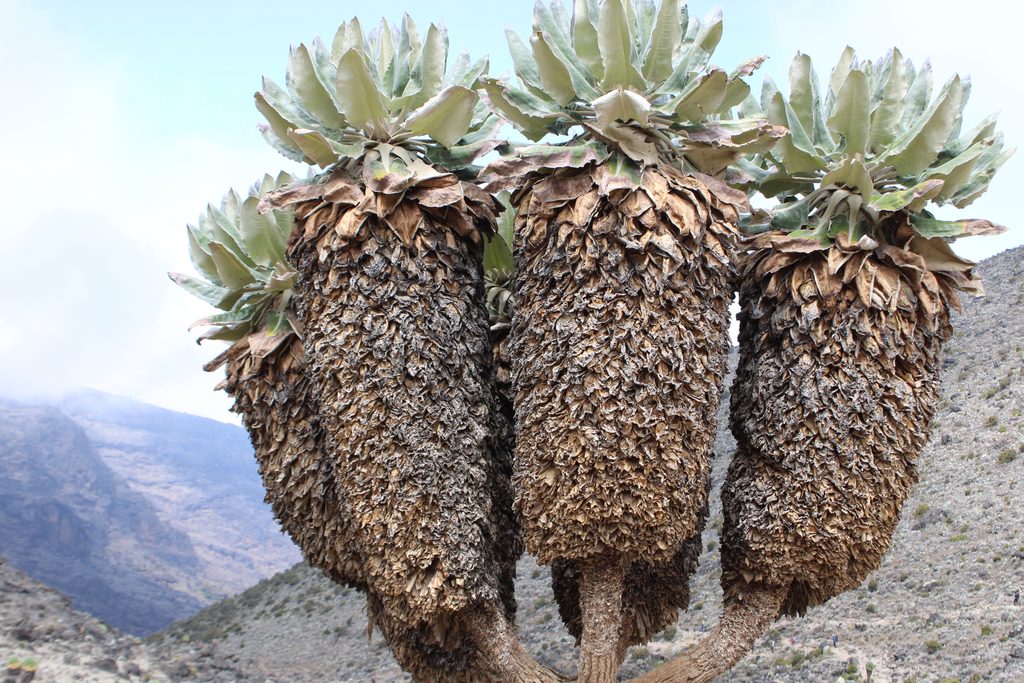
The giant groundsel (Dendrosenecio kilimanjari) is perhaps the most famous plant on Mount Kilimanjaro. Endemic to East Africa’s high mountains, it grows mainly in the Heather and Moorland Zone between 2,800 and 4,000 meters.
Some plants reach heights of 10 meters (33 feet) and can live for many decades. Thick trunks covered with old leaves help insulate the plant against freezing temperatures, while the rosette of leaves protects the growing center from frost.
Its unusual appearance makes it one of the most photographed plants on Kilimanjaro.
Giant Lobelia
The giant lobelia (Lobelia deckenii) is another iconic alpine plant found in Kilimanjaro’s moorlands.
Its broad leaves form a large rosette that collects water during the day. At night, the outer water freezes first, helping protect the inner growing point from frost damage. During flowering, a tall central spike produces hundreds of blue-purple blossoms that attract insects and nectar-feeding birds.
This remarkable adaptation allows the giant lobelia to thrive where few flowering plants can survive.
Yellow Everlasting Flowers
The bright yellow everlasting flowers (Helichrysum species) add vibrant color to Kilimanjaro’s moorlands.
These hardy wildflowers bloom across volcanic slopes and grasslands, often creating golden patches among rocks and shrubs. Their papery flowers retain their shape and color long after blooming, giving them the name “everlasting.”
They tolerate strong sunlight, cold nights, dry conditions, and nutrient-poor volcanic soils, making them perfectly suited to life at high altitude.
Podocarpus Trees
Podocarpus trees are among the tallest native trees in Kilimanjaro’s rainforest.
Some specimens grow more than 40 meters (131 feet) tall, forming part of the dense forest canopy. Their evergreen leaves provide food and shelter for birds, monkeys, insects, and many other forest species.
These ancient conifers grow slowly but can survive for several centuries, making them an important part of the mountain’s ecosystem.
Juniper Trees
The African pencil cedar (Juniperus procera) grows mainly in the upper rainforest and lower heather zones.
Its aromatic wood has long been valued for its durability and resistance to insects. Mature trees develop broad crowns that provide nesting sites for birds and shade for smaller plants beneath them.
Juniper forests also help stabilize volcanic soils and reduce erosion on Kilimanjaro’s steep slopes.
Wild Olive Trees
Wild olive trees (Olea europaea subsp. cuspidata) thrive in the lower montane forests surrounding Mount Kilimanjaro.
These evergreen trees produce small fruits that provide food for birds and mammals. Their dense root systems help hold the volcanic soil together during heavy rains, reducing erosion while supporting healthy forest ecosystems.
Wild olive trees also contribute to the rich diversity of Kilimanjaro’s rainforest.
Tree Ferns
Large tree ferns create a prehistoric atmosphere within the rainforest.
Their graceful fronds spread above moist forest floors, where they thrive in cool, shaded conditions. Unlike flowering plants, tree ferns reproduce through spores rather than seeds, making them part of one of the oldest plant groups on Earth.
Many climbers first notice them along the Machame, Lemosho, and Marangu routes.
Mosses and Lichens
Mosses and lichens grow throughout Mount Kilimanjaro, from the humid rainforest to the harsh alpine desert.
In the rainforest, mosses cover tree trunks, branches, and rocks, helping retain moisture and creating habitats for insects and microorganisms.
Higher on the mountain, lichens become the dominant plant-like organisms. They survive intense ultraviolet radiation, freezing temperatures, and long dry periods by growing directly on volcanic rocks. Their ability to colonize bare rock makes them among the first living organisms to establish themselves in harsh environments.
Wild Orchids
Mount Kilimanjaro’s rainforest supports dozens of wild orchid species, many of which bloom during the rainy seasons.
Some orchids grow in the forest soil, while others attach themselves to tree branches without taking nutrients from the host tree. Their colorful flowers attract bees, butterflies, and other pollinators that play an essential role in maintaining forest biodiversity.
Because many orchid species are small and well camouflaged, they often go unnoticed without the help of an experienced guide.
Protea
The striking protea is another beautiful flowering plant found in Kilimanjaro’s higher elevations.
Its large pink or cream-colored flower heads attract nectar-feeding birds and insects, while its leathery leaves help reduce water loss in the cool, windy climate.
Proteas flower mainly in the Heather and Moorland Zone, adding splashes of color to the volcanic landscape and making them a favorite subject for photographers.
A Living Botanical Journey
One of the most remarkable aspects of climbing Mount Kilimanjaro is watching the vegetation change with every day’s hike. Few places in the world allow you to begin among towering rainforest trees, walk past giant groundsels and lobelias, cross volcanic deserts dotted with lichens, and finish beside glaciers in just a single expedition.
This extraordinary diversity of plants makes Mount Kilimanjaro not only Africa’s highest mountain but also one of the continent’s greatest natural botanical treasures.
Mount Kilimanjaro Wildlife: Animals You May See
Although Mount Kilimanjaro is famous for its glaciers and summit, it is also home to an impressive variety of wildlife. Kilimanjaro National Park protects more than 140 mammal species, making it one of Tanzania’s most important mountain ecosystems. Most wildlife lives in the lower rainforest, where food, water, and shelter are abundant. As you climb higher, the number of animals decreases because temperatures drop, oxygen becomes thinner, and vegetation becomes scarce.
Wildlife sightings are never guaranteed because these are wild animals living in their natural habitat. However, with the help of experienced local guides, many climbers have the opportunity to observe monkeys, antelope, birds, and other fascinating species during their Kilimanjaro adventure.
Blue Monkey
The blue monkey (Cercopithecus mitis) is one of the most commonly seen mammals on Mount Kilimanjaro. Despite its name, its fur appears gray with a slight bluish tint.
Blue monkeys spend most of their lives in the rainforest canopy, feeding on fruits, leaves, flowers, seeds, and insects. They live in family groups and often move quietly through the trees along the Machame, Lemosho, and Marangu routes. Their curious nature sometimes brings them close to trekking trails, making them one of the first wild animals many climbers encounter.
Black-and-White Colobus Monkey
The black-and-white colobus monkey (Colobus guereza) is one of Kilimanjaro’s most striking animals. Its glossy black fur, long white mantle, and flowing white tail create an unforgettable sight as it leaps effortlessly between tall forest trees.
Unlike blue monkeys, colobus monkeys feed mainly on young leaves, flowers, and seeds. Their specialized stomachs allow them to digest tough vegetation that many other primates cannot. They are highly social and usually travel in small family groups high above the forest floor.
Olive Baboon
The olive baboon (Papio anubis) is the largest primate living on Mount Kilimanjaro. These intelligent animals spend much of their time on the ground searching for fruits, roots, grasses, insects, and small animals.
Olive baboons live in large troops with complex social structures. Climbers often see them near park entrances or along lower forest trails. Although they usually avoid people, visitors should never feed or approach them because they remain wild animals.
Bushbuck
The bushbuck (Tragelaphus scriptus) is a shy antelope that prefers dense vegetation within the rainforest.
Its reddish-brown coat, decorated with white stripes and spots, provides excellent camouflage among the forest undergrowth. Bushbucks feed on leaves, shoots, fruits, and grasses, usually becoming active during the early morning and late afternoon. Because they are naturally cautious, sightings are relatively uncommon but always rewarding.
Duiker
Several species of duiker inhabit Mount Kilimanjaro’s forests, including the Harvey’s red duiker and the common duiker.
These small antelopes move quietly through thick vegetation, feeding on leaves, fallen fruit, flowers, and fungi. Their secretive behavior and excellent camouflage make them difficult to spot, but experienced guides occasionally notice them crossing forest trails.
Cape Buffalo
The Cape buffalo (Syncerus caffer) is the largest herbivore regularly found in Kilimanjaro National Park.
Buffalo usually stay in remote forest clearings where they graze on grasses and browse shrubs. Although encounters are uncommon on busy trekking routes, guides remain alert because buffalo are powerful animals that can become defensive if surprised.
If buffalo are nearby, guides maintain a safe distance and may temporarily adjust the group’s route.
Bush Baby
The bush baby, also called a galago, is one of Kilimanjaro’s most fascinating nocturnal mammals.
These small primates have enormous eyes that help them see in the dark and powerful hind legs that allow them to leap several meters between tree branches. Bush babies feed on insects, tree sap, fruit, and nectar.
Because they are active only at night, climbers rarely see them during daytime treks, but they may hear their distinctive calls around forest camps.
Rock Hyrax
The rock hyrax (Procavia capensis) becomes more common as climbers move into the Heather and Moorland and Alpine Desert zones.
Although it looks similar to a large guinea pig, the rock hyrax is surprisingly one of the elephant’s closest living relatives. It shelters among volcanic rocks and feeds on grasses, shrubs, and alpine vegetation.
You may spot hyraxes sunbathing on rocks near camps such as Shira, Barranco, or Lava Tower.
Forest Elephant (Rare)
A small number of African forest elephants (Loxodonta cyclotis) occasionally move through the lower forests of Mount Kilimanjaro.
These elephants are generally smaller than the African savanna elephant and spend most of their lives beneath dense forest cover. They travel along ancient wildlife corridors in search of food and water.
Seeing a forest elephant during a Kilimanjaro climb is extremely rare, but their presence highlights the ecological importance of the mountain’s protected forests.
Leopard (Very Rare)
The African leopard (Panthera pardus) is the most elusive large predator on Mount Kilimanjaro.
Leopards hunt mainly at night and avoid areas with frequent human activity. They use their excellent camouflage and stealth to move unnoticed through the dense rainforest.
Although the famous leopard described in Ernest Hemingway’s The Snows of Kilimanjaro helped make the mountain legendary, modern sightings remain exceptionally rare. Most climbers will never see one, but knowing these magnificent cats still inhabit the mountain adds to Kilimanjaro’s mystery and wilderness.
Wildlife Viewing Tips
If you hope to see wildlife while climbing Mount Kilimanjaro:
- Walk quietly through the rainforest.
- Let your guide know if you are interested in wildlife spotting.
- Bring binoculars for better views of birds and animals.
- Never feed or approach wild animals.
- Keep your camera ready, but avoid using flash near wildlife.
- Respect Kilimanjaro National Park’s conservation rules at all times.
The rainforest offers the greatest chance of seeing wildlife, especially during the early morning when many animals are most active. Every sighting is a reminder that Mount Kilimanjaro is not only Africa’s highest mountain but also one of its richest natural habitats.
Birds of Mount Kilimanjaro
Mount Kilimanjaro is a paradise for birdwatchers. More than 170 bird species have been recorded on the mountain and within Kilimanjaro National Park, ranging from colorful forest birds to hardy species that thrive near Africa’s highest summit. Because Kilimanjaro rises from tropical farmland to glaciers at 5,895 meters (19,341 feet), different birds occupy different elevations according to the climate, vegetation, and food available.
The rainforest hosts the greatest variety of birds, while only a few specially adapted species survive in the alpine desert and near the summit. If you carry a pair of binoculars during your climb, you may spot several remarkable birds that make Kilimanjaro one of East Africa’s best mountain birding destinations.
Hartlaub’s Turaco
The Hartlaub’s turaco (Tauraco hartlaubi) is one of Mount Kilimanjaro’s most beautiful forest birds. Its brilliant green plumage, blue wings, red eye-ring, and long tail make it easy to recognize as it glides through the canopy.
Preferred elevation: 1,800-3,000 meters (5,906-9,843 feet)
Hartlaub’s turaco lives mainly in the Rainforest Zone, where it feeds on wild fruits, berries, flowers, and young leaves. Climbers often hear its loud, distinctive calls before they see it moving through the treetops along the Lemosho, Machame, and Marangu routes.
Malachite Sunbird
The malachite sunbird (Nectarinia famosa) is a dazzling nectar-feeding bird known for its shimmering emerald-green feathers and long curved bill.
Preferred elevation: 2,000-4,000 meters (6,562-13,123 feet)
This species is common in the Rainforest and Heather and Moorland Zones, where it feeds on nectar from giant lobelias, proteas, and other flowering plants. As it moves from flower to flower, it also helps pollinate many of Kilimanjaro’s alpine plants.
White-necked Raven
The white-necked raven (Corvus albicollis) is the highest-flying bird regularly seen on Mount Kilimanjaro. Its glossy black feathers and distinctive white patch around the neck make it easy to identify against the volcanic landscape.
Preferred elevation: 3,500-5,895 meters (11,483-19,341 feet)
Unlike most mountain birds, the white-necked raven thrives in the Alpine Desert and Arctic Summit Zones. Climbers frequently spot these intelligent birds soaring above Barafu Camp, Stella Point, and even Uhuru Peak, where they search for insects and food scraps left by visitors.
Augur Buzzard
The augur buzzard (Buteo augur) is one of Kilimanjaro’s most impressive birds of prey. It has broad wings, a white chest, and a striking chestnut-red tail.
Preferred elevation: 1,500-4,500 meters (4,921-14,764 feet)
This powerful raptor soars over forests, moorlands, and open volcanic slopes, using rising warm air to search for rodents, reptiles, and small birds. It often circles high above valleys, providing climbers with spectacular aerial displays.
Scarlet-tufted Sunbird
The scarlet-tufted sunbird (Cinnyris johnstoni) is one of East Africa’s most remarkable high-altitude birds. Males display brilliant metallic green feathers with vivid scarlet shoulder tufts, while females have more subdued olive coloring.
Preferred elevation: 3,000-4,500 meters (9,843-14,764 feet)
This sunbird specializes in the Heather and Moorland Zone, where it feeds almost exclusively on nectar from giant lobelias. It has evolved to survive freezing nights and cool mountain mornings, making it one of Kilimanjaro’s most specialized bird species.
Birdwatching Tips on Mount Kilimanjaro
To improve your chances of seeing birds during your climb:
- Start looking early in the morning when birds are most active.
- Carry lightweight binoculars.
- Walk quietly through the rainforest.
- Listen for bird calls before searching the trees.
- Ask your local guide to point out species along the trail.
- Bring a camera with a zoom lens if you enjoy wildlife photography.
Birds Across Kilimanjaro’s Ecological Zones
| Bird Species | Preferred Elevation | Main Ecological Zone |
|---|---|---|
| Hartlaub’s Turaco | 1,800-3,000 m | Rainforest |
| Malachite Sunbird | 2,000-4,000 m | Rainforest & Heather/Moorland |
| White-necked Raven | 3,500-5,895 m | Alpine Desert & Arctic Summit |
| Augur Buzzard | 1,500-4,500 m | Rainforest to Alpine Desert |
| Scarlet-tufted Sunbird | 3,000-4,500 m | Heather & Moorland |
From colorful turacos hidden in ancient forests to ravens soaring above glaciers, Mount Kilimanjaro offers an extraordinary birdwatching experience. Each ecological zone supports different species, making every day on the mountain an opportunity to discover new birdlife while climbing Africa’s highest peak.
Rare and Endemic Species of Kilimanjaro
Mount Kilimanjaro is more than Africa’s highest mountain it is also a refuge for rare and endemic species that have evolved to survive in environments found almost nowhere else on Earth. Millions of years of volcanic activity, changing climates, and geographic isolation have allowed unique plants and animals to adapt to the mountain’s forests, moorlands, alpine desert, and summit.
Some species occur only on Kilimanjaro or on a few neighboring mountains in East Africa, while others have developed remarkable adaptations that help them survive freezing nights, strong ultraviolet radiation, low oxygen levels, and limited water. These rare organisms make Kilimanjaro National Park one of the continent’s most valuable conservation areas.
Plants Found Only in East Africa
Several of Kilimanjaro’s most famous plants grow only on the high mountains of East Africa. Their unusual appearance and remarkable survival strategies have fascinated botanists for decades.
The giant groundsel (Dendrosenecio kilimanjari) is one of the mountain’s best-known endemic plants. It grows mainly on Kilimanjaro and a few nearby East African peaks. Thick stems, rosettes of leaves, and layers of old foliage help protect it from freezing nighttime temperatures.
Another extraordinary species is the giant lobelia (Lobelia deckenii), which thrives in the Heather and Moorland Zone. Its leaf rosette stores water during the day, while the outer layers freeze first at night, protecting the plant’s growing center from frost damage.
The mountain also supports endemic everlasting flowers (Helichrysum species), alpine grasses, mosses, and lichens that have evolved to survive intense sunlight, strong winds, and volcanic soils. Together, these plants create one of Africa’s most distinctive alpine landscapes.
Animals Adapted to High Altitude
Although fewer animals live at high elevations than in the rainforest, several species have adapted remarkably well to Kilimanjaro’s harsh mountain environment.
The scarlet-tufted sunbird feeds on nectar from giant lobelias and survives freezing nights in the Heather and Moorland Zone. Its long curved bill perfectly matches the flowers it pollinates, showing how plants and animals have evolved together.
The white-necked raven regularly flies above 5,000 meters, making it one of the highest-flying birds in Africa. Its intelligence and ability to survive in thin air allow it to thrive near the summit where few other birds can live.
The rock hyrax, despite its small size, tolerates dramatic temperature changes by sheltering among volcanic rocks during cold nights and warming itself in the morning sun.
Even tiny organisms have adapted to Kilimanjaro’s extreme conditions. Scientists have discovered bacteria, algae, fungi, and other microorganisms living within glacier ice and on exposed volcanic rocks near the summit. These microscopic forms of life continue to help researchers understand how organisms survive in some of Earth’s harshest environments.
Why Endemic Species Matter
Endemic species are important because they exist in only one region or a small part of the world. If they disappear from their natural habitat, they may disappear forever.
The unique plants and animals of Mount Kilimanjaro help maintain healthy ecosystems by pollinating flowers, dispersing seeds, recycling nutrients, protecting soils, and supporting food webs. They also provide scientists with valuable insights into evolution, climate adaptation, and biodiversity.
However, many endemic species face growing challenges from climate change, habitat loss around the mountain, invasive species, and increasing human pressure. Protecting Kilimanjaro National Park helps safeguard these remarkable organisms and preserves one of Africa’s greatest natural treasures for future generations.
For climbers, encountering these rare species is one of the most rewarding parts of the journey. They remind us that Mount Kilimanjaro is not only a world-famous trekking destination but also a living laboratory of evolution, where life has adapted in extraordinary ways over millions of years.
How Flora Changes as You Climb Kilimanjaro
One of the most fascinating parts of climbing Mount Kilimanjaro is watching the vegetation and wildlife change with every increase in altitude. During a typical 6- to 9-day trek, you pass through five ecological zones, each with its own climate, plants, and animals. As temperatures become colder and oxygen levels decrease, tropical forests gradually give way to giant alpine plants, volcanic deserts, and finally glaciers at the summit.
This rapid transition makes Kilimanjaro one of the few places on Earth where you can experience ecosystems that resemble the tropics, temperate regions, and the Arctic on a single mountain.
| Ecological Zone | Elevation | Average Temperature | Common Plants | Wildlife You May See |
|---|---|---|---|---|
| Cultivation Zone | 800-1,800 m (2,625-5,906 ft) | 20-30°C (68-86°F) | Coffee plants, banana trees, maize, avocado trees, shade trees | Sunbirds, weaver birds, butterflies, chameleons, domestic animals |
| Rainforest Zone | 1,800-2,800 m (5,906-9,186 ft) | 12-20°C (54-68°F) | Podocarpus trees, wild olive trees, juniper, tree ferns, orchids, mosses | Blue monkeys, black-and-white colobus monkeys, olive baboons, bushbuck, duiker, Cape buffalo, rare forest elephants, many bird species |
| Heather & Moorland Zone | 2,800-4,000 m (9,186-13,123 ft) | 5-15°C (41-59°F) | Giant groundsel, giant lobelia, tree heather, protea, everlasting flowers | Scarlet-tufted sunbird, malachite sunbird, rock hyrax, insects |
| Alpine Desert Zone | 4,000-5,000 m (13,123-16,404 ft) | -5°C to 10°C (23-50°F) | Lichens, mosses, alpine grasses | White-necked raven, rock hyrax, beetles, spiders, a few insects |
| Arctic Summit Zone | Above 5,000 m (16,404-19,341 ft) | -20°C to -5°C (-4-23°F) | Very little vegetation, lichens, microscopic algae and bacteria | Occasional white-necked raven, microorganisms, very little visible wildlife |
A Journey Through Five Worlds
Few mountains on Earth offer such dramatic ecological diversity. In less than a week, you can walk from tropical coffee farms and lush rainforest to giant alpine plants, cross a volcanic desert, and stand among glaciers and snow at Uhuru Peak (5,895 meters / 19,341 feet). Every ecological zone introduces new plants, animals, and landscapes, making the climb as rewarding for nature lovers as it is for summit seekers.
Best Routes for Seeing Kilimanjaro Flora and Fauna
Every Kilimanjaro route passes through different ecological zones, but some offer better opportunities to experience the mountain’s remarkable biodiversity than others. The route you choose can influence the wildlife you see, the forests you walk through, and the variety of plants you encounter.
If your goal is more than reaching Uhuru Peak, consider a route that allows you to spend more time exploring Kilimanjaro’s unique ecosystems. Longer itineraries generally provide more opportunities to observe wildlife, identify alpine plants, and enjoy changing landscapes.
Lemosho Route – Best for Wildlife
The Lemosho Route offers the best overall wildlife experience on Mount Kilimanjaro. It begins on the quiet western side of the mountain, where the rainforest receives fewer visitors and wildlife often feels less disturbed.
During the first two days, climbers may see blue monkeys, black-and-white colobus monkeys, olive baboons, bushbucks, colorful butterflies, and numerous bird species. Although sightings of Cape buffalo, forest elephants, and leopards remain very rare, this route passes through habitat where these animals occasionally occur.
As the trail climbs into the Heather and Moorland Zone, giant groundsels, giant lobelias, everlasting flowers, and scarlet-tufted sunbirds become common.
Best for:
- Wildlife photography
- Birdwatching
- Giant alpine plants
- Scenic ecological transitions
Machame Route – Best Rainforest Experience
Known as the Whiskey Route, the Machame Route provides one of Kilimanjaro’s finest rainforest experiences.
The trail winds beneath towering Podocarpus and wild olive trees draped with mosses and lichens. Ferns line the forest floor, while orchids bloom during the rainy seasons.
Blue monkeys, colobus monkeys, olive baboons, Hartlaub’s turacos, and many forest birds frequently appear along the lower sections. Because the rainforest remains lush throughout much of the year, Machame is an excellent choice for climbers who enjoy tropical vegetation.
Best for:
- Dense rainforest
- Ancient trees
- Ferns and orchids
- Forest birds and monkeys
Rongai Route – Best Chance of Seeing Large Mammals
The Rongai Route approaches Mount Kilimanjaro from the quieter northern side near the Kenya border.
This less-traveled route passes through remote forests and open woodland where wildlife experiences less human disturbance. While sightings are never guaranteed, climbers have a better chance of seeing bushbucks, duikers, Cape buffalo, and occasionally signs of forest elephants in the surrounding habitats.
The route also offers excellent opportunities to observe birds and alpine vegetation as it climbs toward the summit.
Best for:
- Large mammals
- Quiet forests
- Birdwatching
- Remote wilderness
Northern Circuit – Best Overall Biodiversity
The Northern Circuit Route is the longest route on Mount Kilimanjaro and provides the greatest variety of ecosystems.
Because climbers spend more days on the mountain and circle around the northern slopes, they experience nearly every ecological zone in greater detail. From rainforest and moorland to alpine desert and glaciers, this route showcases Kilimanjaro’s extraordinary biodiversity better than any other itinerary.
The extended schedule also increases opportunities to spot wildlife, observe endemic plants, and photograph changing landscapes.
Best for:
- Five ecological zones
- Maximum plant diversity
- Birdwatching
- Nature photography
- Comprehensive biodiversity experience
Marangu Route – Best Forest Access
The Marangu Route, often called the Coca-Cola Route, offers excellent access to Kilimanjaro’s rainforest.
The trail begins beneath a dense canopy filled with towering trees, mosses, orchids, and tree ferns. Climbers commonly encounter blue monkeys, black-and-white colobus monkeys, olive baboons, and a wide variety of forest birds during the early stages of the climb.
Unlike the camping routes, Marangu uses mountain huts, making it an attractive option for climbers who prefer indoor accommodation while still enjoying the rainforest’s rich biodiversity.
Best for:
- Easy rainforest access
- Tropical vegetation
- Forest wildlife
- Comfortable hut accommodation
Which Route Is Best for Nature Lovers?
If your main goal is to experience Mount Kilimanjaro’s flora and fauna, the Northern Circuit and Lemosho Route are the strongest choices.
The Northern Circuit offers the greatest biodiversity because it spends more time crossing different ecological zones, while the Lemosho Route provides outstanding wildlife viewing, spectacular scenery, and an excellent introduction to Kilimanjaro’s unique plants and animals.
Regardless of the route you choose, every Kilimanjaro climb takes you through one of Africa’s most remarkable natural environments, where tropical rainforest, alpine plants, volcanic landscapes, and glaciers combine to create an unforgettable ecological journey.
Best Time to See Wildlife and Flowers
Mount Kilimanjaro offers incredible opportunities to observe wildlife and flowering plants throughout the year, but the experience changes with the seasons. Rainfall, sunshine, and temperature influence animal activity, bird migration, and the blooming of wildflowers. Choosing the right season can greatly enhance your wildlife photography, birdwatching, and botanical experience.
Dry Season
The dry seasons are widely considered the best time to explore Mount Kilimanjaro’s flora and fauna.
- January to early March
- June to October
These months bring clearer skies, less rainfall, and better visibility along the trails. Wildlife is often easier to spot because animals remain active around forest paths and open areas. The stable weather also provides excellent conditions for photography, allowing climbers to capture panoramic landscapes and colorful vegetation.
The dry season is especially recommended for visitors interested in:
- Wildlife photography
- Scenic mountain views
- Birdwatching
- Comfortable trekking conditions
Green Season
The green season, which usually occurs from March to May and November to early December, transforms Kilimanjaro into a lush tropical paradise.
Frequent rain encourages rapid plant growth, and the rainforest becomes greener than at any other time of year. Mosses glow with vibrant color, waterfalls become more powerful, and many wild orchids begin to bloom.
Although trails can be muddy and clouds may reduce visibility, the mountain looks exceptionally beautiful. Fewer climbers also mean a quieter experience and more opportunities to enjoy nature without crowds.
The green season is ideal for:
- Botanical enthusiasts
- Landscape photographers
- Nature lovers
- Travelers seeking quieter trails
Birdwatching Season
Birdwatching on Mount Kilimanjaro is rewarding throughout the year, but it reaches its peak between November and April.
During these months, many resident birds are actively breeding, while several migratory species from Europe and Asia visit Tanzania. Forests become especially lively with colorful birds such as:
- Hartlaub’s turaco
- Malachite sunbird
- Scarlet-tufted sunbird
- White-necked raven
- Augur buzzard
- Hornbills, robins, and flycatchers
Early mornings offer the best birdwatching opportunities, when birds are most active and vocal.
Flowering Season
If your goal is to see Mount Kilimanjaro covered in colorful flowers, the best period is December through March, with another flowering period following the short rains in November and December.
During these months, climbers may see:
- Giant lobelias producing tall flower spikes
- Bright yellow everlasting flowers covering alpine slopes
- Wild orchids blooming in the rainforest
- Proteas flowering in the Heather and Moorland Zone
- Numerous rainforest shrubs and wildflowers in full bloom
The combination of fresh green vegetation, flowering plants, and clear mountain views creates some of the most photogenic landscapes on Kilimanjaro.
Best Season by Interest
| Interest | Best Time |
|---|---|
| Wildlife viewing | January-March, June-October |
| Birdwatching | November-April |
| Wildflowers and orchids | December-March |
| Giant groundsels and giant lobelias | Visible year-round |
| Rainforest scenery | Marc-May, November |
| Photography | January-March, June-October |
Whether you climb during the dry or green season, Mount Kilimanjaro offers extraordinary natural beauty. Every month reveals something unique from flowering alpine plants and colorful birds to playful monkeys in the rainforest and breathtaking landscapes stretching from tropical forests to glaciers at Africa’s highest summit.
Conservation of Mount Kilimanjaro’s Flora and Fauna
Mount Kilimanjaro’s extraordinary biodiversity faces increasing pressure from climate change, habitat loss, invasive species, and growing tourism. Protecting the mountain’s ecosystems requires the combined efforts of conservation organizations, local communities, scientists, guides, and responsible visitors.
Today, Kilimanjaro National Park plays a crucial role in safeguarding one of Africa’s most valuable natural landscapes, ensuring that its unique plants and wildlife survive for future generations.
Kilimanjaro National Park
Established in 1973, Kilimanjaro National Park protects approximately 1,688 square kilometers (652 square miles) of forests, moorlands, alpine deserts, and the mountain’s famous glaciers.
The park provides a safe habitat for hundreds of plant species and more than 140 mammal species, including blue monkeys, black-and-white colobus monkeys, Cape buffalo, bushbuck, and numerous bird species. Rangers patrol the park to prevent illegal logging, poaching, wildfires, and other threats to wildlife.
The park also supports scientific research, environmental education, and sustainable tourism while helping protect the mountain’s vital water catchment forests.
UNESCO World Heritage Site
In 1987, Mount Kilimanjaro was designated a UNESCO World Heritage Site because of its outstanding natural value.
UNESCO recognized Kilimanjaro for its exceptional biodiversity, spectacular volcanic landscapes, unique ecological zones, and globally important glaciers. From tropical rainforest to Arctic summit, the mountain contains an extraordinary range of ecosystems found on very few mountains worldwide.
This international recognition encourages stronger conservation efforts and highlights Kilimanjaro as one of Earth’s most important natural treasures.
Climate Change
Climate change is one of the greatest long-term challenges facing Mount Kilimanjaro.
Scientists have documented significant changes in the mountain’s glaciers and snow cover over the past century. Shifts in temperature, snowfall, cloud cover, humidity, and ice sublimation have contributed to the shrinking of Kilimanjaro’s ice fields. Changes in rainfall patterns may also affect forest ecosystems and the plants and animals that depend on them.
Researchers continue to study how these environmental changes influence biodiversity across the mountain’s five ecological zones and how species may adapt in the future.
Invasive Species
Invasive plants and animals can threaten Kilimanjaro’s native ecosystems by competing with indigenous species for sunlight, water, nutrients, and habitat.
Non-native plants introduced outside the park may spread into natural habitats if not carefully managed. Invasive insects and plant diseases can also affect forest health and reduce biodiversity.
Park authorities monitor these threats through ecological surveys, habitat restoration projects, and ongoing scientific research to protect native species.
Responsible Tourism
Every climber can help protect Mount Kilimanjaro’s unique flora and fauna by practicing responsible tourism.
Simple actions make a significant difference:
- Stay on designated trails to avoid damaging fragile vegetation.
- Never pick flowers or remove plants, rocks, or natural souvenirs.
- Observe wildlife from a safe distance without feeding or disturbing animals.
- Carry out all litter and minimize waste during your climb.
- Use reusable water bottles instead of single-use plastics.
- Support ethical local tour operators that follow environmental regulations and treat guides and porters responsibly.
- Respect all rules established by Kilimanjaro National Park.
Responsible tourism helps preserve the mountain’s ecosystems while ensuring future generations can continue to experience its remarkable wildlife, rare plants, and breathtaking landscapes.
Protecting Mount Kilimanjaro is a shared responsibility. Every visitor who respects the mountain contributes to conserving one of Africa’s richest biodiversity hotspots and one of the world’s most iconic natural wonders.
Fascinating Facts About Kilimanjaro Flora and Fauna
Mount Kilimanjaro is full of natural wonders that surprise even experienced climbers. From giant plants that withstand freezing nights to birds soaring above glaciers, the mountain’s flora and fauna have evolved remarkable ways to survive. These fascinating facts reveal why Kilimanjaro is considered one of Africa’s most extraordinary biodiversity hotspots.
Giant Groundsels Can Live for Decades
The iconic giant groundsel (Dendrosenecio kilimanjari) is one of Mount Kilimanjaro’s most recognizable plants. Some individuals can live for several decades while growing up to 10 meters (33 feet) tall. Their trunks remain wrapped in dead leaves, creating natural insulation that protects the plant from freezing nighttime temperatures.
Kilimanjaro Has Five Ecological Zones
Few mountains on Earth offer such dramatic ecological diversity. During a single climb, you pass through five distinct ecological zones:
- Cultivation Zone
- Rainforest Zone
- Heather and Moorland Zone
- Alpine Desert Zone
- Arctic Summit Zone
Each zone has its own climate, vegetation, wildlife, and breathtaking scenery, making every day of the climb feel like a completely different world.
Some Plants Survive Freezing Nights and Intense Daytime Sun
The plants growing above 3,000 meters (9,843 feet) face extreme conditions. Temperatures often fall below freezing at night but can become surprisingly warm under the strong equatorial sun during the day.
Species such as giant groundsels, giant lobelias, and everlasting flowers have developed unique adaptations that allow them to store water, reduce heat loss, and survive dramatic daily temperature changes.
White-Necked Ravens Are Common Near the Summit
Many climbers are surprised to see white-necked ravens flying close to Stella Point, Uhuru Peak, and Kibo Crater.
These intelligent birds are among the few animals that regularly inhabit Kilimanjaro’s Alpine Desert and Arctic Summit Zone. They use powerful air currents to glide effortlessly above Africa’s highest mountain while searching for insects and food.
Forest Elephants Occasionally Enter the Mountain Forests
Although rarely seen, African forest elephants sometimes move through the lower forests of Mount Kilimanjaro.
These shy elephants travel along ancient wildlife corridors connecting Kilimanjaro with surrounding protected areas. Their presence highlights the importance of conserving the mountain’s rainforest, which provides food, water, and shelter for many large mammals.
Giant Lobelias Store Water to Survive Freezing Temperatures
The remarkable giant lobelia (Lobelia deckenii) has evolved one of the mountain’s most effective survival strategies.
Its large rosette of leaves stores rainwater during the day. When temperatures drop below freezing at night, the outer water freezes first, helping protect the plant’s growing center from frost damage. This natural adaptation allows giant lobelias to thrive where many other flowering plants could not survive.
You Can Walk from Rainforest to an Arctic-Like Summit in Less Than a Week
One of Kilimanjaro’s greatest natural wonders is its extraordinary ecological journey.
In just 6 to 9 days, climbers can walk from tropical coffee farms and lush rainforest through alpine meadows and volcanic deserts before reaching a summit covered with glaciers and seasonal snow. Very few places in the world offer such a rapid transition through climates that resemble the tropics, temperate regions, and the Arctic on a single mountain.
Bonus Facts About Kilimanjaro’s Flora and Fauna
- More than 2,500 plant species have been recorded on and around Mount Kilimanjaro.
- Over 140 mammal species inhabit the mountain’s forests and surrounding ecosystems.
- More than 170 bird species have been identified in Kilimanjaro National Park.
- The Rainforest Zone contains the greatest concentration of wildlife on the mountain.
- The Northern Circuit Route offers the widest variety of ecological zones during a single climb.
- Kilimanjaro’s giant groundsels and giant lobelias are among the world’s most famous examples of giant alpine plants.
- Scientists continue studying microorganisms that survive in the mountain’s glaciers and volcanic rocks, helping us understand life in extreme environments.
These remarkable facts demonstrate that Mount Kilimanjaro is much more than Africa’s highest peak. It is a living natural laboratory where rare plants, unique wildlife, and extraordinary ecosystems have evolved over millions of years, making every climb an unforgettable journey through one of the world’s most diverse mountain environments.
Frequently Asked Questions
Mount Kilimanjaro is home to more than 140 mammal species, including blue monkeys, black-and-white colobus monkeys, olive baboons, bushbucks, duikers, Cape buffalo, rock hyraxes, and many bird species. Forest elephants and leopards also occur but are rarely seen.
Yes. Small numbers of African forest elephants occasionally move through the lower forests of Kilimanjaro National Park, although sightings are uncommon.
No. Lions do not live on Mount Kilimanjaro. They prefer open savannas and grasslands rather than high mountain forests.
Yes. Most wildlife sightings occur in the Rainforest Zone, where climbers often see monkeys, birds, antelope, and colorful butterflies.
The giant groundsel (Dendrosenecio kilimanjari) is Kilimanjaro’s most famous plant because of its impressive size and unique adaptation to freezing temperatures.
They protect themselves from frost by keeping old leaves around their trunks, creating natural insulation against cold nights.
Mount Kilimanjaro has five ecological zones: Cultivation, Rainforest, Heather and Moorland, Alpine Desert, and Arctic Summit.
Common species include Hartlaub’s turaco, malachite sunbird, scarlet-tufted sunbird, augur buzzard, and white-necked raven.
Yes. It protects thousands of plant species, abundant wildlife, diverse birdlife, and ecosystems ranging from tropical rainforest to glaciers.
Flora refers to all plant life, while fauna refers to all animal life living in a particular region.
Conclusion
Mount Kilimanjaro’s flora and fauna make Africa’s highest mountain one of the most biologically diverse trekking destinations in the world. From coffee farms and ancient rainforests to giant groundsels, colorful sunbirds, volcanic deserts, and glaciers near the summit, every ecological zone reveals a new landscape filled with remarkable plants and wildlife.
Whether you hope to photograph black-and-white colobus monkeys, admire towering giant lobelias, spot a white-necked raven soaring above the alpine desert, or simply experience the dramatic transition from tropical forest to an Arctic-like summit, Kilimanjaro offers an unforgettable journey through nature. Few mountains allow you to witness such incredible biodiversity in just a few days.
At WeWild Travel, our experienced local guides help you discover much more than the summit. They share their knowledge of Kilimanjaro’s unique ecosystems, identify wildlife and endemic plants along the trail, and ensure you enjoy a safe, responsible, and memorable climbing experience.
If you’re ready to explore the extraordinary flora and fauna of Mount Kilimanjaro, contact WeWild Travel to choose the best route for wildlife viewing, birdwatching, and botanical discoveries. Your adventure to Africa’s highest peak is also a journey through one of the continent’s greatest natural treasures.