Lava Tower Kilimanjaro Guide: Altitude, Difficulty, Routes, Hiking Experience & Volcanic History
Estimated reading time: 36 minutes
Lava Tower Kilimanjaro is a massive volcanic rock formation located at approximately 4,600 meters (15,092 feet) on Mount Kilimanjaro. Known as one of the mountain’s most important acclimatization points, Lava Tower helps climbers prepare their bodies for the high-altitude summit environment. Most trekkers visit Lava Tower on the Lemosho, Machame, and Northern Circuit routes before descending to lower camps such as Barranco Camp.
This ancient volcanic plug offers more than just a challenging hiking point. It represents Kilimanjaro’s powerful volcanic history and gives climbers dramatic views of the Alpine Desert, Kibo Peak, glaciers, and surrounding landscapes.
For many hikers, reaching Lava Tower becomes one of the most memorable moments of their Kilimanjaro journey. The trail climbs gradually from the Shira Plateau into a dry volcanic landscape where vegetation becomes rare, temperatures drop, and the effects of altitude become noticeable.
The main purpose of visiting Lava Tower is not only sightseeing but also acclimatization. Climbers follow the “climb high, sleep low” principle by reaching this high elevation during the day before descending to sleep at a lower camp. This process helps the body adjust to reduced oxygen levels before the final summit attempt.
Whether you are researching Lava Tower Kilimanjaro altitude, wondering about Lava Tower difficulty, planning a Lemosho Route itinerary, or simply interested in Kilimanjaro’s volcanic history, this guide explains everything you need to know about this iconic landmark.
Table of contents
- Lava Tower Kilimanjaro Guide: Altitude, Difficulty, Routes, Hiking Experience & Volcanic History
- What Is Lava Tower on Kilimanjaro?
- The Geological History of Lava Tower: Kilimanjaro’s Giant Volcanic Plug
- Lava Tower Altitude: Why 4,600 Meters Matters
- Why Is Lava Tower Important for Kilimanjaro Acclimatization?
- Lava Tower on Different Kilimanjaro Routes
- Lava Tower Kilimanjaro Day Experience: What Actually Happens?
- Can You Climb Lava Tower?
- Lava Tower Camp Kilimanjaro: Can You Sleep There?
- What Does Lava Tower Look Like?
- Best Time to Visit Lava Tower
- Is Lava Tower Dangerous?
- Fascinating Facts About Lava Tower Kilimanjaro
- Frequently Asked Questions About Lava Tower Kilimanjaro
- Conclusion: Why Lava Tower Is One of Kilimanjaro’s Most Important Landmarks
- Read Also:
What Is Lava Tower on Kilimanjaro?
Lava Tower is a massive volcanic rock formation on Mount Kilimanjaro located at approximately 4,600 meters (15,092 feet) above sea level. This iconic landmark sits on the southern side of Kibo Volcano and serves as one of the most important acclimatization points for climbers preparing for the summit.
Unlike a normal mountain camp, Lava Tower is mainly used as a daytime stopping point where trekkers experience high altitude before descending to lower sleeping camps. This follows the proven acclimatization strategy known as “climb high, sleep low.”
Most climbers visit Lava Tower during the Lemosho Route, Machame Route, and Northern Circuit Route. After reaching this high volcanic formation, many itineraries continue down toward Barranco Camp, allowing the body to adjust before climbing higher toward Barafu Camp and Uhuru Peak.
Where Is Lava Tower Located?
Lava Tower is located on the southern side of Kibo, the largest volcanic cone of Mount Kilimanjaro. It stands along the route between the Shira Plateau and the Barranco Valley, making it an important landmark on several popular trekking routes.
The tower rises above the surrounding Alpine Desert Zone, where the landscape changes dramatically from vegetation-covered slopes to rocky volcanic terrain. From Lava Tower, climbers can enjoy views of Kibo’s summit glaciers, volcanic cliffs, and the wide landscapes below.
How High Is Lava Tower?
Lava Tower stands at approximately 4,600 meters (15,092 feet) above sea level.
At this elevation:
- Oxygen levels are significantly lower than at sea level.
- Climbers may begin feeling the effects of altitude.
- Temperatures become colder, especially with wind.
- Physical movement requires more energy.
Although Lava Tower is not the highest point on Kilimanjaro, reaching this elevation provides valuable preparation for the final summit climb to Uhuru Peak at 5,895 meters (19,341 feet).
Why Is Lava Tower Important for Climbers?
Lava Tower is important because it helps climbers acclimatize safely before reaching higher elevations.
During a typical climbing day, trekkers ascend to Lava Tower, spend time resting and eating lunch, then descend to a lower camp. This exposure helps the body adapt to thinner air and prepares climbers for the challenges ahead.
Lava Tower also allows guides to monitor how climbers respond to altitude. If someone develops early symptoms of altitude sickness, the guide can assess their condition and make the safest decision before the climb continues.
Beyond acclimatization, Lava Tower is also one of Kilimanjaro’s most impressive geological features. Its towering volcanic structure tells the story of the mountain’s ancient volcanic activity and reminds climbers of the powerful forces that created Africa’s highest peak.
The Geological History of Lava Tower: Kilimanjaro’s Giant Volcanic Plug
Lava Tower is one of the oldest and most fascinating geological landmarks on Mount Kilimanjaro. Rising to approximately 4,600 meters (15,092 feet), this towering rock formation is not an ordinary mountain peak. It is an ancient volcanic plug that formed hundreds of thousands of years ago during the volcanic activity that built Kibo, Kilimanjaro’s highest volcanic cone.
Today, Lava Tower stands alone above the surrounding Alpine Desert because the softer volcanic rock around it gradually eroded away, leaving behind a solid core of hardened magma. For climbers, it is an unforgettable landmark. For geologists, it provides a remarkable window into the volcanic history of Africa’s highest mountain.
How Lava Tower Formed
Millions of years ago, Mount Kilimanjaro was an active volcano with repeated eruptions that sent lava and ash across the landscape. During one eruption, molten magma rose through a narrow volcanic vent beneath the surface but cooled and solidified before it could fully erupt.
As this magma cooled, it formed an extremely hard column of volcanic rock inside the vent. Over thousands of years, additional eruptions covered the area with lava flows, ash, and volcanic debris.
Long after Kilimanjaro became dormant, natural forces such as rain, wind, temperature changes, and ice slowly wore away the softer surrounding rock. Because the hardened magma was much more resistant to erosion, it remained standing while the weaker volcanic material disappeared.
The result is the impressive rock formation known today as Lava Tower.
Lava Tower as a Volcanic Plug
Lava Tower is a classic example of a volcanic plug, also called a volcanic neck.
A volcanic plug forms when magma hardens inside the central vent or conduit of a volcano. Instead of flowing out as lava, the magma cools beneath the surface and becomes solid rock.
After thousands or even millions of years, erosion removes the softer rocks surrounding the hardened magma. What remains is a steep, isolated rock tower rising above the landscape.
Lava Tower is composed of dense volcanic rock that has resisted erosion far better than the surrounding lava flows and ash deposits. This natural process explains why it appears as a giant stone pillar in the middle of Kilimanjaro’s Alpine Desert.
The Relationship Between Lava Tower and Kibo Volcano
Lava Tower is closely connected to Kibo Volcano, the highest and youngest of Mount Kilimanjaro’s three volcanic cones.
Kibo, Mawenzi, and Shira formed during different stages of volcanic activity over the past one million years. Lava Tower developed during Kibo’s active volcanic period, when magma repeatedly rose beneath the mountain.
Although Kibo is now considered a dormant volcano, evidence of geothermal activity still exists inside Kibo Crater, where fumaroles release warm volcanic gases. Lava Tower remains one of the best-preserved reminders of the powerful eruptions that shaped the mountain thousands of years ago.
Today, climbers passing Lava Tower walk through a landscape created by the same volcanic forces that built Africa’s highest peak.
Why Lava Tower Survived Millions of Years of Erosion
One of the most remarkable features of Lava Tower is its ability to withstand the forces of nature for an incredibly long time.
The surrounding volcanic ash, loose lava, and softer rock gradually broke down through weathering and erosion caused by:
- Rainfall
- Wind
- Freezing and thawing
- Temperature changes
- Gravity
However, the hardened magma inside the volcanic vent was much stronger than the surrounding material. As erosion continued, the softer rock disappeared while the resistant volcanic core remained standing.
This natural process transformed an underground magma column into the towering landmark seen by climbers today.
Lava Tower is therefore much more than a scenic stop on the trail. It is a geological monument that tells the story of Kilimanjaro’s volcanic birth and the immense natural forces that have shaped the mountain over hundreds of thousands of years. Standing beneath this ancient volcanic plug gives climbers a rare opportunity to witness one of the most impressive geological formations on Mount Kilimanjaro.
Lava Tower Altitude: Why 4,600 Meters Matters
Lava Tower stands at approximately 4,600 meters (15,092 feet) above sea level, making it one of the most important acclimatization points on Mount Kilimanjaro. While the altitude itself is impressive, what truly matters is how your body responds to the thinner air. At this elevation, oxygen becomes less available, breathing feels more difficult, and many climbers begin to notice the first effects of high altitude.
For this reason, experienced Kilimanjaro guides do not take climbers to Lava Tower simply to admire the scenery. They bring them here to help their bodies adapt before continuing to higher camps and, ultimately, Uhuru Peak.
Oxygen Level Compared with Sea Level
One of the biggest changes at Lava Tower is the reduction in available oxygen.
Although the atmosphere still contains about 21% oxygen, the air pressure is much lower than at sea level. This means every breath delivers fewer oxygen molecules to your lungs and bloodstream.
At approximately 4,600 meters, the atmospheric pressure is only about 58-60% of sea-level pressure. As a result, your body receives significantly less oxygen with each breath, forcing your heart and lungs to work harder.
This explains why even simple activities such as walking uphill, talking, or putting on a backpack can feel surprisingly tiring.
Why Climbers Feel Altitude Effects
Many climbers notice the effects of altitude for the first time at Lava Tower.
Common symptoms include:
- Mild headache
- Shortness of breath
- Faster heartbeat
- Fatigue
- Dizziness
- Loss of appetite
- Mild nausea
These symptoms often indicate that the body is adjusting to lower oxygen levels. They are usually mild and improve with proper acclimatization, hydration, and rest.
However, guides carefully monitor every climber because altitude sickness can worsen if ignored. If symptoms become severe or continue to progress, descending to a lower altitude is the safest treatment.
Why Guides Bring Climbers Here for Acclimatization
Lava Tower is famous because it supports one of Kilimanjaro’s most effective acclimatization strategies: “Climb High, Sleep Low.”
During a typical itinerary, climbers hike from Shira Camp to Lava Tower, spending time at 4,600 meters before descending to Barranco Camp, which lies about 650 meters lower.
This approach allows the body to experience high altitude during the day while recovering and sleeping at a lower elevation. As a result, climbers gradually produce more red blood cells, improve oxygen transport, and adapt more effectively to the thin mountain air.
Research and decades of guiding experience show that this strategy significantly improves summit success rates while reducing the risk of altitude sickness.
Experienced local guides also use the stop at Lava Tower to:
- Check each climber’s physical condition.
- Monitor symptoms of altitude sickness.
- Encourage hydration and regular nutrition.
- Adjust the climbing pace if necessary.
- Decide whether it is safe to continue the expedition.
Elevation Comparison on Mount Kilimanjaro
| Location | Elevation |
|---|---|
| Moshi | 900 m (2,953 ft) |
| Shira Camp | 3,600 m (11,811 ft) |
| Lava Tower | 4,600 m (15,092 ft) |
| Barafu Camp | 4,673 m (15,331 ft) |
| Uhuru Peak | 5,895 m (19,341 ft) |
Why 4,600 Meters Is a Turning Point
For many climbers, Lava Tower marks the point where Kilimanjaro becomes a true high-altitude expedition. The landscape changes into an exposed alpine desert, the air becomes noticeably thinner, and every step requires more effort.
Although reaching Lava Tower can feel challenging, it plays a vital role in preparing your body for the final climb to Uhuru Peak. By following the guidance of experienced local guides, maintaining a slow “pole pole” pace, drinking plenty of water, and allowing your body time to acclimatize, you greatly increase your chances of reaching the summit safely and successfully.
Why Is Lava Tower Important for Kilimanjaro Acclimatization?
Lava Tower is one of the most important acclimatization points on Mount Kilimanjaro. At approximately 4,600 meters (15,092 feet), it allows climbers to safely expose their bodies to high altitude before descending to sleep at a lower elevation. This strategy significantly improves the body’s ability to cope with reduced oxygen levels and increases the chances of reaching Uhuru Peak successfully.
Many experienced guides consider the Lava Tower day one of the most valuable parts of the climb. While the scenery is spectacular, the main purpose is to help your body adapt to altitude in a controlled and safe way.
The “Climb High, Sleep Low” Principle
The success of many Kilimanjaro expeditions depends on the “Climb High, Sleep Low” principle.
Instead of sleeping at the highest point reached during the day, climbers first hike to a higher elevation to stimulate acclimatization and then descend to a lower camp for the night.
A typical itinerary looks like this:
- Start at Shira Camp (3,600 m / 11,811 ft)
- Climb to Lava Tower (4,600 m / 15,092 ft)
- Descend to Barranco Camp (3,950 m / 12,959 ft)
This method gives your body time to experience thinner air while allowing it to recover overnight at a safer altitude.
Scientific research and decades of guiding experience show that this approach greatly improves summit success rates and reduces the likelihood of serious altitude illness.
How Lava Tower Prepares Your Body for the Summit
At 4,600 meters, the amount of oxygen available in every breath is much lower than at sea level. To cope with this change, your body begins making several natural adjustments.
During acclimatization, your body:
- Breathes faster to take in more oxygen.
- Increases heart rate to deliver oxygen more efficiently.
- Produces more red blood cells over time.
- Improves oxygen transport to muscles and organs.
- Becomes more efficient at working in low-oxygen conditions.
These adaptations do not happen instantly. They require time, which is why longer Kilimanjaro itineraries generally have higher summit success rates than shorter ones.
Lava Tower provides the first major opportunity for these changes to begin before climbers continue toward Barafu Camp and eventually Uhuru Peak.
Signs of Altitude Sickness at Lava Tower
Because Lava Tower is one of the highest daytime points on many Kilimanjaro routes, it is also where climbers may first experience symptoms of Acute Mountain Sickness (AMS).
Acute Mountain Sickness (AMS)
AMS is the mildest and most common form of altitude illness. It develops when the body has not yet fully adapted to lower oxygen levels.
Common symptoms include:
- Headache
- Nausea or vomiting
- Dizziness or light-headedness
- Fatigue or unusual weakness
- Loss of appetite
- Difficulty sleeping
Many climbers experience mild AMS, and symptoms often improve after resting, drinking fluids, eating, and descending to a lower camp. Guides closely monitor these symptoms throughout the day.
When Symptoms Become Serious
While mild AMS is common, it can sometimes progress into life-threatening altitude illnesses if ignored.
High-Altitude Cerebral Edema (HACE)
High-Altitude Cerebral Edema (HACE) occurs when fluid builds up in the brain due to severe altitude illness. It is a medical emergency.
Warning signs include:
- Severe headache that does not improve
- Confusion or unusual behavior
- Loss of balance or difficulty walking
- Slurred speech
- Extreme drowsiness
- Loss of consciousness
A climber showing signs of HACE must descend immediately with assistance from the guide. Supplemental oxygen may be given if available, but rapid descent is the most important treatment. The climber should receive urgent medical care as soon as possible.
High-Altitude Pulmonary Edema (HAPE)
High-Altitude Pulmonary Edema (HAPE) is often even more dangerous because fluid leaks into the lungs, making it increasingly difficult to breathe.
Symptoms include:
- Shortness of breath while resting
- Persistent cough, sometimes producing frothy or pink-tinged sputum
- Chest tightness
- Rapid heartbeat
- Blue lips or fingertips caused by low oxygen
- Extreme weakness and difficulty walking
HAPE is a life-threatening emergency.
If a guide suspects HAPE:
- The climber must stop ascending immediately.
- They must descend as quickly and safely as possible.
- Emergency oxygen should be administered if available.
- The climber must be transported to a medical facility for urgent treatment.
Without prompt treatment, HAPE can become fatal.
Listen to Your Guide
Experienced Kilimanjaro guides are trained to recognize both mild and severe altitude illness. During the Lava Tower acclimatization stop, they monitor each climber by asking questions, observing how they walk, checking their breathing, and, on many expeditions, measuring oxygen saturation and pulse rate.
Never hide symptoms because you want to reach the summit. Reporting a headache, nausea, dizziness, or unusual fatigue early allows your guide to make safe decisions before the condition becomes more serious.
Reaching Uhuru Peak is an incredible achievement, but returning safely is always the true success of every Kilimanjaro expedition.
Lava Tower on Different Kilimanjaro Routes
Lava Tower is one of Mount Kilimanjaro’s most famous landmarks and an essential acclimatization stop on several climbing routes. Although every route reaches Lava Tower differently, they all use it for the same purpose to help climbers adapt to high altitude before continuing toward the summit.
The Lemosho Route, Machame Route, Northern Circuit Route, and Umbwe Route all pass Lava Tower, but each offers a unique hiking experience, scenery, and pace of acclimatization.
Lemosho Route: Lava Tower Day 4
The Lemosho Route offers one of the best acclimatization profiles on Mount Kilimanjaro, making Lava Tower a highlight of Day 4.
The typical trekking route is:
Shira Plateau – Lava Tower (4,600 m) – Barranco Camp (3,950 m)
After leaving Shira Camp in the morning, the trail gradually climbs across the open Alpine Desert. As climbers gain elevation, the landscape becomes more rugged, with volcanic rocks replacing the giant groundsels and lobelias found at lower elevations.
Reaching Lava Tower is often the first time many trekkers experience the effects of high altitude. Guides encourage everyone to hike slowly, drink plenty of water, and eat lunch while monitoring for any signs of altitude sickness.
After spending time at Lava Tower, the trail descends to Barranco Camp, where climbers sleep nearly 650 meters lower. This follows the “Climb High, Sleep Low” principle and makes the Lemosho Route one of the most successful routes for summit attempts.
Machame Route: Lava Tower Day 4
The Machame Route, often called the Whiskey Route, also visits Lava Tower on Day 4.
The day’s itinerary usually follows:
Machame Camp – Shira Camp – Lava Tower – Barranco Camp
After climbing through the Shira Plateau, trekkers enter the Alpine Desert before arriving at Lava Tower. This section offers spectacular views of Kibo Peak, volcanic rock formations, and the vast high-altitude landscape.
Following lunch and a short rest at Lava Tower, climbers descend to Barranco Camp for the night. Although the day involves many hours of hiking, the altitude gain and descent provide excellent acclimatization before tackling the famous Barranco Wall the following morning.
Northern Circuit Route
The Northern Circuit Route is the longest standard route on Mount Kilimanjaro and offers the best acclimatization of all the trekking routes.
Like the Lemosho Route, climbers usually travel:
Shira Plateau – Lava Tower – Barranco Camp
However, the Northern Circuit continues around Kilimanjaro’s quieter northern slopes instead of heading directly toward Barafu Camp.
Because the expedition lasts nine or more days, climbers spend additional time adapting to altitude. This gradual ascent allows many trekkers to arrive at Lava Tower feeling stronger and better acclimatized than on shorter itineraries.
The Northern Circuit is widely recognized for its high summit success rate, and the Lava Tower acclimatization day plays an important role in that success.
Umbwe Route
The Umbwe Route is the shortest and steepest route that passes Lava Tower, making it the most physically demanding approach.
Unlike the gradual ascent of the Lemosho or Northern Circuit routes, Umbwe climbs rapidly through dense rainforest before entering the Alpine Desert.
Trekkers eventually join the southern circuit and continue toward Lava Tower before descending to Barranco Camp.
Because Umbwe gains altitude quickly, climbers have less time to acclimatize before reaching 4,600 meters. This increases the likelihood of experiencing altitude sickness, which is why the route is generally recommended only for experienced hikers with previous high-altitude trekking experience.
Route Comparison: Lava Tower on Kilimanjaro
| Route | Typical Lava Tower Day | Route to Lava Tower | Acclimatization Quality |
|---|---|---|---|
| Lemosho Route | Day 4 | Shira Plateau – Lava Tower – Barranco Camp | Excellent |
| Machame Route | Day 4 | Machame/Shira – Lava Tower – Barranco Camp | Very Good |
| Northern Circuit Route | Day 4 | Shira Plateau – Lava Tower – Barranco Camp | Excellent (Longest Route) |
| Umbwe Route | Day 3 or 4 | Umbwe – Lava Tower – Barranco Camp | Moderate (Rapid Ascent) |
No matter which route you choose, Lava Tower is far more than a scenic stop. It is one of Kilimanjaro’s most valuable acclimatization points, helping climbers prepare safely for higher camps and improving their chances of standing on Uhuru Peak, the highest point in Africa.
Lava Tower Kilimanjaro Day Experience: What Actually Happens?
The day you hike to Lava Tower is one of the most unforgettable days on Mount Kilimanjaro. It is the day when the mountain begins to feel truly wild. The forests are far behind you, the air becomes noticeably thinner, and every step brings you closer to the volcanic heart of Africa’s highest mountain.
Unlike summit night, this day is not about reaching the highest point. It is about allowing your body to adapt to the altitude while experiencing one of Kilimanjaro’s most dramatic landscapes. From the open Alpine Desert to the towering volcanic plug and the lush Barranco Valley below, the scenery changes constantly, making this one of the most rewarding days of the entire expedition.
Morning Departure
The day usually begins just after sunrise at Shira Camp. The cold mountain air greets you as you unzip your tent and step outside to golden light spreading across the plateau.
After enjoying a hot breakfast of porridge, eggs, fruit, tea, or coffee, your guides give a short briefing about the day’s hike. They remind everyone to walk pole pole slowly, steadily, and at a pace that allows the body to adjust to the altitude.
As you leave camp, the trail climbs gently across the volcanic plateau. Behind you, the vast Shira Plateau stretches toward the horizon, while ahead, the dark slopes of Kibo dominate the skyline.
Walking Through the Alpine Desert
As the morning progresses, the landscape changes dramatically.
The green vegetation slowly disappears, replaced by a world of volcanic rocks, loose gravel, and dry, dusty trails. This is the Alpine Desert Zone, where rainfall is scarce and temperatures can change rapidly throughout the day.
Only a few hardy plants survive here, including small mosses, lichens, and occasional giant groundsels that cling to sheltered areas.
The silence is remarkable. Apart from the sound of boots crunching over volcanic stones and the occasional breeze, the mountain is almost completely quiet.
Every deep breath reminds you that the air is becoming thinner.
First View of Lava Tower
After several hours of gradual climbing, a giant dark rock suddenly appears in the distance.
Standing high above the surrounding landscape, Lava Tower looks almost unreal. Rising from the barren Alpine Desert, it resembles the ruins of an ancient fortress or a massive stone pillar placed there by nature itself.
As you get closer, its true size becomes clear.
The volcanic plug towers above the trail, creating one of the most iconic landmarks on Mount Kilimanjaro. Many climbers pause here to take photographs, not only because of its beauty but because reaching Lava Tower marks an important milestone in the journey to Uhuru Peak.
Reaching the Volcanic Giant
Arriving at 4,600 meters (15,092 feet) feels like entering another world.
The air is cooler, breathing becomes slower, and even simple movements require more effort. Guides encourage everyone to take their time, drink water, and pay attention to how they feel.
This is often the first place where some climbers notice mild altitude symptoms such as a slight headache or increased fatigue.
Your guide carefully observes the group, checking that everyone is adapting well before continuing. This stop is one of the most important acclimatization points on the mountain and plays a key role in preparing climbers for the summit.
Standing beside Lava Tower, you can truly appreciate the immense volcanic forces that shaped Kilimanjaro thousands of years ago.
Lunch at Lava Tower
One of the highlights of the day is enjoying a freshly prepared lunch at one of Africa’s highest picnic spots.
Depending on the itinerary, your mountain crew may serve hot soup, sandwiches, fruit, pasta, boiled eggs, popcorn, biscuits, and warm drinks to help restore energy.
While you eat, you can admire panoramic views of:
- Kibo Peak
- The Alpine Desert
- Towering volcanic cliffs
- Distant glaciers high above the mountain
Despite the cold air, the atmosphere is relaxed. Climbers from around the world share stories, laugh together, and celebrate reaching this important landmark.
Descending Toward Barranco Valley
After lunch, the journey takes a surprising turn.
Instead of continuing higher, the trail begins descending toward Barranco Valley. This descent is intentional and follows the proven “Climb High, Sleep Low” acclimatization strategy.
As you lose elevation, the landscape changes once again.
The dry volcanic desert gradually gives way to giant groundsels, towering giant lobelias, and patches of green vegetation. Ahead, the famous Barranco Wall rises dramatically above the valley, hinting at tomorrow’s adventure.
By the time you arrive at Barranco Camp, the air feels noticeably richer in oxygen than it did at Lava Tower. Many climbers find they have more energy after descending, despite the long day.
As the sun sets behind Kibo, you look back toward the towering volcanic giant you visited earlier. It is more than just a landmark it is a turning point in your Kilimanjaro journey. The day at Lava Tower has prepared your body for higher elevations and given you an unforgettable glimpse into the volcanic history of Africa’s highest mountain.
Can You Climb Lava Tower?
Yes, you can climb parts of Lava Tower, but most Kilimanjaro trekkers do not climb to its summit. During a standard Kilimanjaro expedition, climbers hike to the base of Lava Tower at approximately 4,600 meters (15,092 feet) as part of their acclimatization day. The main goal is to adapt to the altitude, not to summit the rock formation itself.
Although Lava Tower attracts adventurous climbers because of its impressive appearance, reaching the top is not included on normal Kilimanjaro trekking itineraries. Climbing the tower requires scrambling and technical rock-climbing skills beyond those needed for a regular Kilimanjaro hike.
Is Lava Tower Technically Difficult?
For most visitors, reaching the base of Lava Tower is not technically difficult. The trail follows a well-established trekking path through Kilimanjaro’s Alpine Desert and does not require ropes or climbing equipment.
However, climbing onto the Lava Tower itself is a different challenge.
The rock formation includes:
- Steep volcanic rock faces.
- Loose stones in some areas.
- Exposed scrambling sections.
- Sharp volcanic rock.
These conditions make the climb much more demanding than the normal hiking trail.
Technical climbing experience, good balance, and appropriate equipment are essential for anyone attempting higher sections of the tower.
Do Climbers Climb to the Top?
Most climbers do not climb to the top of Lava Tower.
Instead, they:
- Hike to the base of the volcanic plug.
- Rest and eat lunch.
- Take photographs.
- Enjoy the panoramic mountain views.
- Continue descending to Barranco Camp for acclimatization.
Some experienced rock climbers have explored parts of Lava Tower, but these are specialized climbing activities, not part of the standard Kilimanjaro trekking experience.
Because the main purpose of visiting Lava Tower is acclimatization, guides usually encourage climbers to conserve energy rather than attempt additional climbing at high altitude.
Safety Considerations
Safety always comes before adventure on Mount Kilimanjaro.
At 4,600 meters, the thin air already places extra stress on the body. Attempting unnecessary climbing can increase fatigue and reduce your energy for the summit attempt.
When visiting Lava Tower, remember that:
- Most climbers safely walk around the base.
- A few short scrambling sections may exist near the lower rocks, but only where your guide considers them safe.
- Reaching the summit of Lava Tower requires technical climbing skills and should only be attempted by experienced climbers with proper equipment and permission where applicable.
- Loose volcanic rock and high altitude increase the risk of slips and falls.
- Weather can change quickly, bringing strong winds, cold temperatures, or reduced visibility.
Always follow your guide’s instructions and stay on established trekking paths. Your goal is to acclimatize safely and continue toward Uhuru Peak, not to take unnecessary risks.
Should You Climb Lava Tower?
For nearly all Kilimanjaro trekkers, the answer is no.
The views from the base of Lava Tower are already spectacular, and the stop plays a vital role in helping your body adjust to altitude. Saving your strength for the summit push is a much better strategy than attempting a technical climb.
Standing beside this ancient volcanic plug, surrounded by the dramatic landscapes of Kibo and the Alpine Desert, is an unforgettable experience in itself. For most climbers, reaching the base of Lava Tower is one of the highlights of the Kilimanjaro adventure.
Lava Tower Camp Kilimanjaro: Can You Sleep There?
Most climbers do not sleep at Lava Tower. Although the area is often called Lava Tower Camp, it is primarily used as an acclimatization stop rather than an overnight campsite. Trekkers usually spend one to two hours here to rest, eat lunch, take photographs, and allow their bodies to adjust to the high altitude before descending to a lower camp.
The standard Kilimanjaro itinerary follows the proven “Climb High, Sleep Low” principle. Climbers hike up to Lava Tower at 4,600 meters (15,092 feet) during the day and then descend to Barranco Camp at 3,950 meters (12,959 feet) to sleep. Sleeping lower gives the body a better chance to recover while still benefiting from exposure to high altitude.
Why Don’t Most Climbers Sleep at Lava Tower?
The main reason is altitude.
At 4,600 meters, the air contains much less available oxygen than at lower elevations. Spending the night here would increase the risk of altitude sickness without providing the same recovery benefits as sleeping lower.
Descending to Barranco Camp helps climbers:
- Recover more comfortably.
- Sleep better.
- Reduce the risk of Acute Mountain Sickness (AMS).
- Prepare for the following day’s climb over the Barranco Wall.
- Improve their chances of reaching Uhuru Peak successfully.
For these reasons, almost all commercial Kilimanjaro itineraries include only a daytime stop at Lava Tower.
What Is the Main Purpose of Lava Tower?
Lava Tower serves as one of Kilimanjaro’s most important acclimatization points.
During the stop, climbers typically:
- Eat a hot lunch or packed meal.
- Drink plenty of water.
- Rest before descending.
- Allow guides to monitor their health.
- Observe how their bodies respond to high altitude.
Many climbers experience mild altitude symptoms here, making it an ideal place for guides to assess whether everyone is acclimatizing well before continuing the expedition.
Do Any Expeditions Camp at Lava Tower?
Yes, but they are uncommon.
Some specialized expeditions, scientific research teams, mountaineering groups, or custom high-altitude programs may establish temporary camps near the Lava Tower area for operational reasons.
However, these are exceptions rather than the rule.
Standard trekking itineraries operated by reputable Kilimanjaro companies almost always continue to Barranco Camp after visiting Lava Tower because it is the safer and more effective option for acclimatization.
Camp Elevation Comparison
| Camp | Elevation |
|---|---|
| Shira Camp | 3,600 m (11,811 ft) |
| Lava Tower | 4,600 m (15,092 ft) |
| Barranco Camp | 3,950 m (12,959 ft) |
Is Sleeping at Lava Tower Recommended?
For most climbers, no.
The short visit to Lava Tower provides all the acclimatization benefits needed without exposing climbers to an unnecessary night at high altitude. By descending to Barranco Camp, your body has a better opportunity to recover, making you stronger and better prepared for the challenging days ahead.
Although you may not spend the night at Lava Tower, the stop remains one of the most memorable parts of a Kilimanjaro climb. Standing beside this ancient volcanic plug at 4,600 meters is an unforgettable experience and an important milestone on the journey to Africa’s highest summit.
What Does Lava Tower Look Like?
Lava Tower is one of the most striking natural landmarks on Mount Kilimanjaro. Rising dramatically from the barren Alpine Desert Zone, this enormous dark volcanic rock stands like a giant stone fortress against the mountain’s open landscape. Its rugged cliffs, weathered surface, and isolated position make it one of the most photographed features on the climb.
Unlike the green rainforests and moorlands found lower on Kilimanjaro, the area surrounding Lava Tower feels wild and almost otherworldly. The combination of volcanic rock, high altitude, and wide-open skies creates a landscape that resembles the surface of another planet.
Giant Dark Volcanic Rock
Lava Tower is an ancient volcanic plug formed when molten magma hardened inside a volcanic vent thousands of years ago. Over time, wind, rain, and ice eroded the softer surrounding rock, leaving behind this massive pillar of solid volcanic stone.
Its dark gray to black color comes from hardened volcanic lava, while cracks and rough textures reveal the powerful geological forces that shaped Mount Kilimanjaro.
Standing at the base of Lava Tower, climbers often feel dwarfed by its size. The towering rock rises steeply above the trail, making it one of the mountain’s most recognizable landmarks.
Tower Rising from the Alpine Desert
One of the most remarkable features of Lava Tower is its location.
The tower rises from the Alpine Desert Zone, where vegetation is sparse and the landscape is dominated by volcanic gravel, rocky slopes, and dusty trails. Temperatures can change quickly, with warm sunshine during the day and freezing conditions after sunset.
The contrast between the dark volcanic rock and the pale desert terrain makes Lava Tower visible from a great distance. As climbers approach, it appears to grow larger with every step, creating one of the most exciting moments of the trek.
The silence of the Alpine Desert adds to the experience. Apart from the sound of boots on volcanic gravel and the occasional mountain breeze, the area is remarkably peaceful.
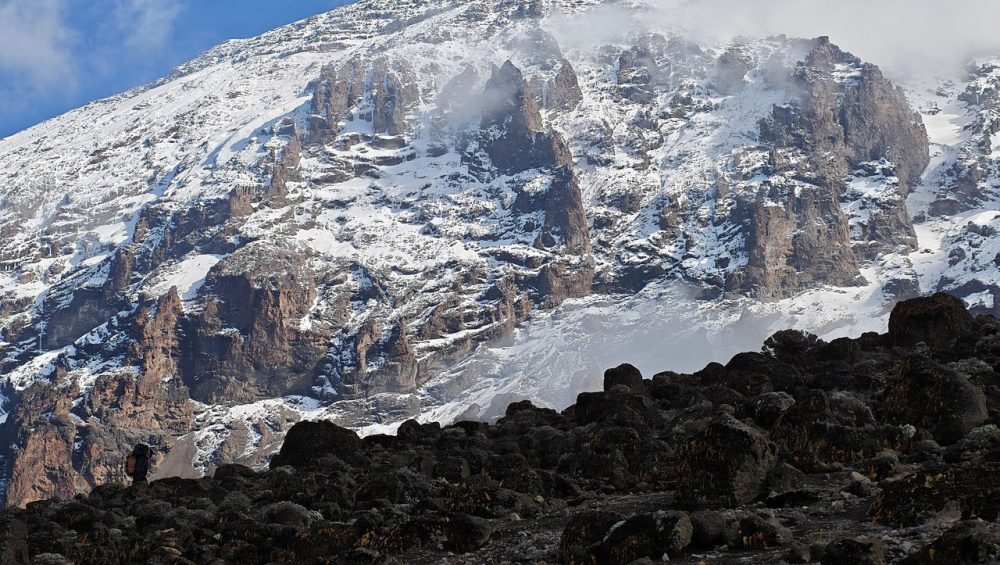
Surrounded by Glaciers and Kibo Summit Views
Looking beyond Lava Tower, climbers enjoy breathtaking views of Kibo, the highest volcanic cone on Mount Kilimanjaro.
On clear days, you can see:
- The snow-covered slopes leading toward Uhuru Peak.
- The remaining glaciers near Kibo’s summit.
- The vast Alpine Desert stretching across the mountain.
- The dramatic cliffs of Barranco Valley below.
- Layers of clouds floating far beneath the trail.
The contrast between ancient volcanic rock, white glaciers, and brilliant blue skies creates one of the most spectacular landscapes on Kilimanjaro.
For photographers, Lava Tower is one of the best locations to capture the mountain’s geological beauty and the dramatic transition between Kilimanjaro’s ecological zones.
Image: Lava Tower on Mount Kilimanjaro
Suggested Image: A panoramic photograph of Lava Tower showing the towering volcanic plug rising from the Alpine Desert, with Kibo Peak and its glaciers visible in the background. Including climbers on the trail helps illustrate the immense scale of the rock formation and the dramatic high-altitude landscape.
Best Time to Visit Lava Tower
The best time to visit Lava Tower on Mount Kilimanjaro is during the dry seasons, from January to March and June to October. These months usually offer clearer skies, drier trails, better visibility, and more stable weather, making the hike to Lava Tower safer and more enjoyable.
Although Lava Tower is accessible throughout the year, weather conditions greatly affect the hiking experience. Because the landmark sits at 4,600 meters (15,092 feet) in the Alpine Desert Zone, temperatures can change quickly, and rain or snow may occur at any time. Choosing the right season increases your chances of enjoying spectacular views of Kibo Peak, the surrounding volcanic landscape, and Kilimanjaro’s glaciers.
Dry Seasons
The dry seasons provide the best overall conditions for visiting Lava Tower.
January to March
The January to March climbing season is one of the most rewarding times to visit Lava Tower.
During these months, climbers often enjoy:
- Mild daytime temperatures.
- Clear morning skies.
- Fewer crowds than the middle of the year.
- Excellent visibility of Kibo Peak and Lava Tower.
- Good opportunities for photography.
Afternoon clouds can still develop, but mornings are often bright and calm. This season is ideal for trekkers who prefer quieter trails while still enjoying favorable weather.
June to October
The June to October dry season is the most popular time to climb Mount Kilimanjaro.
During this period, you can expect:
- Dry and well-maintained trails.
- Stable mountain weather.
- Crisp air with excellent long-distance views.
- Spectacular sunrises and sunsets.
- Busy trekking routes due to peak climbing season.
Because rainfall is usually lower, the volcanic paths around Lava Tower are less slippery, making hiking more comfortable and safer.
Rainy Seasons
Lava Tower remains accessible during the rainy seasons, but conditions become more challenging.
The main rainy periods are:
- Late March to May (long rains)
- November to early December (short rains)
During these months, climbers may experience:
- Wet and muddy lower trails.
- Thick clouds reducing visibility.
- Occasional rain or snow at higher elevations.
- Colder temperatures due to increased moisture.
- More unpredictable mountain weather.
Despite these challenges, rainfall often decreases as you reach the Alpine Desert around Lava Tower. However, changing weather can still affect visibility and photography.
Best Seasons to Visit Lava Tower
| Season | Months | Trail Conditions | Visibility | Crowds | Recommendation |
|---|---|---|---|---|---|
| Short Dry Season | January to March | Dry to moderately dry | Excellent | Moderate | ★★★★★ |
| Long Dry Season | June to October | Very dry | Excellent | High | ★★★★★ |
| Long Rainy Season | March to May | Wet and muddy | Variable | Low | ★★☆☆☆ |
| Short Rainy Season | November to December | Mixed conditions | Fair to good | Moderate | ★★★☆☆ |
Our Recommendation
If your goal is to experience Lava Tower at its best, plan your Kilimanjaro climb between January and March or June and October. These dry seasons provide the clearest mountain views, the best photography conditions, and safer hiking trails.
No matter when you climb, remember that weather on Mount Kilimanjaro can change quickly. Dress in layers, carry waterproof gear, and follow your guide’s advice to enjoy a safe and unforgettable visit to one of the mountain’s most iconic volcanic landmarks.
Is Lava Tower Dangerous?
Lava Tower is not dangerous for most climbers who are well prepared and accompanied by experienced guides. However, at 4,600 meters (15,092 feet), it is one of the highest points reached before the final summit push, and the altitude can make this section physically demanding. The main risks are altitude sickness, cold temperatures, rapidly changing weather, and rocky terrain, but these can usually be managed by following your guide’s instructions and climbing at a steady pace.
Every year, thousands of climbers safely pass through Lava Tower because they acclimatize properly, stay hydrated, and allow their guides to monitor their health.
Altitude Sickness
The greatest challenge at Lava Tower is high altitude, not the trail itself.
At 4,600 meters, atmospheric pressure is much lower than at sea level, meaning each breath delivers less oxygen to your body. As a result, many climbers experience mild symptoms of Acute Mountain Sickness (AMS).
Common symptoms include:
- Headache
- Nausea
- Dizziness
- Fatigue
- Loss of appetite
- Shortness of breath during exercise
These symptoms are often mild and improve after resting and descending to a lower camp. However, they should never be ignored.
If AMS becomes more severe, it can develop into:
- High-Altitude Cerebral Edema (HACE) – a life-threatening condition caused by swelling of the brain. Warning signs include severe headache, confusion, poor balance, slurred speech, unusual behavior, and loss of consciousness.
- High-Altitude Pulmonary Edema (HAPE) – a life-threatening condition in which fluid builds up in the lungs. Symptoms include severe shortness of breath at rest, persistent cough, chest tightness, extreme weakness, and difficulty walking.
If HACE or HAPE is suspected, the climber must descend immediately. Supplemental oxygen should be used if available, and urgent medical treatment is essential. Experienced Kilimanjaro guides are trained to recognize these conditions and will make safety the highest priority.
Cold Temperatures
Even though Mount Kilimanjaro stands close to the Equator, Lava Tower experiences true alpine conditions.
Daytime temperatures are often cool, while strong winds can make the air feel much colder. During cloudy weather or storms, the temperature can drop rapidly.
To stay warm, wear:
- Thermal base layers
- Insulating fleece
- Down jacket
- Waterproof outer shell
- Warm gloves
- Hat or balaclava
Layering clothing allows you to adjust quickly as mountain conditions change.
Weather Changes
Weather on Kilimanjaro can change within minutes.
A sunny morning may become cloudy by midday, and strong winds, fog, rain, sleet, or even light snowfall are possible around Lava Tower.
Reduced visibility can make navigation more difficult, which is why climbers should always remain with their guide and group.
Before leaving camp, guides monitor weather conditions and adjust the day’s pace if necessary to keep everyone safe.
Rocky Terrain
The trail around Lava Tower passes through the Alpine Desert, where volcanic rocks, loose gravel, and uneven paths are common.
Although the route is not technically difficult, hikers should watch their footing, especially during wet or icy conditions.
Trekking poles provide extra stability and reduce pressure on your knees during both the climb and the descent toward Barranco Camp.
How to Stay Safe at Lava Tower
The best way to stay safe is to follow simple but important mountain safety practices.
- Go slowly (“Pole Pole”). A slow pace allows your body to adapt to altitude more effectively.
- Listen to your guides. They monitor your condition and understand how to manage high-altitude environments.
- Stay hydrated. Drink plenty of water throughout the day to support acclimatization.
- Eat regular meals and snacks. Your body needs energy to perform well at altitude.
- Report symptoms immediately. Tell your guide if you develop a headache, nausea, dizziness, unusual fatigue, or breathing difficulties. Early action can prevent serious altitude illness.
Is Lava Tower Safe?
Yes. Lava Tower is a safe and rewarding part of a Kilimanjaro climb when approached with proper preparation and guidance. The trail itself is manageable for most trekkers, while the stop at 4,600 meters plays a vital role in helping your body acclimatize before the summit attempt.
The key is not to underestimate the altitude. Climb slowly, follow your guide’s advice, stay hydrated, and always speak up if you feel unwell. By respecting the mountain and listening to your body, Lava Tower becomes one of the most memorable and valuable stages of the journey to Uhuru Peak.
Fascinating Facts About Lava Tower Kilimanjaro
Lava Tower is far more than a lunch stop on the way to the summit. It is one of Mount Kilimanjaro’s most famous landmarks, a remarkable geological formation, and one of the mountain’s most important acclimatization points. These fascinating facts explain why nearly every climber remembers their visit to this iconic volcanic giant.
- Lava Tower stands at approximately 4,600 meters (15,092 feet) above sea level, making it one of the highest daytime stops on the Lemosho, Machame, Northern Circuit, and Umbwe routes.
- It is an ancient volcanic plug, formed when magma hardened inside a volcanic vent before the surrounding softer rock gradually eroded away.
- The tower formed hundreds of thousands of years ago during the volcanic activity that created Kibo, the highest of Mount Kilimanjaro’s three volcanic cones.
- Lava Tower is one of Kilimanjaro’s most important acclimatization points. Climbers hike to its high elevation before descending to Barranco Camp, following the proven “climb high, sleep low” strategy.
- It sits on the southern slopes of Kibo Volcano, between the Shira Plateau and Barranco Valley, making it a key landmark on several popular trekking routes.
- The surrounding landscape belongs to the Alpine Desert ecological zone, where vegetation is sparse and only hardy plants such as lichens and mosses can survive.
- Lava Tower offers spectacular views of Kibo Peak, the summit glaciers, Barranco Valley, and the vast volcanic plains stretching across the mountain.
- Many climbers experience the effects of high altitude here for the first time, making it an ideal location for guides to assess acclimatization before the summit push.
- Despite its dramatic appearance, most trekkers do not climb to the top of Lava Tower. Standard Kilimanjaro itineraries visit only the base because the upper sections require technical rock-climbing skills.
- Lava Tower is one of the most photographed landmarks on Mount Kilimanjaro. Its towering volcanic rock, set against the open Alpine Desert and the snow-capped slopes of Kibo, creates one of the mountain’s most iconic views.
- The name “Lava Tower” comes from its volcanic origin. It is composed of hardened magma that remained standing after millions of years of erosion removed the surrounding softer rock.
- Reaching Lava Tower is often considered a turning point in the Kilimanjaro climb. It marks the transition from lower-altitude trekking into the true high-altitude environment that prepares climbers for the final ascent to Uhuru Peak.
These facts highlight why Lava Tower is not only one of Kilimanjaro’s greatest natural attractions but also a vital part of a safe and successful journey to the Roof of Africa.
Frequently Asked Questions About Lava Tower Kilimanjaro
Lava Tower is a giant volcanic plug on Mount Kilimanjaro at 4,600 meters (15,092 feet). It is one of the mountain’s most famous landmarks and an important acclimatization stop.
Lava Tower helps climbers acclimatize using the “climb high, sleep low” method, improving their chances of reaching Uhuru Peak successfully.
The Lemosho Route, Machame Route, Northern Circuit Route, and Umbwe Route all pass Lava Tower.
Most trekkers only visit the base. Climbing to the top requires technical rock-climbing skills and is not part of standard Kilimanjaro itineraries.
Usually not. Most climbers stop for lunch and acclimatization before descending to Barranco Camp to spend the night.
The main risk is altitude rather than the trail itself. Climbers should walk slowly, stay hydrated, and report any symptoms of altitude sickness to their guide immediately.
The best months are January to March and June to October, when the weather is generally drier and visibility is excellent.
Daytime temperatures are usually between 5°C and 15°C (41°F-59°F), while wind can make it feel much colder.
You can enjoy views of Kibo Peak, Barranco Valley, the Alpine Desert, volcanic landscapes, and Kilimanjaro’s glaciers.
It is called Lava Tower because it is an ancient volcanic plug formed when magma hardened inside a volcanic vent and remained after the surrounding softer rock eroded away.
Conclusion: Why Lava Tower Is One of Kilimanjaro’s Most Important Landmarks
Lava Tower is much more than a stop along the trail to Uhuru Peak. It is one of Mount Kilimanjaro’s most significant geological landmarks, a vital acclimatization point, and an unforgettable highlight of the climbing experience. Rising to 4,600 meters (15,092 feet), this ancient volcanic plug tells the story of Kilimanjaro’s volcanic past while helping thousands of climbers prepare safely for the journey to Africa’s highest summit.
Whether you reach Lava Tower on the Lemosho, Machame, Northern Circuit, or Umbwe Route, the experience is unforgettable. The dramatic Alpine Desert, towering volcanic rock, breathtaking views of Kibo Peak, and the surrounding glaciers create one of the mountain’s most spectacular landscapes. It is also the place where many climbers first appreciate the importance of walking pole pole, listening to their guides, and allowing their bodies to adapt to the high altitude.
Lava Tower also reminds us that climbing Kilimanjaro is about more than reaching the summit. It is about understanding the mountain’s geology, respecting its changing environment, and enjoying every stage of the adventure. The acclimatization stop at Lava Tower greatly improves your chances of reaching Uhuru Peak while reducing the risk of altitude sickness.
At WeWild Travel, our experienced local mountain guides use proven acclimatization strategies, monitor your health throughout the climb, and ensure you enjoy every step of the journey safely. If you’re planning your Kilimanjaro adventure, including Lava Tower on a well-designed itinerary such as the Lemosho Route or Northern Circuit Route gives you the best opportunity to experience this incredible volcanic landmark and achieve a successful summit.
Your journey to the Roof of Africa is not defined by a single destination it is shaped by unforgettable places like Lava Tower, where Kilimanjaro’s ancient volcanic history meets the adventure of a lifetime.